
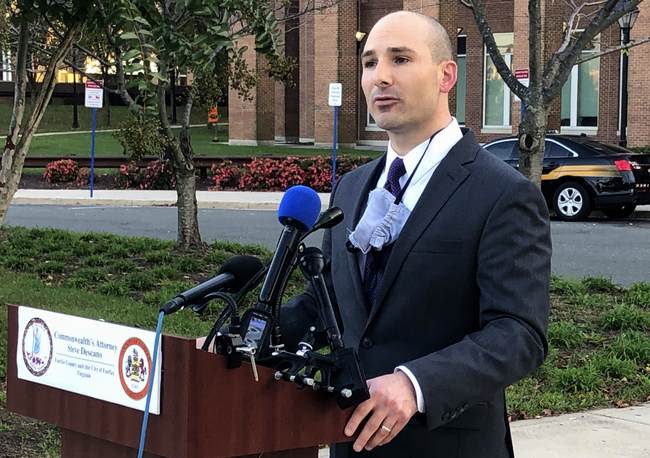
Fairfax County Commonwealth’s Attorney Steve Descano faced sharp questioning after an apology to Cheryl Minter — the mother of a woman killed by an illegal immigrant — only came after a congressional hearing. Reporters pressed why the apology did not come earlier, and the exchange exposed broader concerns about leniency toward illegal immigrant defendants and accountability in sanctuary jurisdictions.
On camera, a reporter asked point-blank, “Why didn’t you apologize to Stephanie Minter’s mother much sooner?” and “Why did it take a Congressional hearing to apologize to her?” Descano visibly shifted away from the question and avoided a direct response, a moment that Republicans seized as proof of double standards. Journalists pushed for clarity while Descano and his team attempted to walk past the confrontation, leaving the family’s pain at the center of the controversy.
Stephanie Minter, a 41-year-old single mother from Fredericksburg, Virginia, was stabbed to death in February while waiting at a bus stop. The man charged in her death, Abdul Jalloh, was an illegal immigrant from Sierra Leone with more than 30 prior arrests that included violent offenses. Those prior cases were handled in ways critics say show a pattern of leniency by Descano’s office.
The Commonwealth’s Attorney later addressed Minter directly during a congressional appearance, saying, “I am deeply sorry for your loss. I say that as not only a prosecutor, but as a parent with a daughter. I promise, my office is doing everything we can to prosecute the man responsible.” That apology, while sincere-sounding in court, had not been offered publicly to the family until the federal hearing forced the moment.
Republican members of Congress and conservative commentators argue this episode highlights a systemic problem: prosecutors in sanctuary jurisdictions prioritize political messaging over public safety. They point to charging decisions, plea bargains, and released defendants as evidence that policies sympathetic to illegal immigrants can come at the cost of citizens’ safety. The Department of Justice has launched a probe into whether those practices show preferential treatment that disadvantages U.S. citizens.
At the hearing, Descano struggled under questioning and at times used evasive language, even calling critics “obtuse.” That reaction only intensified critics’ claims that some prosecutors are out of touch with victims and the communities they serve. For many Republicans, the scene reinforced a simple demand: officials must own mistakes quickly, not wait until political pressure mounts.
Reporters who have covered Descano’s history say his office previously dismissed or downgraded charges against defendants now accused of serious crimes, raising alarms about pattern and practice. That record is central to why the Minter family and the public demanded answers immediately and why Congress felt compelled to intervene. The political fallout is now tied to questions about whether local prosecutors are adhering to their duty to protect citizens first.
When a second-in-command, Jenna Sands, was pressed for an apology, staffers attempted to shield her from cameras and continued moving away while she smiled in the background. That moment, captured on video, fed the narrative that the office was more comfortable managing optics than directly addressing victims. Conservatives see those gestures as emblematic of how sanctuary policies are enforced in practice.
The broader debate now is straightforward: should prosecutorial discretion include protective measures for illegal immigrants when that discretion appears to leave citizens vulnerable? Republicans argue it should not and that accountability must follow when patterns of leniency correlate with tragic outcomes. The Minter case will likely be cited in future fights over sanctuary policies, federal oversight, and how prosecutors balance community trust with the basic duty to keep people safe.
As investigations and hearings proceed, the family remains the human center of the story, and the questions raised by reporters reflect wider frustration with a system perceived as slow to confront its own failures. For Republican critics, this episode is not just about one apology; it is about restoring a legal culture that prioritizes victims and public safety above political posturing.

Add comment