
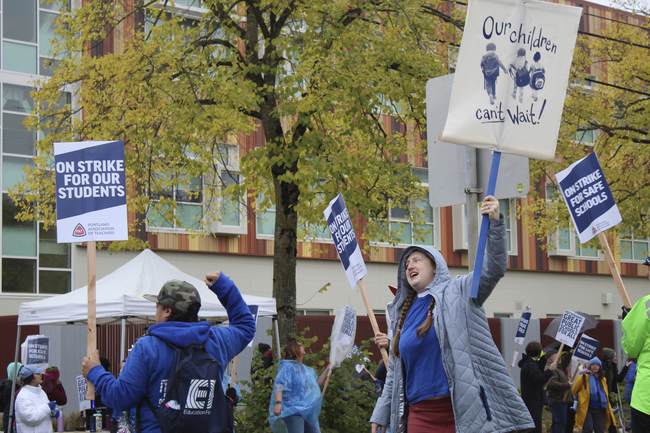
The article lays out a coordinated effort by the Democratic Socialists of America to recruit educators, leverage teachers’ unions, influence curricula and shape education policy—arguing this is a deliberate, long-game strategy to shift public schools toward a political movement’s goals.
Beware the New Red Lesson Plan
There is a clear push by the Democratic Socialists of America to steer young people into teaching careers and then use those positions to reshape public education. The claim is not subtle: the organization openly urges followers to take school-based jobs for their political potential. That strategy treats classrooms and unions as terrain for long-term political transformation.
DSA’s plan centers on building what it calls a pipeline: recruit, place, organize, and then influence. The organization encourages its members to become teachers and other school workers, citing the opportunities those roles provide. Teachers gain professional credibility, access to curricula, contracts and the networks unions provide, all of which can be mobilized politically.
The pamphlet spells out the intent plainly: “(S)ocialists should take jobs as teachers (and other school-based workers) for the political, economic and social potential the industry holds.” The pamphlet goes on to say, “(W)e as Socialists need to build a ‘militant minority’ of class-conscious teachers.” Those words are presented as strategy, not speculation.
In labor organizing terms, this approach is known as salting—placing sympathizers inside a workplace to organize it from within. Salting is not hypothetical here; the movement has promoted it as intentional. With public-sector education showing high union membership, the tactic has a lot of promise from the organizer’s point of view.
Federal data underscore why education is attractive to organizers: the highest union membership rates in 2025 were in education, training and library occupations at 32.5 percent, and public-sector workers remain far more likely to organize than private-sector workers. For activists eager to transform institutions, that concentration of union power is a strategic prize.
The path the piece outlines is straightforward. An individual becomes a teacher, joins the union, and then participates in rank-and-file organizing that pushes the union leftward. The plan does not require converting every classroom—just enough committed activists to take leadership roles and influence contracts, policy and training over time.
On curriculum, the article points to networks that promote particular historical framings and lesson plans. It highlights groups that reframe American history through a specific lens and notes endorsement and promotion by chapters and affiliates connected to the movement. Those curriculum networks, the piece argues, are the next link in the chain connecting recruitment to classroom influence.
National unions and their platforms are named as amplifiers: organizations that host or partner with curriculum projects, list materials as resources, and co-sponsor events that push back against critics of that approach. The result, the article says, is a broad ecosystem connecting local organizers, national unions and curriculum providers in a shared effort to influence what students learn.
Political action follows curriculum and organizing. The article describes instances where unions mobilize to influence state policy, such as urging governors to reject federal voucher programs. That political muscle extends beyond school buildings into statehouses, where coordinated demands are presented as the unions’ unified position.
The piece argues parents and policymakers need transparency and tough questions. It urges school boards and lawmakers to examine whether school systems and union contracts serve students or serve a broader movement that has openly documented its goals. The article insists this is not speculation, but a documented strategy that deserves attention from anyone who cares about the purpose of public education.



Those so called teachers are activist Enemies Within! They’re guilty of Seditious and Treasonous Indoctrination of America’s youth for which they must be arrested, tried at GITMO by a Military Tribunal and appropriately sentenced in accordance with the U.S. Constitution!