
I’ll explain who Angie Nixon is, detail her rise in Florida Democratic politics, highlight viral moments and campaign messaging, place her primary win in a Republican perspective, and include the original embeds for context.
Angie Nixon, a 42-year-old member of Democratic Socialists of America and a state representative from Jacksonville, won the Democratic Senate nomination over Alexander Vindman by roughly 56 percent to 44 percent. That victory came despite being massively outspent, about $16 million to $1 million, which tells you something about the kind of voters who showed up in that primary. Her platform embraces policies like abolishing ICE, Medicare for All, rent controls, and cutting aid to Israel — positions that appeal to a radical base but are far from mainstream. For Republicans looking toward November, Nixon is a straightforward target: loud on ideology, light on governing experience.
On paper, Nixon fits the pattern of candidates who thrive on attention rather than bipartisan solutions. She first won a seat in the Florida House in 2020 and has spent much of her time trading barbs with state Republicans and Governor Ron DeSantis. Her decision to formally join the DSA before launching a Senate bid signaled to activists that she was aligning with the most vocal left-wing faction. Voters outside her base will see that alignment as a red flag rather than a selling point.
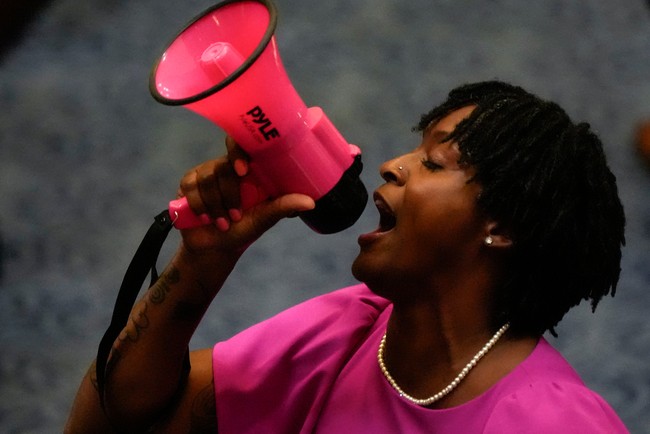
Her campaign’s media moments have been as calculated as they are performative. A widely circulated clip shows Nixon walking the House floor with a pink megaphone, shouting during a legislative session and drawing obvious eye-rolls from colleagues. That spectacle reinforced a narrative Republicans have pushed: a politician who prefers theatrics to the steady work of legislating. The political calculation paid off in a primary, but primaries and general elections ask different questions of candidates.
Republican groups were quick to amplify another aspect of her public remarks: Nixon bragged about taking her young children to drag shows and insisted there was no sexualization happening there. That statement became a focal point for conservative criticism and was shared widely by the National Republican Senatorial Committee. For many voters, that line crossed a cultural boundary and provided ammunition for a campaign framing her as out of step with mainstream family values. It’s the sort of issue that turns neutral voters into skeptics.
The RNC also circulated clips highlighting Nixon declaring in her victory speech that Floridians are embracing socialism, a claim intended to energize Republican turnout. When a candidate openly celebrates socialism as a winning message, it makes it easier to define them in contrast to the priorities most Americans cite: economic opportunity, safe communities, and secure borders. Republicans can point to that rhetoric as proof that the Democrats are moving toward policies that have historically failed in practice.
Besides the policy disagreements, Nixon’s style feeds a larger argument about electability. Her campaign résumé appears built for viral content and activist applause, not routine governance or coalition-building. The general election in November will require appealing to moderates, independents, and skeptical suburban voters who care about practical results, not ideological purity. Her primary victory shows strength within a narrow slice of the electorate, not necessarily in the broader contest.
Watching the post-primary media scrum, you see how legacy outlets rushed to cover Nixon the moment her win was official. Their excitement reinforces the divide Republican strategists point to: the press and activist wing of the party celebrate candidates for theatrical moments, while many voters prioritize competence and common-sense policies. That dynamic gives Republicans a clear contrast to present to voters when campaigns shift from intraparty battles to the general election.
https://x.com/AshleyMoodyFL/status/2089892722031140868
From a Republican perspective, Nixon’s nomination confirms a worry about the Democratic pipeline: a steady stream of candidates who test the edges of acceptability in primaries and then must be checked by general election voters. Her positions on immigration enforcement, healthcare, housing, and foreign aid are unlikely to play well in the middle of the electorate. The months ahead will be a test of whether voters prefer spectacle or steady governance.
Given Nixon’s public statements and the viral footage that followed her win, the campaign narrative for Republicans is simple and direct: contrast radical promises with the practical needs of Floridians. That messaging aims to make the November choice clear and force voters to weigh dramatic ideological shifts against the everyday concerns that most people actually face. Expect that to be the theme of Republican ads and debates as the race heats up.



Add comment