
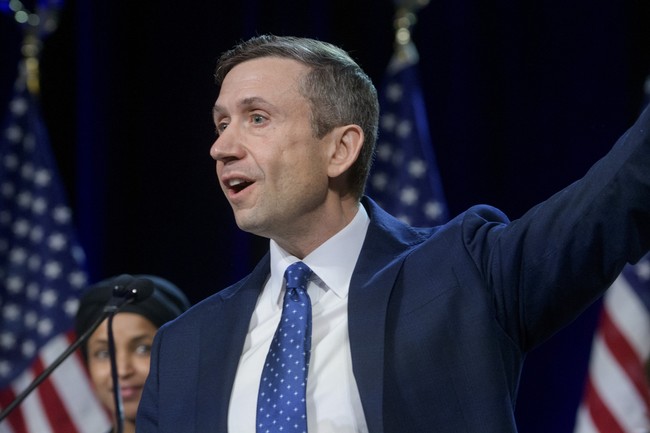
The Democratic National Committee’s internal mood went public this week when DNC Studios deputy Scott Brown posted a candid video defending colleagues amid a cascade of bad headlines, and that short clip revealed more about the party’s problems than any single scandal did.
Scott Brown identified himself as the deputy director of DNC Studios and posted a video to his personal account with the caption, “I work at the DNC. Just needed to get this off my chest.” He sat in front of editing monitors with a cat on his lap, delivering a morale message that came off oddly staged and oddly timed.
Brown opened by acknowledging a “tough week” and chose not to answer specific headlines, instead praising staff as “incredible” and “some of the most talented, hardworking people” he had worked with.
“There have been a lot of different headlines about the organization, and it’s been extremely tough to see your place of employment end up in the headlines with a lot of bad press… The story that isn’t being told is that the people that I work with at the DNC are incredible. They’re some of the most talented, hardworking people that I’ve ever worked with.”
The clip read as a candid defense and also as an admission that the headlines were hitting home inside the committee. When a deputy director feels compelled to publicly reassure coworkers, that says something about internal morale and leadership capacity.
https://x.com/ScottBrownDC/status/2083019354271076490
The trouble began with a phishing loss reported on July 28 in which the cash-strapped committee surrendered nearly $29,000 to an email scammer impersonating the chairman, recovering only $7,000. That episode arrived while the DNC was already carrying debt, delaying vendor payments, and using its headquarters as collateral for a $15 million credit line.
That same day a whistleblower allegation emerged about female employees being fired at a migrant facility overseen by a former cabinet official after reporting sexual harassment by unaccompanied minors, creating another political headache. A D.C. Circuit panel also rejected Democrats’ bid to block a presidential executive order on election integrity, finding the challenge premature.
On July 29, details resurfaced about an old affair involving a prominent governor now seen as a potential presidential contender, including claims that the relationship was far more sustained than previously acknowledged. For an ambitious politician, the gap between public statements and new accounts matters for credibility and voter trust.
By July 30, the issue shifted from individual scandals to structural trouble: new redistricting analysis moved the median House district to R+3, forcing Democrats to win an implausibly high share of swing contests just to retake a majority. What had been painted as midterm comfort suddenly looked like an uphill math problem instead of a cushion.
The candidate picture offered more complications. Party officials in Maine replaced a scandal-plagued nominee only to end up with a new pick whose family ties provoked fresh questions. In Michigan, a divisive primary pitted a far-left activist against an establishment congresswoman, with polls showing the activist would underperform against likely Republican opponents.
That primary fight spilled into personal accusations, accusations of scapegoating, and fractured supporter loyalty, with only modest willingness among some backers to unite behind the eventual nominee. Those internal splits aren’t just policy disputes; they translate into lost general election opportunities when voters prefer safer, more broadly acceptable nominees.
At the same time, Michigan’s attorney general announced she would skip her own party’s convention because she feared harassment over her Jewish identity and support for Israel. “I feel like my presence isn’t going to be welcome. I don’t want to get chased around. I don’t want to get booed off the stage, irrespective of what I’m saying.”
A sitting attorney general saying she feels unsafe at her party’s event points to something deeper than messaging or fundraising. It suggests a party struggling to manage extremism within its ranks and to protect officials who don’t align with its activist wing on every issue.
Brown likely meant his video as a human defense of coworkers. Instead, it read as a public thermometer of a committee knocked off balance by financial missteps, personnel scandals, bad optics, and painful political math that together produced a very rough 72-hour stretch.
With that much volatility in a single week, a morale video by a deputy director isn’t an isolated oddity. It’s a visible symptom of a party wrestling with disunity, distraction, and strategic vulnerability heading into a crucial election cycle.

Add comment