
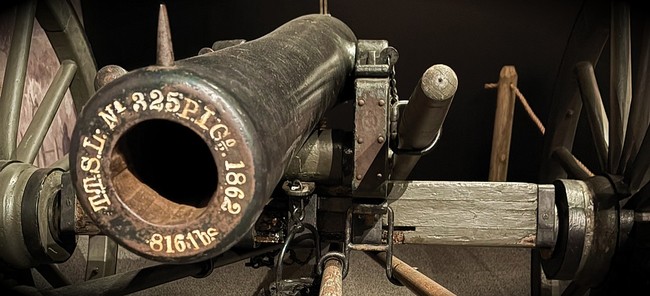
This article recounts how five Civil War-era cannonballs stolen from Fort Morgan in Alabama were found wrapped in a grandmother’s luggage during routine TSA screening at Gulf Shores International Airport on July 18, explores why removing historical artifacts is illegal and risky, and reflects on the odd choices and consequences behind the incident.
Visitors to old battlefields sometimes stumble across relics like musket balls, uniform buttons, or cannonballs, leftovers of intense fights long ago. Those items belong to the public when found on protected lands or in museum collections, so removing them is theft, not souvenir hunting. The rules are clear: if an item is part of a historical site or museum, it stays there for preservation, study, and public benefit.
At Fort Morgan on Mobile Bay, a juvenile reportedly removed five Civil War cannonballs from a storage area and hid them in a grandmother’s checked bag. The grandmother claimed she did not know they were stolen, and the sheriff’s office traced paint markings on the artifacts back to the fort to confirm their origin. Authorities say the relics date to the American Civil War, and the fort itself played a notable role in several conflicts.
A TSA agent discovered a set of stolen Civil War-era cannonballs in a passenger’s suitcase during a routine security screening at an Alabama airport earlier this month, law enforcement officials said.
The Transportation Security Administration said in a statement Friday that the relics were discovered at Gulf Shores International Airport on July 18 after the agent observed what appeared to be a large, opaque item inside a suitcase during an X-ray screening. When he opened the luggage, he found five small cannonballs wrapped in paper towels and notified a supervisor.
Transporting such items in checked baggage set off immediate safety and legal alarms. Even if century-old artillery is likely inert, there is always a nonzero risk that an explosive or a component could remain dangerous, and airports treat any artillery munitions as prohibited items. Beyond safety, the theft of cultural heritage is a real crime that deprives communities and future generations of history.
“I had never seen anything quite this unique,” TSA Officer Justin Dupree said in a statement from the agency. “I’ve seen inert grenades and training munitions but never an Indiana Jones-esque stolen artifact-type situation.”
The cannonballs — the largest about the size of grapefruits and weighing about as much as a shot put ball — were inactive and didn’t contain any explosive material or active components, the TSA said. Still, cannonballs are artillery munitions and considered prohibited items on planes.
Those plain facts underline why security screeners are trained to flag dense, round, metallic objects and why inspectors treat them seriously even when they seem harmless. The items were wrapped in paper towels inside the bag, which likely drew attention on an X-ray image because of size, shape, and opacity. The largest ball was described as grapefruit-sized and roughly the weight of a shot put, which is large enough to cause alarm in transit contexts.
Once the TSA notified supervisors and law enforcement, the investigation moved quickly to identify where the cannonballs came from. Paint markings applied by fort staff provided enough evidence for police to determine the pieces had been removed from Fort Morgan. The Baldwin County Sheriff’s Office issued a statement confirming the juvenile’s involvement and the ongoing process to return the artifacts.
Police eventually determined the cannonballs were stolen from Fort Morgan, based on paint marking applied to the artifacts by fort staff, and that they dated to the American Civil War. The historic Gulf Shores fort played a significant role in several military conflicts, including the Civil War.
The Baldwin County Sheriff’s Office said Thursday that a juvenile stole the cannonballs from a storage area in the fort and then placed them in their grandmother’s checked bag. The grandmother told officers she did not know they were stolen.
Beyond the immediate law-enforcement angle, the episode raises questions about judgment and responsibility. Sneaking cultural artifacts into checked luggage is reckless at best and criminal at worst, and involving an unwitting relative compounds the wrongdoing. People who grow up around strong family discipline often recall quick corrective measures for foolishness; in this case, the writer imagines a stern talking-to that might have followed a similar stunt when they were young.
Thankfully, the cannonballs were identified, recovered, and are expected to be returned to their rightful place at the fort or into appropriate custody for conservation. The incident serves as a reminder to visitors everywhere that historical relics are public property when found on protected sites and that museums and parks guard those items for good reasons. Removing artifacts deprives the broader public, risks legal trouble, and can create dangerous situations during travel.
Collectors, tourists, and curious teens should remember that history is best preserved where it belongs, and that respect for historical sites is part of civic responsibility. Stealing from a national or state historic site is not a harmless prank, and airport security will treat suspicious items seriously for safety and legal enforcement. In the end, returning artifacts and learning from the mistake is the right course.



Add comment