
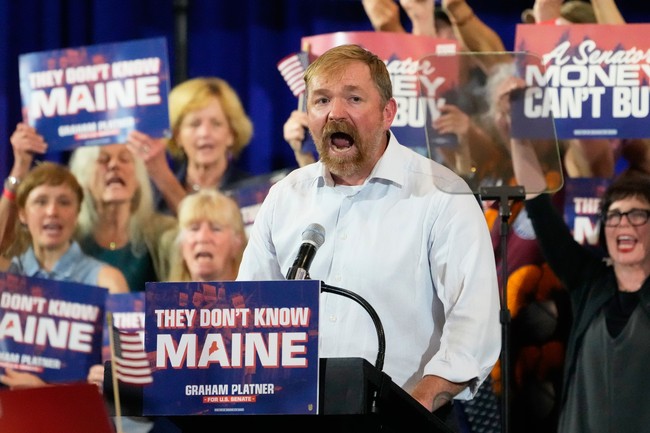
The Maine Senate contest erupted after a woman publicly accused Democratic nominee Graham Platner of rape, triggering withdrawals of high-profile endorsements, party pressure to step aside, and a live television interview that added details to her account. This article walks through the allegations, reactions from national and state Democrats, the accuser’s interview with Jake Tapper, and the immediate campaign fallout.
On Monday a woman went public with serious accusations against Graham Platner, who is the Democratic nominee for Senate in Maine. She alleges the incident occurred in 2021, and Platner has rejected the claims. The timing and severity of the accusation have prompted swift responses across the political landscape.
High-profile Democrats moved quickly to distance themselves. Rep. Ro Khanna rescinded his endorsement, citing accusations of “violence” as a red line. That choice drew attention given earlier allegations from another woman, Lyndsey Fifield, which had not prompted Khanna to withdraw support previously.
As the story spread, party leaders increased the pressure on Platner to leave the ticket. Senate Minority Leader Chuck Schumer and DSCC Chairwoman Kirsten Gillibrand urged him to “immediately withdraw.” Those leaders warned the party would not funnel campaign dollars to the Maine race if Platner remained the nominee, effectively raising the financial stakes for his decision.
“The allegations reported today are incredibly disturbing – violence, abuse and sexual assault are absolutely unacceptable,” the New York Democrats said in a statement released by the DSCC. [….]
The senators warned that Senate Democrats’ campaign and fundraising arm “will not invest in the Maine Senate race if Platner remains on the ballot.”
The DSCC’s warning makes clear that the party’s institutional support could vanish if Platner stays on. That politicized calculus is familiar: when a candidate risks national resources, the party often chooses containment over loyalty. For Republicans watching this unfold, it’s further evidence that Democrats are quick to act when it suits electoral needs.
State-level leaders and influential progressive groups also stepped back. The Maine Democratic Party pulled its backing, and other organizations followed suit. Media reports noted End Citizens United and local Democratic leadership withdrew public support, signaling a broader willingness to cut losses rather than carry a contested nominee into the fall.
Sen. Elizabeth Warren, who had previously praised Platner, reversed course and called for him to step aside. Her statement emphasized the need for leaders who reflect certain values and drew a direct link between the allegations and the party’s electoral hopes in Maine. That kind of high-profile renunciation added pressure on Platner to consider his options.
Jenny Racicot, the woman making the accusation, spoke with CNN’s Jake Tapper to expand on her account. Tapper disputed assertions from Platner’s team that the allegation was the work of “out-of-state operatives.” He said he reached out because Racicot was referenced in a prior New York Times report, which prompted him to verify the claim directly with her.
https://x.com/MaineDems/status/2074249756449140867
Racicot described weighing a moral conflict: she agreed with some of Platner’s policy positions but felt compelled to speak out based on her personal experience. She said she hesitated to come forward earlier due to concerns about privacy and the public intrusion that often follows such accusations.
In the interview, Racicot said the alleged incident happened five years ago and that she had told Platner no when he arrived uninvited at her unlocked home. She recounted that he was intoxicated and not responsive to her refusal, that a physical struggle ensued, and that a sewing kit fell during the confrontation. She said she instructed him not to touch her and that he did not use protection.
Racicot asserted that Platner later acted as if he could not recall the events and that she told him to leave, never wanting further contact. She characterized the incident as “absolutely” rape. Those words have fueled the call for him to step away from the campaign amid mounting institutional pressure.
The accumulating endorsements rescinded, coupled with national party warnings about funding, leave the Maine race in flux. With both state and national actors publicly distancing themselves, the path forward for Platner as the nominee looks increasingly narrow. The episode raises broader questions about vetting, party response, and how quickly political alliances shift when allegations of this magnitude surface.


Add comment