
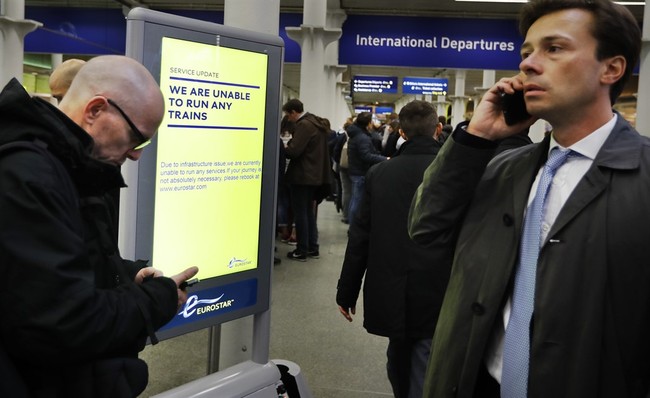
Travel chaos erupted around New Year’s as an electrical failure in the Channel Tunnel halted Eurostar services between Paris, London, Brussels, and Amsterdam, leaving passengers stranded, disrupting holiday plans, and prompting a slow, staggered resumption of trains later in the day.
As the holiday rush swelled, an unexpected technical failure turned stations into bottlenecks and left travellers staring at long delays and uncertain departures. People who expected to be home for celebrations or at family gatherings found themselves stuck in stations and trains, trying to figure out new plans on the fly. The sheer scale of the disruption made it clear how fragile major cross-border rail links can be when infrastructure issues arise at critical moments.
Authorities traced the problem to an electrical issue deep inside the Channel Tunnel that rapidly affected scheduled Eurostar services. That breakdown left a LeShuttle shuttle stranded in the tunnel, which compounded the initial failure and forced operators to suspend all services across the key continental routes. Eurostar warned passengers to avoid stations unless they held tickets for that day and offered options for refunds or exchanges to anyone affected.
An electrical outage in the Channel Tunnel has caused all Eurostar trains between Paris, London, Brussels, and Amsterdam to be suspended on Tuesday, December 30th. A gradual resumption of service is expected to begin around 3 p.m.
With trains stopped, platforms and concourses filled quickly as crowds grew and sleep-deprived travellers tried to make sense of shifting announcements. Lines grew at ticket desks and information points, and many people faced hours of delay before services could even begin to restart. For some, minor inconveniences became full-scale travel nightmares as events and connections evaporated.
Officials described a gradual restart beginning in the afternoon, but warned that normal service would take much longer to restore. Even after first trains rolled again, backlog and congestion at hubs like Gare du Nord meant lingering delays for many journeys. Operators urged passengers to postpone nonessential trips because the knock-on effects of the outage would ripple across schedules for days.
Eyewitness accounts captured the frustration and odd moments that cropped up amid the chaos, from passengers dressed for events to people hoping to salvage parts of their plans. One couple, due to attend a wedding, described hurried preparations and dashed expectations while they waited. Those personal snapshots illustrated the human side of infrastructure failure, where schedules and celebrations collide with technical problems.
The incident began this morning with an electrical failure, which was followed by a LeShuttle shuttle becoming stranded in the tunnel, according to information released by Eurostar and confirmed by a company spokesperson. Passengers are advised to avoid the stations unless they hold tickets for today, and to postpone their travel plans if possible. The company states on its website that it is offering free ticket exchanges, or refunds via bank transfer or travel voucher.
Photos and videos from stations painted a chaotic scene: packed waiting areas, exhausted travellers trying to sleep upright, and staff stretched thin trying to answer an avalanche of questions. The images spread quickly on social feeds, feeding wider awareness of delays and helping loved ones outside the affected areas understand why connections were missed. For staff, managing safety and logistics in cramped conditions became the immediate priority.
Several passengers described long, uncomfortable hours onboard trains or stranded at terminals as officials worked to clear the tunnel and get services moving again. One young student called the experience an “absolute chaos” after enduring a ten-hour ordeal, reflecting widespread exasperation among those caught up in the mess. Such firsthand accounts underline how an infrastructure fault can quickly escalate into public frustration during peak travel periods.
Reports indicated that the initial electrical problem triggered automated safety responses that left equipment and shuttle units immobilized until technicians could access the scene. That necessary caution slowed resolution but protected passengers and staff from greater risk. Once teams reached the affected area and assessed the damage, efforts to free the stranded shuttle and restore power were prioritized to allow any safe resumption of service.
Nayim and his wife Kimberley should be celebrating the marriage of an old friend this afternoon – but instead they’re stuck on a train in Calais…
“My wife’s done her make-up for the wedding and I’ve got my suit in the car ready, but at this rate I don’t think I’ll be wearing it any time soon,” he says.
“We might get there for the dessert and cheese.”
“He [the conductor] said in his 29 years of working on this he’s never seen anything like it.”
As trains slowly restarted, operators emphasized that a full recovery of timetables would not be instant and that passengers should expect residual delays. The backlog of cancelled services and rerouted travellers meant stations remained busy long after the initial problem was fixed. For many, the practical response was to accept adjusted itineraries or take advantage of refunds and rebooking options offered by the operator.
In the aftermath, passengers and transport analysts alike are likely to ask how essential cross-border links can be better protected against single-point failures. The incident will prompt close scrutiny of maintenance, backup systems, and emergency response protocols to reduce the chances of a repeat during peak travel windows. For now, travellers caught in the disruption were left to wait for schedules to normalize and to make new plans where possible.



Add comment