
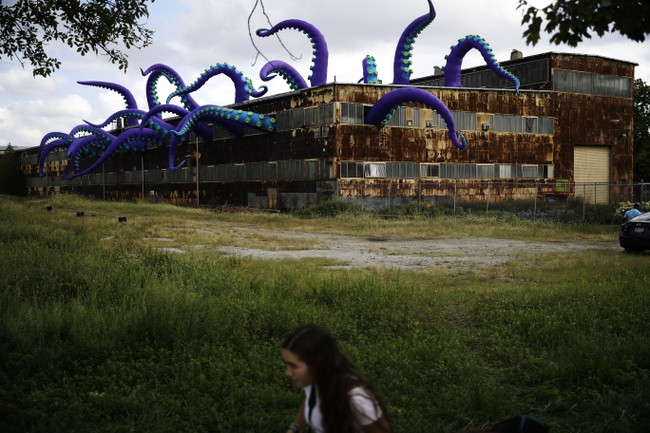
The Philadelphia Navy Yard has moved from idle docks and art exhibits into a full-throttle national asset as major private capital and a pro-defense administration push shipbuilding back onto American soil, with Hanwha Defense and big banks stepping up alongside promises of billions in investment and hundreds of thousands of skilled jobs over the coming decade.
The Navy Yard sat largely quiet for decades after its shipbuilding work wound down, with public investment years ago converting much of the site to commercial and research use. Now those dormant slipways are once again part of a strategic plan to rebuild the industrial base that supports our Navy and national security. The shift reflects both private-sector confidence and a federal focus on reindustrialization, especially in critical defense manufacturing.
Hanwha Defense announced it will join the effort, bringing advanced shipbuilding capability back to Philadelphia. That private commitment is joined by big-name financiers who announced financing packages to help scale production quickly. The goal is clear: turn a historic yard into a modern hub that can produce radar ships, submarine components, and other major platforms needed for deterrence.
President Trump used the Pennsylvania Defense and Innovation Summit to signal strong executive-level backing for this revival, and he announced near $10 billion in related investments to energize the defense industrial base. Republican leadership framed this as a straightforward national security and jobs win, where federal support unlocks private capital and creates resilient supply chains. Local and national leaders emphasize that strategic manufacturing must return to American shores if we are to remain secure and competitive.
https://x.com/RapidResponse47/status/2077478286863560865
Work at the Navy Yard will revive a legacy of shipbuilding that stretches back to the Revolutionary War and peaked during World War II. The last new ship fully built there was decades ago, and major overhauls in the 1990s closed the old yards. Now, large corporations and defense firms are planning to produce ships and major components on site again, demonstrating how policy and private investment can restore critical capacity.
Jamie Dimon of JP Morgan Chase discussed the effort on national television and underscored the scale of what’s required to rebuild an industrial base. Dimon highlighted the need for skilled workers to meet production goals and said the bank will support financing for the companies and the labor-training ecosystem. That kind of financing is intended to accelerate hiring, training, and supply-chain development so the industry can scale quickly.
We’re sitting in the Philadelphia Navy Yard, where we built ships. They built ships here that won the Revolutionary War. That helped win World War II. And so, now you have, the arsenal of democracy has been reignited and shipbuilding people said that couldn’t happen, but here you have Hanwha Shipbuilding at the Philadelphia Navy Yard which will be building components for nuclear submarines and major ships. So, we’re just aiding here, by doing some financing, you know, a special kind of financing for Hanwha here.
But, very importantly, and people have to remenber, this is just one big complex ecosystem. We’re also financing you know, people, we need 300,000 electricians, welders, etc., to build ships in the next five or 10 years.
Dimon went on to describe the broader workforce challenge, noting that infrastructure investments fail without skilled labor to run them. He said banks are helping finance the organizations that will train workers, creating a multiplier effect across the industrial ecosystem. Estimates discussed at the summit suggest the current workforce at the yard could double as new programs ramp up, emphasizing the long-term job creation potential.
So, we’re helping to finance people who train people, who train people here. There’s 16,000 workers here, that number may very well double over the next five years as it builds more ships, and we build a lot of shipbuilding back to the United States.
There’s also a whole ecosystem here. I’m going to meet with Rose Industry later, there’s probably over 100 vendors who help supply all the things that take place here. So, we’re doing our part to help protect the future of freedom and the future of America.
At the Defense & Innovation Summit, Hanwha Defense USA’s leader expressed public gratitude for the administration’s industry-friendly stance and emphasized the national defense purpose behind the investments. The company explicitly tied its Philadelphia work to defending the homeland, stating radar ships and other platforms will be central to countering missile threats. That public-private alignment mirrors a conservative view that strong defense and domestic industrial capacity go hand in hand.
We’re very grateful for the opportunity to build the radar ships that you announced today. They will be a central part of defending the homeland from the missile threats that you have also made a priority.
[…]
You know this better than anybody, Mr. President, but ships win battles, shipyards win wars. And we are going to recreate what has been great in Philadelphia. Philadelphia, home to the nation, home to the Navy, home to Naval shipbuilding with the first frigate. It is going to be the home to make American Shipbuilding Great Again, and we’re very glad to be a part of that, sir.
This revival ties together national security, economic recovery, and workforce development in a single project. With corporations providing capital and banks underwriting the training and supply chains, the Navy Yard aims to become a template for how the nation restores critical industrial capabilities. The plan puts real work and high-skilled jobs where policy and patriotism intersect.
Watch coverage of the announcements and remarks at the summit here:
More on the financing and workforce initiatives can be seen in this clip:
And watch the final remarks and company commitments here:


Add comment