
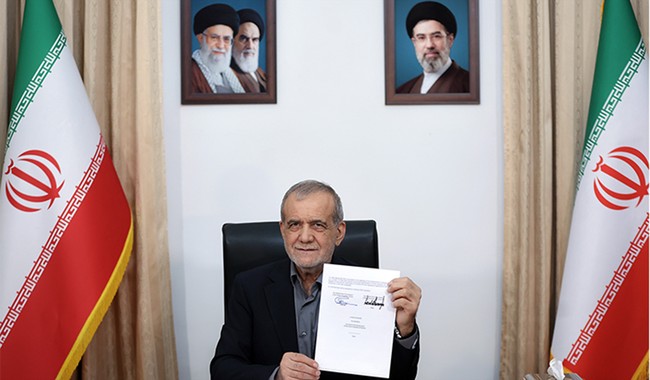
The United States and Iran concluded a first formal round of high-level talks in Switzerland that mediators called “encouraging progress,” while President Donald Trump drew a hard line on Hezbollah and warned of military options if Iran did not curb regional aggression. Mediators from Qatar and Pakistan announced steps to set up direct communications, a deconfliction cell for Lebanon, and a High Level Committee to oversee follow-up work on nuclear issues, sanctions, and enforcement. The opening talks focused on immediate risks in the Strait of Hormuz and the fighting in Lebanon, with tougher questions about sanctions, inspections, and Iran’s nuclear ambitions left for later rounds. Tensions flared at points, but the session moved forward with an agreement to pursue technical talks and working groups over the coming weeks.
The first formal meeting took place at a lakeside resort in Switzerland and ended with a joint statement framed by Qatari and Pakistani mediators. The statement emphasized creating clearer channels to avoid miscommunication and the establishment of a “deconfliction cell” aimed at ending military operations in Lebanon. Officials presented the session as a positive, constructive start intended to translate a fragile ceasefire into a practical process for negotiations. Those are slender but important steps toward managing an immediate regional crisis while protecting U.S. interests.
Lara Korte posted the mediators’ joint statement and highlighted the main takeaways:
https://x.com/lara_korte/status/2068917805785727478
“Good morning. The first round of talks between the U.S.-Iran have concluded.
In a joint statement, Pakistani and Qatari mediators said the parties agreed to set up a line of communication to avoid miscommunication over the SoH and a ‘deconfliction cell’ to ensure an end to military operations in Lebanon.”
The mediators’ release described the Lake Lucerne talks as constructive and said mechanisms were created for further technical discussions. Participants agreed to form a High Level Committee to oversee mediation and working groups to tackle nuclear questions, sanctions relief, monitoring, dispute resolution, and implementation of any memorandum of understanding. Those institutional steps are meant to give the process structure and to prevent the talks from collapsing under episodic violence or misunderstanding. The challenge will be turning agreements on paper into verifiable, enforceable actions on the ground.
Two immediate priorities emerged from the session: safe commercial passage through the Strait of Hormuz and de-escalation in Lebanon. Delegations agreed to set up a direct communications line to reduce the risk of incidents involving merchant shipping in the Strait, a critical global energy chokepoint. They also approved a de-confliction cell for Lebanon, facilitated by Qatar and Pakistan, intended to halt military operations there and reduce the chance that fighting between Israel and Hezbollah drags the region into a wider war. Those moves are pragmatic, focused on lowering short-term risk while other issues are negotiated.
The statement reiterated the importance of the Strait and the need to prevent misinterpretation or dangerous incidents at sea. “A communication line between the parties has been formed…to avoid incidents and miscommunication with the aim of safe passage for commercial vessels through the Strait of Hormuz.” That language underscores how easily local clashes can cascade into disruptions of global energy supplies and why the U.S. places high priority on maritime security. Ensuring safe passage is a practical objective that benefits many nations and gives the U.S. a clear, defensible interest in the talks.
Lebanon represents the most volatile test for the nascent process because Hezbollah remains Iran-backed and engaged against Israel, making de-escalation politically fraught. Iranian officials described “major progress” on ending conflict there, while also noting concessions like waived export restrictions and discussions about frozen assets and reconstruction. But words from Tehran have to be backed by verifiable steps on the ground in Lebanon and a demonstrable restraint of Iran-backed proxies. Without that, any agreement can be undone by renewed hostilities or covert escalations.
Before the talks began, President Donald Trump publicly demanded that Iran rein in Hezbollah and warned the U.S. could take military action if Tehran failed to comply. His statements briefly rattled negotiators and prompted a sharp reaction from Iran’s delegation leadership, but the conference resumed after a pause. Trump reiterated that the U.S. could “resume” bombing and even “take over” the Strait of Hormuz if diplomacy failed, a posture meant to strengthen the negotiating position while signaling that America remains willing to use force to protect key interests.
“Don’t they think that if their threats had any effect, they wouldn’t be in this desperate situation today?… No matter how much they talk, it is we who take action.”
Vice President JD Vance, who led the U.S. delegation, framed the talks as an opening and said the U.S. would reward genuine changes in Iranian behavior on regional stability and nuclear ambitions. Technical sessions are slated to continue at the same Swiss venue in the coming days, as teams work through the specifics of monitoring, enforcement, and sanctions relief. The path from “encouraging progress” to a binding, verifiable agreement runs straight through Hezbollah, enforcement mechanisms, and clear limits on Iran’s nuclear program.
For now, the lakefront talks established structures and lines of communication that can reduce the chance of miscalculation while leaving the hardest questions for future rounds. The next weeks will test whether Tehran actually curbs proxy violence and accepts meaningful verification, or whether U.S. warnings and leverage will be necessary to secure lasting commitments. The stakes are high, and the United States is signaling it will back diplomacy with clear consequences if Iran undermines the process.


Add comment