
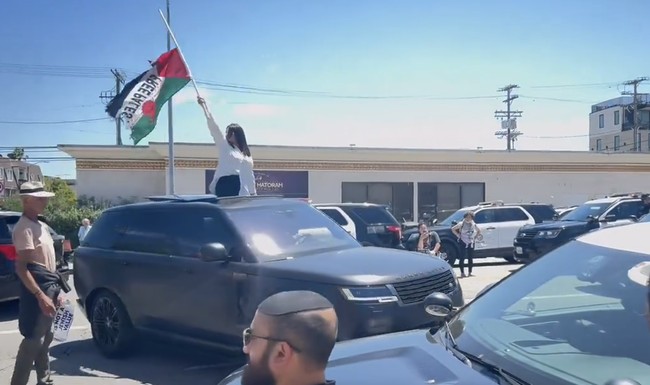
Nearly two years after violent pro-Hamas crowds attacked the area around a Los Angeles synagogue, the Justice Department under Trump has charged a suspect in a hate crime tied to those assaults, and the case highlights failures by local authorities and a political divide over who enforces accountability.
On June 23, 2024, protests outside a Pico-Robertson synagogue devolved into violence that targeted worshipers, journalists, and neighbors, leaving people punched, pepper-sprayed, and chased. Eyewitness accounts described a chaotic scene where protesters and counter-protesters clashed and some local residents say police response was slow and ineffective. This article focuses on the arrest and federal indictment of a man accused of a targeted, unprovoked attack during that unrest.
The Justice Department announced that Zaid Gitesatani, 28, of Carlsbad was arrested on a federal hate crime indictment for an assault during the protests. According to charging documents, the attack occurred when a man walking his dog near the synagogue was struck from behind and suffered obvious pain and swelling. Prosecutors say Gitesatani returned to the crowd after the assault and later posted about it on social media.
The indictment describes Gitesatani traveling to Los Angeles to attend protests organized by multiple groups opposed to an event at the synagogue tied to property sales in Israel. Authorities allege he sought out the chaos rather than stumbling into it, and that his words afterward were meant to celebrate the violence. If convicted of the federal charge, he faces up to 10 years in prison.
The social posts cited in the indictment are explicit and disturbing. Prosecutors say he shared a screenshot of the attack, displayed a photo of bruised knuckles, and wrote: “Whooped the Zios today and we took their flag.” In private messages he allegedly bragged, “I whopped 2 zios,” “I swung good on them,” “It was satisfying,” and “I [sic] hand it [sic] numb from punching him so hard.”
“The Chosen People sometimes need a good smack to wake up.”
Those messages form the basis of the government’s view that the assault was motivated by the victim’s Jewish identity. Assistant Attorney General Harmeet Dhillon of the Civil Rights Division emphasized the seriousness of such crimes in a formal statement, saying:
“The defendant’s conduct, if proven, is a serious violation of the law — every American deserves to live without fear of violence based on who he is or how he worships. The Justice Department is committed to vigorously prosecuting such crimes of hate and violence.”
The grand jury returned the indictment on May 5, 2026, and the defendant is scheduled to appear in U.S. District Court in downtown Los Angeles. The case is being prosecuted by federal prosecutors and Civil Rights Division trial attorneys, who say they will pursue the matter aggressively. That federal involvement matters because many local victims and observers felt their own city government and police were overwhelmed at the time.
Reports from the scene described the LAPD forming cordons that prevented synagogue members from safely entering their own building while demonstrators occupied the sidewalk. People who were present say worshipers and families trying to access the synagogue were effectively blocked and left vulnerable for hours. Those on the ground expressed anger at city leadership and at what they saw as a failure to protect residents.
Mayor Karen Bass eventually issued a statement on X in the hours after the violence, a move some residents say came too late. In the middle of the night she finally a statement on X, after the neighborhood had already been terrorized. For many, the delay symbolized a lack of urgency from city officials during a moment of real danger for a vulnerable community.
Beyond the immediate assault and social media boasting, the episode has become a political touchpoint about how different federal administrations handle civil unrest and hate crimes. Supporters of the current federal action argue it shows that the Justice Department is willing to step in where local systems failed. Critics point out that violent protests and targeted attacks should never be minimized or treated as routine by any level of government.
Victims and community leaders continue to press for stronger protections around houses of worship, arguing that being able to attend services without fear should be a basic expectation. The arrest and indictment give them one path toward legal accountability, but they also raise broader questions about crowd control, local policing priorities, and how social media posts can track motive and intent. The case will move through the federal courts, where prosecutors will lay out the evidence they say proves the assault was a hate crime, and the community will be watching closely.
https://x.com/MayorOfLA/status/1805110392806642141


Add comment