
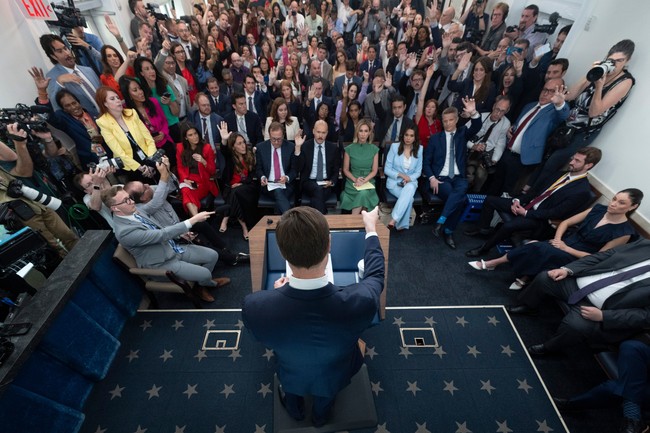
Vice President JD Vance stepped into the White House briefing room and ran the table, calling out media bias, mocking the left’s “No Kings” posture, and sparring with reporters who turned questions into speeches. His blunt exchanges highlighted a clash over narrative, decorum, and who gets to set the agenda. This piece walks through the moments that landed hardest and shows why the briefing felt more like a reality check than a routine press duty.
The rotating press briefings have put different officials in front of cameras while the usual press secretary is away, and Vance used his slot to press the point that words matter. He didn’t shy away from naming the contradiction he saw in the left’s theatrics around monarchy and ceremony. The moment landed because it wasn’t polished political theater; it was direct and unvarnished.
One clip centered on the “No Kings” crowd and Vance’s take was sharp and memorable. He framed applause for a visiting monarch alongside protests that claim to oppose kings, and he suggested that political grandstanding often masks real priorities. That bluntness made a lot of people nod and a lot of people bristle.
MIC DROP: @VP perfectly calls out the left’s ‘No Kings’ hypocrisy
“How many Democratic lawmakers have I seen holding up signs that say ‘No Kings’ — they’re very, very insistent that we not have kings. And then King Charles comes to the Congressional Chamber and these guys break out in rapturous applause.
So maybe they don’t care so much about kings as they pretend that they do. Maybe they just don’t like the agenda that we’re implementing that’s actually making American workers and American families safe and prosperous again.”
That exchange made a point about inconsistency and policy priorities, not just rhetoric. Vance leaned into the contrast between performative protest and policy outcomes, tying the applause and the signs back to the administration’s claims about delivering for workers and families. He wasn’t interested in polite framing; he wanted accountability for the selective outrage.
Another moment was a public rebuke of a reporter whose question read more like an opinion piece than a prompt for information. The press corps sometimes blurs the line between questioning and lecturing, and Vance stopped short of letting that pass. He challenged the performative approach and demanded real, concise questions instead of speeches disguised as interrogations.
.@VP just HUMILIATED a reporter who attempted to posture over asking a real question at today’s press briefing:
“Come on, man! Have a little bit of objectivity in the way that you ask these questions, because there were a lot of things in that speech masquerading as a question that didn’t actually get asked.”
The back-and-forth turned pointed when the reporter kept talking instead of getting to a clear question. Vance called out the tactic and highlighted how reporters can skew a briefing by turning it into a platform for editorializing. His line about different ways to ask a question underscored a basic expectation of the briefing room: ask, listen, and move on.
Before I answer your question, I want to just observe, there are different ways to ask a question, okay? You can just ask a question, try to get your answer, or you can do like a speech where you say, you know, Mr. Vice President, you’re a terrible human being and so is the president, so is the entire cabinet.
And then I’m like, what’s your question? And then your question is, how dare you?
Come on, man.
The message was simple: the briefing is not an op-ed page. Vance made it clear that if reporters want to deliver indictments, they should do it in a format that suits that purpose, not during an official press function. That distinction matters because it affects the information flow and the public’s ability to hear answers instead of monologues.
Vance also pushed back on narrative framing when a network correspondent tried to characterize the president’s remarks about pocketbooks in a particular light. He disputed the misrepresentation and insisted context matters. The exchange highlighted how single lines can be lifted and repackaged as a story, divorced from the fuller exchange.
.@VP shuts down CNN’s Kaitlan Collins for trying to push the FALSE narrative that President Trump said he doesn’t care about Americans’ financial situations:
“See, Kaitlan, what you did is you misrepresented the question that I was asked and then you misrepresented the answer I gave […] It was totally taken out of context.”
Throughout the briefing Vance referenced several policy items and events, including appearances at community institutions and other engagements, signaling that the administration wanted to steer attention back to action. He mixed policy points with media criticism, a strategy aimed at changing the conversation. The result was a briefing that read as part press conference, part media critique.
What stood out was the tone: blunt, impatient, and unapologetic. Vance’s style in the room wasn’t about cozy conversation; it was about asserting control over how questions get asked and how answers are framed. For supporters, it was a refreshing refusal to tolerate selective narratives; for critics, it was a confrontational posture that raised eyebrows.
In short, the briefing gave a clear glimpse of how this administration plans to handle media pressure: call out inconsistency, demand clearer questions, and refuse to let context be stripped away. The exchanges made the point without elaborate theatrics, and that directness is exactly why the footage spread so quickly.
Vance’s performance left the briefing room with a sharper edge, and that edge is likely to show up again as the administration continues rotating officials through the podium. The clash over norms and narratives is far from over, and this appearance proved that the White House is ready to fight for how the story gets told.
Vance also talked about at the Islamic Center in San Diego, the , and more. Watch the full briefing here:


Add comment