
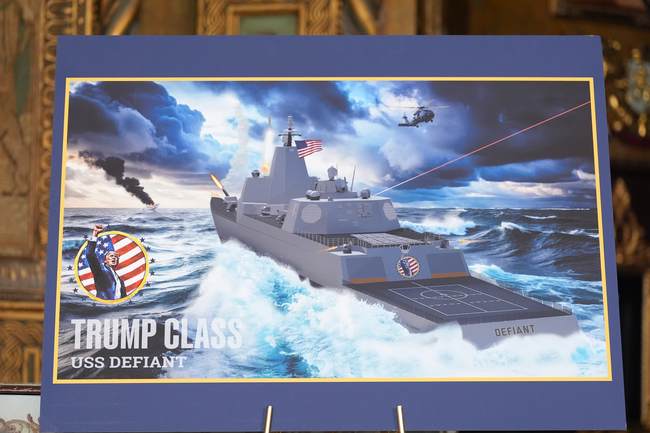
The U.S. Navy’s proposed USS Defiant, the lead of a new “Trump-class” battleship line, would be a modern, heavily armed surface combatant featuring missiles, lasers, and a railgun, while carrying a price tag and political implications that will shape whether it ever sails.
The Defiant is billed as a large, fast surface warship not trying to relive World War II in steel and triple 16-inch turrets, but instead to push new technologies into frontline service. Its proponents argue the ship fills capability gaps with layered strike options and modern defensive systems. Skeptics point to cost and congressional appetite as the real constraints on the program’s future.
Chief of Naval Operations (CNO) Adm. Daryl Caudle and Secretary of the Navy John Phelan both discussed the Trump class battleship, also known as the BBG(X), at separate roundtables on the sidelines of the Navy League’s Sea Air Space 2026 exposition this week. President Donald Trump had officially rolled out plans for the Trump class, the first of which is currently set to be named the USS Defiant, last December.
“I think it is a necessary element to the force,” and “I think it provides real flexibility to the force,” Secretary Phelan said about the BBG(X) effort at his roundtable.
Public descriptions put the displacement around 35,000 tons, roughly three times a Flight III Arleigh Burke destroyer, and a length between 840 and 880 feet. Reported beam figures range from 105 to 115 feet and designers are aiming for speeds above 30 knots. That size and speed combination would make the Defiant the largest U.S. surface combatant since 1945 if it reaches the fleet.
The planned weapons mix leans heavily on versatility: large vertical launch arrays for both conventional and nuclear-capable missiles including hypersonic types, an electromagnetic railgun, multiple directed-energy weapons, and conventional naval guns. The concept aims to combine long-range strike, area denial, and close-in defense in a single hull. That “do-everything” idea is appealing in concept but expensive in practice.
Cost estimates for a single ship vary widely, with figures cited in public reporting from roughly $10 billion to as high as $17 billion per hull. To put that in perspective, a new Ford-class carrier has carried a roughly similar per-ship bill. Those numbers make Congress the ultimate gatekeeper, and partisan control of the House or the purse strings will determine whether this class moves forward. The Navy’s planning target of an FY2028 first order faces a tough political climb.
Reported offensive loadouts include a mix of nuclear-capable and conventional cruise missiles, cells for prompt global strike concepts, and an ambitious railgun capability claimed to be a 32 megajoule system alongside two five-inch guns. Defenses are said to feature RAM launchers, 30mm guns, multiple laser systems, and counter-unmanned systems. Designers are squeezing both reach and point defense into the same design, which complicates weight, power, and space trades.
All of this relies on high-power electrical generation and thermal management to run railguns and lasers, plus robust VLS capacity for a wide array of missiles. Those technical demands drive cost, complexity, and development risk, especially when integrating immature systems into a single platform. If the Navy and industry can tame those engineering problems, the result could be a powerful ship; if they can’t, costs and delays will pile up.
Politically, this project wears the President’s brand and benefits from a Republican appetite for a stronger, more capable Navy that asserts deterrence. That alignment helps push funding and attention in sympathetic circles, but opponents will question whether a handful of very costly hulls is the best way to defend American interests. The debate will come down to doctrine, budgets, and whether Congress sees a strategic need worth the price.
There is also a cultural element: advocates want a visible symbol of maritime strength, while critics favor distributed, lower-cost platforms and unmanned systems. That tension echoes older fights over battleship versus carrier relevance but updated for hypersonics, directed energy, and electromagnetic weapons. Whether the Defense Department chooses concentrated power in the Defiant or a larger mix of smaller platforms will shape the Navy for decades.
Enthusiasts can imagine a ship bristling with missiles and energy weapons, a new kind of capital ship for the 21st century. Detractors see funding pressure, integration risk, and the political winds as likely to blunt or delay the program. For now, the Defiant is a proposal full of potential and big questions about cost, technology, and national priorities.
That’s a lot of hitting power.:



Add comment