
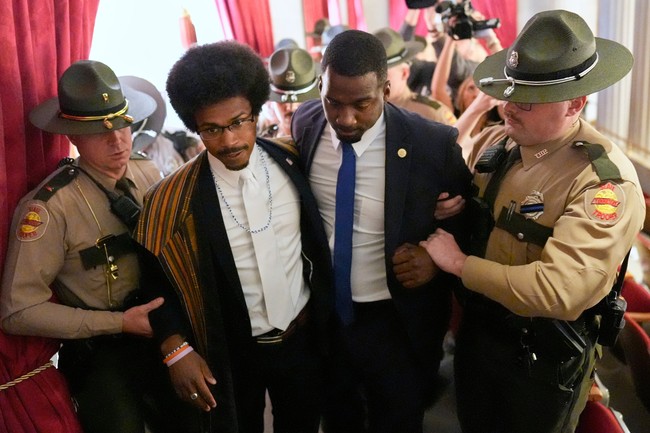
The Tennessee redistricting fight turned chaotic as Democrats protested a new map that likely eliminates their only congressional seat, sparking loud outbursts, a banner tug-of-war, gallery disruptions, and a confrontation between Rep. Justin Pearson and a Tennessee Highway Patrol trooper that escalated into profanity and physical contact.
Republicans in Tennessee moved quickly after court rulings to finalize a congressional map that reshapes political realities in the state, and Democrats responded with predictable outrage. The new map almost certainly costs them their lone competitive district, and the reaction inside the legislature was loud and theatrical. Lawmakers and protesters in the gallery screamed, chanted, and used crude language as votes were finalized.
Suffice to say, Democrats have not taken this well, but stopped short of chaining themselves to their legislative desks. As the vote was being cast and finalized, Democrat lawmakers and protesters in the gallery yelled, screamed, “No!” and “Shame!” and broke into profanity and chants.
A memorable moment came when a Democrat lawmaker engaged in a tug-of-war with the Senate Sergeant at Arms over a banner reading, “No Jim Crow 2 Stop the Steal.” That sign and the theatrics were designed to frame the redistricting as illegitimate, yet the facts of population shifts and court decisions still drive the map. The legislature acted on its authority, and the spectacle didn’t change the outcome. Disruption and symbolism can make headlines, but they do not alter legal processes or demographic data.
The House gallery became so disruptive that police were called in to clear it, as people threw items and fire alarms were reportedly pulled. Parachutes were reportedly tossed from the gallery, adding a circus-like element to an already tense session. Removing agitators when they block legislative business is standard procedure, not an assault on protest rights. Lawmakers who turn a chamber into a stage should expect security to restore order when necessary.
Troopers then escorted people from the gallery, and that is when the confrontation intensified. One of the people being removed was the brother of Rep. Justin Pearson, who reacted with visible anger and verbal attacks as officers did their job. Pearson intervened physically and verbally while troopers attempted to move his brother out, inserting himself into the removal and escalating the situation. That decision by a sitting representative made a manageable enforcement action into a headline-making clash.
What unfolded next was a raw, profanity-laced confrontation captured on video, and the language used was graphic. Pearson shouted at the trooper, “Move the f*** back, boy! What the f*** is wrong with you?” and later called the officer a “stupid motherf*****.” Those exact words reflect a level of disrespect for law enforcement that is unbecoming of an elected official. Officers in that clip appear restrained, focused on removing a disruptive gallery participant, not provoking a violent reaction.
Pearson’s behavior raises questions about judgment and decorum for someone in public office, especially when his own actions insert him into a situation that could have been handled without confrontation. This is not a trivial stand-off; it points to a pattern where theatrics and escalation become a political strategy. Expulsion and reinstatement in recent years should have been a cautionary lesson, but the episode shows familiar brinkmanship from some Democrats who prioritize spectacle over process.
There is a political cost to this kind of conduct. Voters watching from outside the chamber see chaos and insults instead of policy arguments, and that can harden public attitudes against the disruptors. Republicans who pushed the map framed it as lawful and responsive to court guidance and demographic realities, while Democrats painted themselves as defenders of fairness. The optics of profanity and physical contact with law enforcement do not help the story Democrats are trying to tell.
Legislative bodies have rules for a reason, and enforcement of those rules falls to officers whose job is to keep proceedings moving. Elected officials are expected to model behavior that respects institutions and the ballots that shape them. When a representative crosses into aggressive interference with law enforcement, it invites criticism and distracts from substantive debate about district lines and representation.
The chaotic scene in Tennessee is a reminder that redistricting is ultimately a political and legal exercise, often decided by courts and legislatures rather than gallery protests. Democrats will likely lean into the narrative of victimhood and unfair maps, but the occurrence of public disorder undercuts their argument and gives Republicans cover to say they followed proper channels. Both sides understand the stakes, but only one side’s rhetoric here crossed into personal attacks against officers doing their duty.
As this battle plays out, conservatives will note that breaking decorum and attacking law enforcement rarely wins broader support, even among those sympathetic to a cause. The Tennessee episode offers a cautionary tale about tactics: loud protests and confrontational theater can energize a base, but they also risk alienating undecided observers and hardening opposition. The state will move forward under the new map, and the political fallout from the spectacle will be debated for weeks to come.



Add comment