
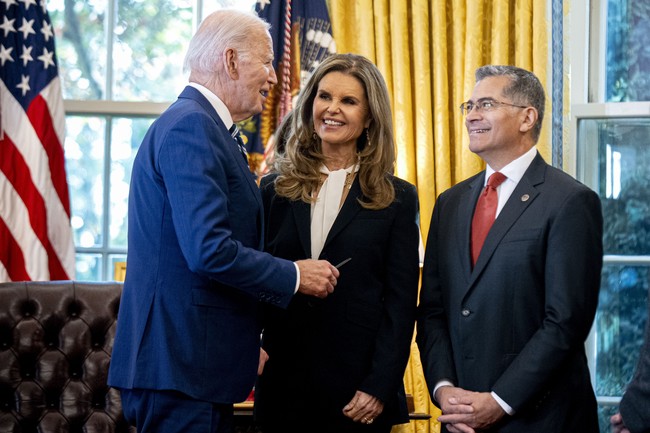
Xavier Becerra, once a cabinet official in the Biden administration, has become a leading Democrat contender for California governor despite criticism from former colleagues who say he was frequently absent in critical moments. This piece examines that contrast, the reactions from ex-administration staff, and what it could mean for California politics as the campaign unfolds.
The California governor’s race is already strange enough without adding in the odd rise of a former cabinet official who many say was seldom visible when it mattered most. After Eric Swalwell left the contest, attention turned to Xavier Becerra, the former Health and Human Services secretary and longtime California politician. Voters and observers are left asking how a figure with a reputation for not showing up could now be in pole position for the state’s top job.
Former Biden administration colleagues, speaking off the record to a national outlet, relayed a common theme: Becerra did not lead on crises in the way a cabinet secretary should. They say he allowed others to take the visible role during the Covid emergency and didn’t take charge of key implementation efforts. That kind of absentee leadership, they argue, is a worrying credential for someone seeking to lead a complex state.
Six former Biden administration officials, all of whom were granted anonymity to speak candidly about a former colleague, acknowledged the subject of Becerra’s unlikely rise has come to dominate their group chats and conversations. “It gets the biggest laugh every time we send around a poll,” the first former official said, describing the perception across the administration that the former HHS secretary was ineffective on the Covid response, a migrant health crisis at the border and other matters.
The anecdotes paint a picture of a political operator who excelled in litigation and legislative tactics but faltered in crises that demanded steady managerial presence. As attorney general, Becerra was known for filing suits and playing to a legal playbook. In a cabinet role, however, the tasks were different: coordinating agencies, managing public health responses, and being a public face during emergency moments.
“He ran one of the most consequential agencies in government at the height of the pandemic,” the former official continued. “But he took a backseat to Dr. Fauci and his team, didn’t visibly lead on implementation and had to go through layers to get to POTUS even as a Cabinet member.”
A second former Biden official shared that view, describing Becerra as having been “absent” on Covid responses. So did a third former Biden official, who called Biden’s selection of the former California attorney general, who brought no medical or public health background to the job, “an unfortunate choice.”
Becerra, a fourth former Biden official said, “is very good at being a politician. When he was attorney general, the formula was: you file a lawsuit. When you’re a member of Congress, you help your constituents and you introduce legislation. When people noticed he wasn’t cut out for [the Cabinet] was when there was a crisis — it was clear he didn’t know how to handle that.”
That criticism cuts in two directions politically. To Republican voters and skeptics, those stories confirm what they suspect about Democrat governance: style over substance and optics instead of operations. To Democrats who worry about electability and competence, the reports raise questions about whether the party’s bench can deliver real managerial talent for a state with enormous challenges.
Political observers also note a pattern across the Biden era where loyalists were rewarded despite shaky performance. The idea of promoting people into roles they are not prepared for echoes the Peter Principle, where officials rise to their level of incompetence. If true, Californians could be looking at a familiar Democratic script: bold rhetoric paired with underwhelming execution.
Critics within the conservative media have already coined nicknames and references to Becerra’s alleged habit of not showing up. That kind of messaging lands well in a campaign environment where voters care about reliability and accountability. Opponents will likely lean into those stories to contrast their candidates’ promises of more hands-on leadership with Becerra’s reported track record.
Beyond the spectacle, the practical question remains: can a state as large and complicated as California tolerate a governor who prefers political maneuvering to hands-on crisis management? The stakes are high for infrastructure, housing, emergency response, and state fiscal health, and competence at the top matters more than party loyalty.
For now, Becerra’s frontrunner status is as much a reflection of California’s political dynamics as it is of his personal strengths and weaknesses. As the campaign continues, voters will have to weigh anecdotes from former colleagues against the promises and plans being presented on the stump. The contrast between presence and absence, action and grandstanding, will be a central theme voters decide in the months ahead.


Add comment