
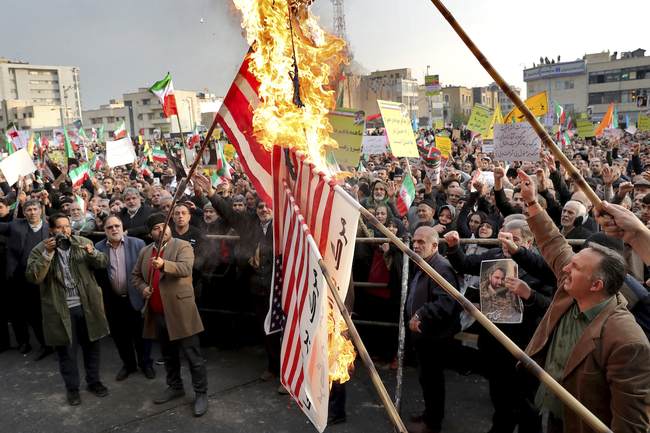
Tehran faces an acute water emergency that could force mass evacuation as reservoirs run dry, groundwater collapses and infrastructure strains under persistent drought and mismanagement; this article explains the scale of the shortages, the risks to the capital and to the country, and how political and technical failures turned a drought into a potential national collapse.
Then the anger of the Lord will be kindled against you, and he will shut up the heavens, so that there will be no rain, and the land will yield no fruit, and you will perish quickly off the good land that the Lord is giving you.
— Deuteronomy 11:17
Iran is now in its fifth straight year of drought and Tehran, a metropolis of about 9.7 million people, is staring down what officials call a “Day Zero” scenario. Autumn rainfall collapsed to roughly two millimeters in 2025, a fraction of previous years, and government warnings point to a crisis that could reach peak severity in early January. This is not just a seasonal hiccup; it reflects decades of policy choices that made a capital dependent on fragile water infrastructure.
President Masoud Pezeshkian warned that if drought conditions continued more than a month, “we’ll have to evacuate Tehran.” That is a stark statement with no clear plan behind it, and it exposes a government unready to relocate millions or provide basic services when water runs out. Pezeshkian has suggested moving the capital toward the Persian Gulf where there is access to open waters, but proposals like that understate the logistical nightmare and political fallout of relocating a population center.
The five-dam system feeding Tehran has been gutted by low inflows and poor management. The Amir Kabir Dam, once holding over 160,000 acre-feet, now sits at roughly 8 percent capacity — only about two weeks of supply for the city in current conditions. Other reservoirs in the chain are in equally dire shape: Latyan at a small usable fraction of its fill, Lar near one percent, Mamloo around seven percent, and Taleqan at about 30 percent despite being one of the larger basins.
Beyond surface storage, Iran has exhausted much of its groundwater by drilling and pumping to expand agriculture and feed a growing population. That extraction has produced land subsidence across the country, with Tehran sinking at about 25 centimeters per year as aquifers collapse. The sinking undermines infrastructure, threatens subways and utilities, and creates more leaks and failures — a feedback loop that accelerates catastrophe when water supplies are scarce.
This is a national emergency, not a local mishap. Thirty of Iran’s 31 provinces face land subsidence linked to groundwater depletion, and the drought affects virtually every region. When the underlying water table drops and reservoirs slump, cities cannot simply import enough potable water fast enough to keep systems running, especially in a country with limited international cooperation and restricted access to outside aid.
Hydropower is also suffering. Iran depends heavily on hydroelectric generation, and shrinking reservoirs have damaged roughly 12,500 megawatts of capacity or more, destabilizing electricity supplies. Rolling blackouts have returned in Tehran and surrounding areas, compounding the crisis by increasing demand for water and forcing the state to ration both power and water at the same time.
Parliamentarians and environmental officials call for smart meters, real-time monitoring and strict consumption enforcement, arguing that public institutions must be held to the same standards as citizens. Those measures make sense technically, but they will not buy enough time if reservoirs keep falling and groundwater keeps collapsing. The core problem is political: decades of centralized planning, misallocation of water to inefficient agriculture, and a failure to invest in resilient infrastructure.
From a Republican viewpoint, the collapse is a textbook example of what happens when bad governance and ideological indifference to practical constraints replace stewardship and accountability. The regime’s inability to plan and prioritize basic services will have geopolitical consequences, from mass displacement internally to destabilizing refugee flows across borders. Tehran’s evacuation, if it happens, will be more than a humanitarian crisis — it will reshape security, migration and the regional balance.
Even if the government avoids a full evacuation, the downstream effects are staggering: failing crops, collapsed towns, crippled power grids and an overwhelmed civil order. The practical reality is that when major reservoirs and groundwater are exhausted, recovery takes years and massive investment, not slogans or promises. The question now is whether Iranian authorities can marshal the political will to enact real reforms before the taps run dry for millions.
After more than 40 days of screwing Americans, a few Dems have finally caved. The Schumer Shutdown was never about principle—just inflicting pain for political points.Help us report the truth about the Schumer Shutdown. Use promo code POTUS47 to get 74% off your VIP membership.


Add comment