
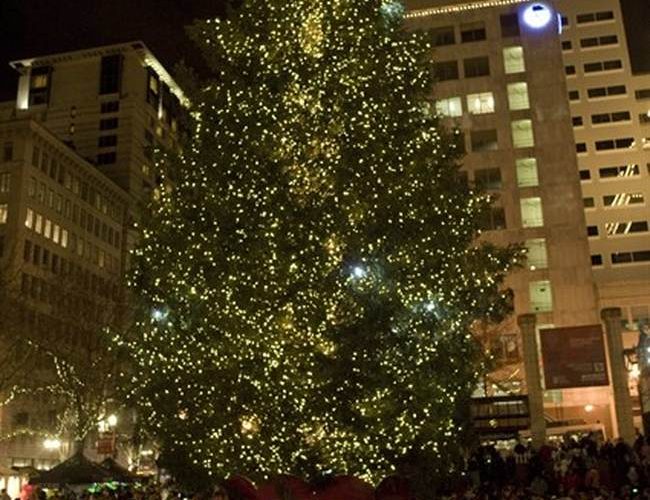
I’ll walk through what happened at Portland’s 41st annual tree-lighting: the ceremony avoided saying “Christmas,” a tribal speaker led an Indigenous song and then a political chant, city leaders stood by, and the event exposed how politics now crowds out tradition in Portland’s public life.
This year’s Pioneer Courthouse Square gathering showed a city that leans hard into identity and politics when people came expecting a simple seasonal tradition. Thousands showed up for the 75-foot lighting ritual, but the words and symbols we associate with Christmas were conspicuously absent. Officials and presenters consistently called it “the tree” rather than “the Christmas tree,” and the decision felt deliberate rather than accidental.
The ceremony opened with a member of the Confederated Tribes of Warm Springs thanking the crowd on Native American Heritage Day and introducing younger tribe members. They referred to it only as “the tree lighting” before handing the microphone to another guest. That guest, draped in a Palestinian flag, used her stage moment to convert the occasion into a political rally.
The woman said, just moments after she began speaking:
This is the perfect time to bring this up. There are a lot of genocides going on. Can I get a ‘Free, free Palestine?’
She then led the audience in that chant and followed with the Strong Woman Song, described onstage as an intertribal Indigenous song celebrating resilience and empowerment. The song and the stage setup featured children and other women, with the speaker explaining it “felt appropriate since we’re representing our matriarchs up here.” Mixing a religious holiday replacement with political messaging and international politics turned a local tradition into a platform.
Portland’s elected leaders can claim inclusion, but the net effect was exclusion for many locals who come to remember a holiday tradition. The ceremony went nearly an hour before the mayor finally introduced familiar holiday figures and flipped the switch, making the lighting feel like the last act in a long, politically tinged program. A ritual that once centered community and faith instead looked like an obligatory civic duty staged around progressive priorities.
There are broader consequences when civic celebrations are repurposed as stages for partisan or international causes. People attend seasonal events for shared culture and comfort; when those moments are coopted, many feel pushed out. For residents who value the traditional meaning of Christmas, the omission of the name and the tilt toward political signaling felt disrespectful, not inclusive.
Portland’s current trajectory on public safety, homelessness, and city services colors how outsiders and many locals read moments like this. A city grappling with encampments, drug problems, and strained resources will have citizens asking whether their leaders are focusing on the right priorities. Using a civic holiday to make political statements does not reassure people that those leaders are addressing the pressing issues on the ground.
Critics might point out that public squares are venues for free speech and diverse voices, and they’re right. But there is a difference between inviting varied cultural performances and turning a traditional holiday event into a moment for geopolitical protest. When ceremony organizers set rules that implicitly silence some expressions while privileging others, it undermines the sense of neutral public space everyone deserves.
Imagine the backlash if a Republican-run city staged a holiday display while soft-pedaling or sidelining a Muslim or other religious celebration out of fear of offense. The double standard would be obvious. Civic rituals can and should reflect the common life of a community rather than a litany of editorial positions favored by the political class.
Many attendees likely left feeling the lights were beautiful but the evening was hollowed out by politics. Tradition was reduced to a backdrop for messaging that many in the crowd did not sign up for. For those who still care about cultural continuity, that sense of loss is real and it feeds a wider disaffection with local governance.
Portland will keep changing and some will cheer every step. Others will see civic life, including holiday traditions, as casualties of a cultural agenda that prioritizes signaling over shared ritual. Either way, the tree-lighting this year was less about warmth and more about a city performing its woke identity on a public stage, and a lot of people noticed.


Add comment