
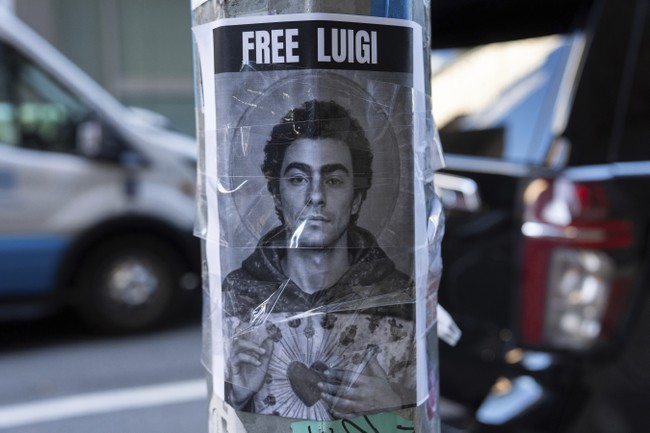
Luigi Mangione, accused of killing UnitedHealthcare CEO Brian Thompson, returned to court as supporters gathered outside and his lawyers pushed to suppress key evidence seized after his arrest in Pennsylvania; the case mixes shocking courtroom moves, a suspect’s alleged writings and weapons, and unsettling public reactions that critics link to political normalization of violence.
The Manhattan killing happened nearly a year ago on December 4, and the proceedings this week focus on whether evidence gathered during Mangione’s arrest should be excluded. Authorities say police recovered a .9mm handgun and a notebook with troubling entries, and prosecutors argue that material ties him directly to the ambush in midtown. The defense contests how that evidence was collected five days after the shooting in Altoona, Pennsylvania.
Mangione’s supporters have drawn attention outside the courthouse, with people queuing for hours in cold weather and some in costumes. Observers described the scene as grotesque given the gravity of the charge and the fact the victim was a father of two. Billboard trucks and social posts praising Mangione added to what critics called an unnerving spectacle around a criminal matter.
Mangione’s lawyers are asking the court to suppress evidence collected during his arrest at a Pennsylvania McDonald’s five days after the murder. The evidence includes physical evidence from a backpack, including the suspected murder weapon and his journals, as well as statements he made to police before they read him a Miranda warning.
The hearings are expected to run for several days, with a break on Wednesday.
That motion targets a backpack, journals, and statements allegedly made prior to a Miranda warning, and if the court rules to exclude some or all of that material it could significantly affect prosecutors’ case. Federal and state prosecutors maintain they have solid proof linking Mangione to the shooting, and they say evidence recovered during the arrest is lawful and probative. The judge will hear testimony and legal argument over multiple days before ruling.
Included among the items at issue is the .9mm handgun prosecutors say was used in the killing and a notebook where the defendant allegedly wrote about his intent to “wack” a health-insurance executive. Prosecutors say those documents and the weapon together form the core of a premeditation case. Defense attorneys counter that police procedure and the timing of certain statements may render parts of the seizure inadmissible under the law.
In court the defendant appeared composed, a contrast that inflamed critics who called the reaction from fans disturbing. One prominent description labeled Mangione as “one of the most divisive murder suspects of the decade,” reflecting how the case has become a cultural flashpoint. Public fascination with high-profile defendants is nothing new, but many found the fan behavior around this hearing especially repellent.
Social media amplified the odd public response, with posts celebrating the accused and others mocking mainstream outrage. Fans showed up in costumes, including outfits modeled on a well-known video game character, and packed the area hours ahead of the hearing. These displays prompted commentators to debate whether political rhetoric and social trends have made certain acts appear excusable to some groups.
Dozens of supporters were described lining up in frigid temperatures, some even dressed as the Luigi character from Super Mario, trying to get a glimpse of the accused at his hearing. Such images and reports have been repeatedly cited by critics as evidence that parts of the political left are normalizing extreme behavior. Observers also noted that public sympathies appeared driven less by facts of the case and more by an overlay of ideological grievance.
Earlier this year, a judge tossed state-level terror charges, which surprised many observers and added to the legal complexity surrounding Mangione’s prosecution. Regardless, the defendant still faces multiple New York charges and federal counts that could bring the harshest penalties, including capital exposure at the federal level. The interplay between state dismissals and federal prosecutions will be a continuing theme as the case proceeds.
Critics argue that cheers and sympathy for an accused killer reflect a dangerous cultural shift that trivializes violence when it serves a narrative. They point to other violent incidents and rhetoric to illustrate how political extremism and partisan anger can bleed into real-world criminal acts. Many commentators urged a return to sober, law-focused discussions rather than celebratory reactions to alleged murderers.
The case also raises questions about mental state, motive, and the role of ideology in violent acts, while the legal fight over evidence may be decisive. Courtroom testimony, forensic analysis, and the judge’s rulings on admissibility will shape the trial timeline and potential outcomes. As the hearings continue, both sides will marshal experts and witnesses to press their competing versions of events.
Outside the formal proceedings, the spectacle around Mangione’s appearance has become a headline unto itself, prompting debate about media responsibility and the public’s appetite for sensational trials. For now, the court will methodically examine the suppression claims and weigh whether key pieces of the prosecution’s case can be used at trial. The legal process will determine how much of the contested material remains in play as the case moves forward.

Add comment