
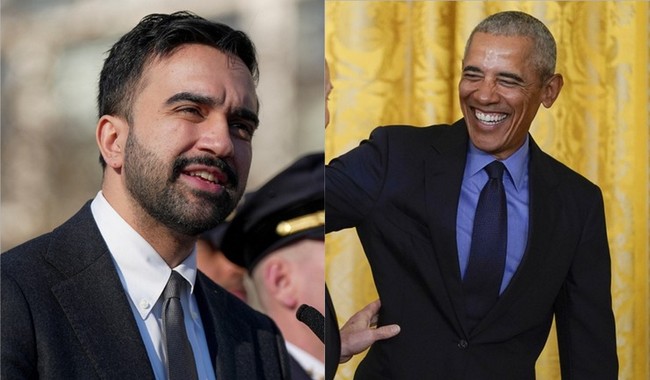
Former President Barack Obama and New York City Mayor Zohran Mamdani were captured leading children in a sing-along, a moment many see as tone-deaf given the explicit praise and flirtation with socialist language; this article looks at what happened, why critics are alarmed, and the historical comparisons opponents are using to make their case.
There’s a clear sense among critics that the footage crosses a line from lighthearted interaction into political theater. Many are bothered not by the presence of a politician with kids, but by the context and the messaging those politicians bring with them. When public figures connect cheerful moments to ideological symbols, observers are likely to react strongly.
Conservative critics point out that socialism and Marxism have been tried widely and produced catastrophic outcomes, and they argue that applauding elements of that history is insensitive at best and dangerous at worst. The reaction isn’t merely about policy disagreement; it’s about the emotional and historical weight attached to those ideologies. For many, celebrating or normalizing that legacy while engaging children feels like a betrayal of hard lessons learned over decades.
The clip of Obama and Mamdani singing with kids is being read as more than a benign photo op. Detractors say Obama’s participation signals a substantive ideological shift, arguing that his presence gives a sheen of respectability to a mayor who openly identifies with leftist models. That perception fuels the claim that older, mainstream politicians are now openly embracing policies many see as failed experiments.
There’s a long memory in political culture about how leaders behave in moments of stress or symbolism, and comparisons are already being drawn to past controversies involving presidential optics. Those earlier debates remind people that how a leader appears with children, or in a classroom, can carry outsized symbolic meaning. Observers say context matters, and in this case the context triggers alarm bells for those wary of collectivist models of governance.
Mamdani’s policy moves in New York, including proposals for municipally run grocery initiatives, are being cited as practical examples that amplify the symbolic value of the sing-along. Critics argue that government-run enterprises historically create scarcity, reduced incentives, and central planning failures, and they claim those historical patterns were on display in other nations that adopted similar models. The sing-along then becomes a shorthand for policies critics contend will produce the same results.
The rhetoric around the clip often invokes the imagery of mechanized, top-down governance. Phrases like “the wheels go round and round” are being framed as metaphors for state-directed life, not the innocent lyrics of a children’s song. Opponents warn that what begins as a catchy chorus can become a slogan that masks the harsher realities of centrally planned systems.
Conservative commentary leans on historical evidence and classical liberal critiques to make its point about economic consequences. One cited voice emphasizes that central planning suffers from inevitable information problems and resource misallocations, leading to empty shelves and stalled services. That perspective argues markets are the best mechanism for coordinating complex human needs and warns against replacing spontaneous order with bureaucratic command.
[Austrian philosopher] Mises called it a century ago. Central planning is economic blindness. The market is humanity’s greatest information processor, and no commissar can replicate what emerges spontaneously from free exchange.
Every empty Soviet shelf was a testament to the impossibility of rational economic calculation without private property and market prices.
For those critical of the sing-along, this is not mere nitpicking about tone. They see a broader alignment between national figures and local leaders who favor interventionist, centrally-oriented policies. That alignment, they argue, has real consequences for cities and citizens who must live under those systems. The concern is practical and immediate, rooted in how policy experiments play out in day-to-day life.
Many conservatives also argue that political theater that uses children as props invites cynicism and distrust. They say adults owe it to the next generation to teach civic virtues without turning classrooms into stages for ideological messaging. To them, the most troubling part of the clip is not the smiles but the signals: an endorsement, by example, of a political roadmap critics believe leads to diminished freedom and economic failure.
Voices on the right are calling on voters and civic leaders to pay attention to both symbolic gestures and the concrete policies that follow. They contend that applause for certain slogans today can harden into institutional change tomorrow. That link between performance and policy is what drives the intensity of the debate around Obama and Mamdani’s public moment with children.
“Editor’s Note: New York City is now facing the consequences of Mayor Zohran Mamdani’s socialist takeover.”

Home-based job that pays more than 12,000 Dollar per month by doing simple tasks on a laptop or mobile device part-time. Last month, I earned 24,863 Dollar from this job by working 4 hours per day online. Very simple jobs to do, and the earnings are insane. Everyone can now make more money online by joining the website listed below…..
𝒋𝒖𝒔𝒕 𝒖𝒔𝒊𝒏𝒈 𝒕𝒉𝒊𝒔 𝒔𝒊𝒕𝒆.. Www.FindJobs1.Site