
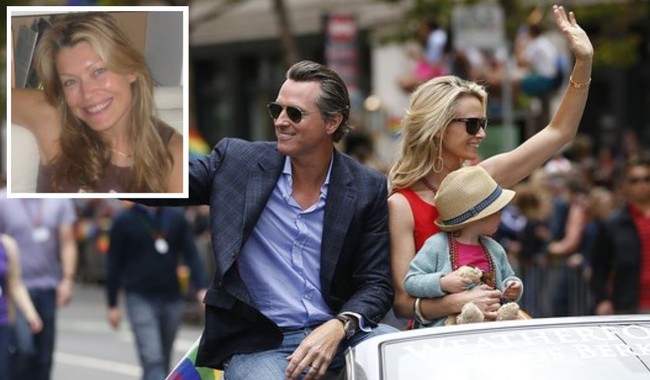
This piece revisits Ruby Rippey’s account of her long-hidden affair with Gavin Newsom, lays out the timeline she provided, contrasts it with Newsom’s public statements, records the responses and reactions around it, and notes why her essay matters now as 2028 political calculations begin to form.
Ruby Rippey had spoken once publicly about the affair back in 2018 and kept mostly quiet for two decades. That silence ended when she published a first-person account detailing dates, locations, and memories that diverge from the official lines put forward by Gavin Newsom and associates.
The initial revelation surfaced in February 2007 when Rippey’s then-husband, Alex Tourk, resigned from his posts after learning of the relationship. Newsom acknowledged the encounter at the time, and local reporting framed it as a brief lapse—”only a couple of encounters”—a description that now conflicts with Rippey’s timeline.
In her essay Rippey dates the affair from July 2, 2005, carrying on intermittently until May 19, 2006, when she entered rehab in Arizona. She details encounters in multiple settings: a penthouse in Russian Hill, a private room at a North Beach bar, and the W Hotel in Los Angeles, among others, suggesting a longer and more persistent relationship than Newsom’s public account implies.
Rippey describes the flirtation beginning months earlier at a dinner where she noticed Newsom staring across the table, even as her husband sat beside her. The exchange she remembers includes this line and moment exactly as she wrote it:
“As the waiter takes orders, I feel the mayor looking at me. I glance up—across the table—back at him. As if caught off guard, he reacts, pointing at me.”
“Hey—you look really good,” he says. “You’ve lost all your pregnancy weight.” There’s an awkward laugh.
She admits to an ongoing struggle with alcohol before and during these years, noting that she once used Antabuse and later turned to cocaine to extend nights that were already heavy with drinking. Those details frame the environment in which the encounters unfolded and complicate any suggestion that everything was simply consensual in a neutral setting.
Rippey also describes being moved to a desk outside the mayor’s office, a placement she felt reduced her role and put her in closer proximity to Newsom. She writes about being shifted to the position of “gatekeeper” and feeling the change as a demotion, a detail that paints the workplace dynamic in an intense, more personal light.
The first physical turn in the relationship, she says, happened at a Napa wedding. She recalls a cramped hallway outside a bathroom, a charged silence, and later sitting on the edge of a hot tub opposite Newsom as the mood shifted. She describes the scene that followed in clear, personal terms:
The next clear memory is getting into the back of my boss’s chauffeured town car, heading to The Carneros Inn.
Then nothing.
I wake the next morning beside him, still dressed. I am cold, almost shivering, and my dress—the one my mother warned me not to wear—is soaked from the waist down. I had passed out. I had also wet the bed. (It wasn’t the first time.)
Her account includes a moment where Newsom returned a bracelet she left at the hotel, placing it on her desk as he walked by, which she reads now as an intentional, intimate gesture. She says their texts shifted from professional matters to personal ones and that coworkers noticed the change while her husband did not.
Rippey waited to tell Tourk about the affair until after rehab, following advice that the public fallout could hurt her recovery. When she finally told him on January 13, 2007, he left the home shortly afterward and they separated, later divorcing. She recounts Tourk’s request to meet Newsom so he could “look him in the eye one last time,” and remembers the meeting as evasive and incomplete.
“That detail—subtle but significant—is the one that stays with me. It reads—to me, at least—as a version of events that gives him credit for something I had already done. Technically defensible, perhaps, but one that leaves the unmistakable impression that he, not I, was the one who told Alex the truth.”
Rippey says the timing of her essay was influenced by seeing Newsom treat the episode as a minor footnote in his recent memoir. She describes being offered an advance for a memoir years earlier, and recalls choosing silence on the advice of a mentor who counseled patience while she got sober and recovered.
Her reflection on power and responsibility remains sharp: she keeps her earlier line that she does not consider the affair part of the Me Too movement because she participated willingly, yet she also insists that power changes dynamics even when no outright coercion is used. She writes it this way:
“Still, the reckoning exposed what I had missed: Power does not need to coerce. It only needs to exist. The responsibility to hold the line belongs to the one who holds it. That didn’t happen. But I didn’t stumble into the space left open—I saw a possibility and went for it.”
“Both things are true: I am responsible for what I did. Power does not distribute consequences evenly.”
Newsom’s camp responded with a standard statement noting that he acknowledged his role two decades ago, publicly apologized when he was mayor, and has since focused on his family and governing. They said he has nothing further to add. In private, advisers have reportedly avoided attacking Rippey’s account directly.
The essay arrives as political calculations for 2028 are already in motion and as other figures connected to this story remain prominent in national politics. The new details Rippey supplies, and the discrepancies between her memories and Newsom’s public narrative, are likely to be revisited as voters, reporters, and opponents consider how personal conduct intersects with public ambition.
https://x.com/carnerosresort/status/515578867428651008
Is this a joke? An affair with some broad can be a problem for his 28′ possible candidacy??? This evil bastard with Mayor Bass were directly responsible for the Hell Fires of Southern California in 2025!!!
(From January 7 to 31, 2025, 14 destructive wildfires affected the Los Angeles metropolitan area and San Diego County in California, United States.[5] The fires were exacerbated by drought conditions, low humidity, a “buildup of vegetation from the previous winter,” and hurricane-force Santa Ana winds, which in some places reached 100 miles per hour (160 km/h; 45 m/s). The wildfires killed at least 31 people, forced more than 200,000 to evacuate, destroyed more than 18,000 homes and structures, and burned more than 57,529 acres (23,281 ha; 89.889 sq mi) of land.
Most of the damage was from the two largest fires: the Eaton Fire in Altadena and the Palisades Fire in Pacific Palisades, both of which were fully contained on January 31. Municipal fire departments and the California Department of Forestry and Fire Protection (CAL FIRE) fought the property fires and wildfires, which were extinguished by tactical aircraft alongside ground firefighting teams. The deaths and damage to property from these two fires made them likely the second and third-most destructive fires in California’s history, respectively.) Wikipedia
ZERO CONTROLLED BURNS for AREAS PRONE TO HAVING MASSIVE AMOUNTS OF DRY VEGETATION AND NO WATER AVAILABLE AT MOST OF THESE LOCATIONS FIRE HYDRANTS! BY ORDER OF NEWSOM AND BASS!
The last thing this maniac should be doing is holding anymore political or government offices for the rest of of his stinking life!
BAN him from all Public Offices!