
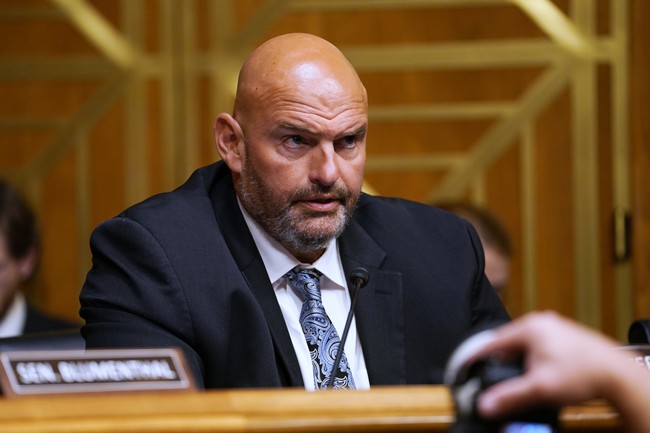
Senate testimony featuring Anthony Fauci turned into a largely defensive spectacle for Democrats, but one senator stood out for admitting partisan bias may have clouded judgment early in the pandemic; this piece recounts that moment, contrasts it with other Democratic reactions, and argues for accountability based on the harms of pandemic-era policy choices.
The Homeland Security Committee hearing on Anthony Fauci mostly played out like a favor-forgiving session from Democrats, with many offering praise or dodging hard questions. Fauci leaned on the Fifth Amendment repeatedly while his defenders mostly circled the wagons. Amid the theatrical defenses, one senator broke from the chorus and acknowledged a painful truth about how partisan labels shaped thinking during a crisis. That acknowledgment deserves attention because it’s rare to hear an honest admission of having been misled by politics rather than evidence.
Senator John Fetterman refused to join the parade of uncritical support, and he didn’t try to turn his remarks into a partisan attack. Instead, he engaged in what amounted to a moment of political soul-searching, admitting that he had dismissed the lab-leak theory early on because it had been labeled a right-wing talking point. He described that misstep as one of his “regrets” during the pandemic and urged a different standard next time. The admission matters because it exposes how easily political labels can derail genuine inquiry into serious matters.
Fetterman’s candor was straightforward and specific, and he addressed the underlying problem head-on. He said that the lab-leak theory “became like a ‘right-wing’ kind of theory,” and that he “thought it seemed to make sense.” Those exact words capture both the sway of partisan framing and the slow, belated reconsideration of the evidence. He urged that in future crises officials and the public should pursue the truth regardless of which side seems to benefit politically.
“And that is, early on, that there was the theory that the virus could’ve emerged from the lab. And early on that became like a ‘right-wing’ kind of theory, and I thought it seemed to make sense,” Fetterman confessed. He went on to warn that partisanship can blind decision-makers to real possibilities and that defending a narrative because it aligns with your tribe is a dangerous habit. If more lawmakers had followed that logic earlier, we might have avoided some of the preventable confusion that shaped public policy.
“That became a very partisan thing, and now it seems now it’s more and more emerging theory that it would have come from the lab,” he continued. “I hope, I think, that the next time our nation’s facing something like this we (do) not become, as I might have been, blinded by the partisan idea that maybe the truth might come from a side that’s different than you are.” Those are clear words calling for humility and truth-seeking over party loyalty. That kind of honesty is rare on either side, but especially striking coming from a senator in the party that largely defended Fauci.
Contrast that with the performance of other Democrats, who treated Fauci as a near-martyr of science and dismissed any probing as partisan theater. Senator Richard Blumenthal delivered nearly theatrical defenses, declaring that recent efforts were part of a campaign to “rewrite this history” and calling the hearing one of “the darkest days in our Senate’s history.” His rhetoric framed accountability as an assault on public health, which is exactly the sort of reflexive defense Fetterman warned against. When elected officials prioritize reputational preservation over rigorous inquiry, the public loses.
https://x.com/townhallcom/status/2082481171099709782
“For the past 18 months, the Trump administration has been engaged in a campaign to rewrite this history and today’s proceeding, I fear, is part of that effort,” Blumenthal lamented. “One of the darkest days in our Senate’s history.” Those quoted lines exemplify how some Democrats refuse to engage with the substance, preferring instead to cast any challenge as political retribution. That posture undermines trust and blocks the kind of bipartisan oversight America needs when policy choices had such serious consequences.
The tangible costs tied to pandemic management are enormous: lives, livelihoods, education, and social stability all paid a price under policies shaped by centralized decision-making and, in some cases, questionable guidance. The fallout demands answers, not sanctimony. A confession like Fetterman’s should open a path toward accountability, not be treated as an inconvenient footnote drowned out by partisanship and performative loyalty.
Accountability does not mean vendetta; it means honest review and consequences where warranted. The hearing highlighted a broader problem: too many in positions of oversight treated a public health disaster like a political wedge instead of a shared crisis requiring blunt, unbiased scrutiny. If lawmakers truly care about preventing repeat mistakes, they should heed Fetterman’s call to seek truth wherever it leads and resist letting partisan frames decide which possibilities get investigated.
Fetterman’s admission was a rare example of political self-awareness, and it reveals how deeply the instinct to defend your side can distort judgment. That moment stands in sharp relief against the prevailing tone from Democrats at the hearing, who largely prioritized reputation management over probing outcomes. When leaders fall short of demanding answers, the public suffers, and the only cure is consistent, bipartisan oversight that puts truth above tribe.


Add comment