
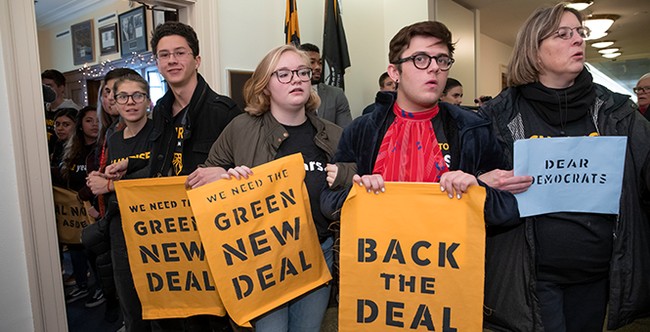
The Green New Deal for Schools debate has returned to the national stage, driven by a progressive push in the House that would steer money and curriculum toward environmental and social justice priorities. The proposed legislation, led by Representative Pramila Jayapal, resurrects ideas from earlier Green New Deal school bills and has set off predictable partisan clashes over purpose, priorities, and parental rights. Republicans are warning that this approach shifts schools away from core academics and toward ideological programming. The controversy highlights deeper tensions in the Democratic Party between traditional liberals and an increasingly influential progressive wing.
Democrats are once again splitting over what public education should prioritize, and the new bill is a clear example. The proposal aims to inject Green New Deal principles into public schools through grants and curriculum shifts, reviving language that links racial, economic, and environmental justice with classroom instruction. Critics see this as a takeover of school priorities, funding, and hiring practices by activists who want to reshape education around ideology. Supporters frame it as investment and equity, but the practical effect would be substantial direction of taxpayer money into nonacademic programs.
The environmental and social justice movement behind the Green New Deal is back at the forefront of Democrats’ agenda, this time targeting America’s education system.
A group of House progressives led by Rep. Pramila Jayapal, D-Wash., introduced a bill this week to “establish a Green New Deal for public schools.”
Details of the bill are not immediately available, and Jayapal’s office did not respond to a Fox News Digital request for more details.
Five years ago, a similar bill from then-Representative Jamaal Bowman showed what this kind of legislation could look like in practice. That version proposed hundreds of billions in grants for clean energy upgrades and curriculum changes that explicitly teach the principles of the Green New Deal. It also spelled out goals like diversifying the workforce and expanding social service programming tied to schools. Those are not traditional educational priorities; they are broad policy prescriptions that belong to elected bodies, not classrooms.
But a similar bill introduced five years ago by controversial ex-Rep. Jamaal Bowman, D-N.Y., entailed investing hundreds of billions of dollars into grants for public schools to make clean energy upgrades while also promoting curriculum changes focused on social and environmental equity.
Grants under that 2021 legislation would have also been aimed at “development of place-based and experiential education and community-driven curricula, with a focus on curricula that affirm and explore the underlying principles of the Green New Deal, including the significance of and the connections between racial, economic, and environmental and climate justice.”
Grant funding would also be marked for “diversifying the workforce” and “expanding social service programming.”
The core objection from the Republican side is plain: schools should teach reading, writing, math, science, and critical thinking that prepares students for work and citizenship. Redirecting funds to ideological programming undermines that mission and risks turning classrooms into political training centers. Parents expect schools to deliver marketable skills and a basic civic education, not to serve as engines for social engineering. When federal dollars and mandates start defining curriculum, local control and parental input get squeezed.
House Republicans have already signaled resistance, with committee leaders ready to block measures that prioritize ideology over academics. Representative Tim Walberg put the case crisply: the best preparation for the next generation is stronger academics, not expanded ideological programs. That argument resonates with many voters who see schools increasingly focused on activism rather than fundamentals. For GOP lawmakers, this fight is as much about defending parents and taxpayers as it is about educational outcomes.
Rep. Tim Walberg, R-Mich., chairman of the House Committee on Education and the Workforce, panned the legislation when reached by Fox News Digital.
“The best way to prepare the next generation is by strengthening core academics, not expanding ideological programs. Parents and taxpayers have every right to expect schools to stay focused on education,” Walberg said.
The political math matters: this Congress has limited time, and the bill faces an uphill climb if Republicans keep control of key committees. Yet the symbolic move by progressives matters because it signals the priorities of the party’s activist base. If Democrats are willing to push federal curriculum standards tied to a specific political agenda, that sets a blueprint for future policy fights. Voters who care about classroom focus will register that shift during campaign season and in local school debates.
At stake is more than money; it is the identity and purpose of public education. Will schools be judged by how well they teach literacy, numeracy, and civic knowledge, or by how effectively they promote a set of political goals? The answer will shape hiring, budgeting, and classroom time for years to come. Republicans argue the right approach is clear: protect core academics, defend parental rights, and keep classrooms focused on preparing students for productive adult life.


Add comment