
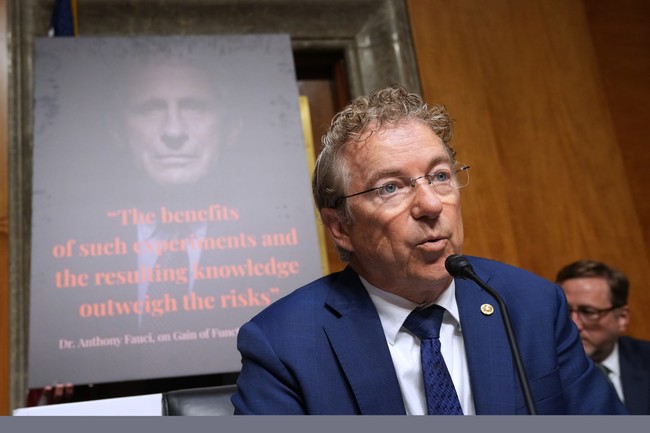
Sen. Rand Paul confronted a fake Anthony Fauci social account after a heated Senate hearing where Fauci invoked the Fifth Amendment 111 times, and Paul announced a committee vote on contempt of Congress next week; the exchange spilled into social media and raised questions about pardons, accountability, and whether Congress will press charges.
The hearing was tense from start to finish, and Rand Paul made it clear he wasn’t buying the witness protection offered by the Fifth Amendment in this case. Dr. Fauci’s repeated refusals to answer left Republican members frustrated, and Paul turned some of that frustration toward a fake account playing at moral superiority. Social media added a performative layer to what was already a combustible political scene, and Paul didn’t let the online post go unanswered.
The troll account posted a short, dramatic line: “Good vs. Evil,” and that was enough to draw a barb from Paul. He replied in kind, steering the public moment back toward the hearing’s substance rather than the spin. Paul used the exchange to underline a larger point: this isn’t merely a debate about words, it’s about whether oversight means anything if witnesses can hide behind silence.
https://x.com/Fauci/status/2082485853901791515
“Oh, so now you have something to say??” Paul wrote, cutting through the theatricality. He then told reporters the Senate Homeland Security and Governmental Affairs Committee will vote on whether to hold Fauci in contempt of Congress. “That’s a vote that will happen in committee next week. It will be in contempt of Congress,” Paul told reporters after the hearing. The remark cemented his intent to move from rhetoric to procedure.
Paul emphasized the legal angle, noting the complication added by presidential pardons and the scope of the Fifth Amendment when immunity from criminal liability may be in play. He suggested that if a pardon removes the risk of prosecution, the usual justification for refusing to testify might evaporate. That argument is meant to force a legal reckoning about whether claiming the Fifth can be used as a blanket shield for officials with potential immunity.
The hearing itself produced striking moments beyond the social-media skirmish, but most of the news value centers on accountability. If Congress votes to hold Fauci in contempt, the issue moves to the Department of Justice for possible prosecution. Paul framed the committee vote as a necessary step in the oversight process; for him it’s about establishing that no one is above scrutiny, regardless of how loudly their defenders declare them virtuous online.
Every person who having been summoned as a witness by the authority of either House of Congress to give testimony or to produce papers upon any matter under inquiry before either House, or any joint committee established by a joint or concurrent resolution of the two Houses of Congress, or any committee of either House of Congress, willfully makes default, or who, having appeared, refuses to answer any question pertinent to the question under inquiry, shall be deemed guilty of a misdemeanor, punishable by a fine of not more than $1,000 nor less than $100 and imprisonment in a common jail for not less than one month nor more than twelve months.
That statute is the backbone of contempt charges and explains why senators talk in terms that sound criminal: contempt can carry jail time in rare instances, and it’s precisely the threat that gives weight to congressional subpoenas. Paul’s comments about pardons attempt to tighten the logic: if criminal exposure is removed, then the Fifth shouldn’t be a safe harbor against testimony that Congress deems relevant.
The sheer hubris to think you are in any way the “good” while being part of a pandemic build up and response that killed millions and ruined the schooling and businesses of so many…
Paul wasn’t content to leave the narrative to opponents or to anonymous accounts praising Fauci; he pushed back on what he characterized as moral preening from people who had a role in pandemic decisions. The political fight now shifts to committee procedure and possibly the courts, where legal questions about pardons and compelled testimony will be tested. For Republicans watching, the hearing was another chance to demand answers and press the case for oversight.
The Senate vote next week will tell whether committee Republicans can convert their anger into a formal finding of contempt, and whether the DOJ decides to pursue charges if that finding is approved. Either path feeds into a larger debate about accountability for public-health leaders and the reach of congressional power when witnesses refuse to answer.
Add comment