
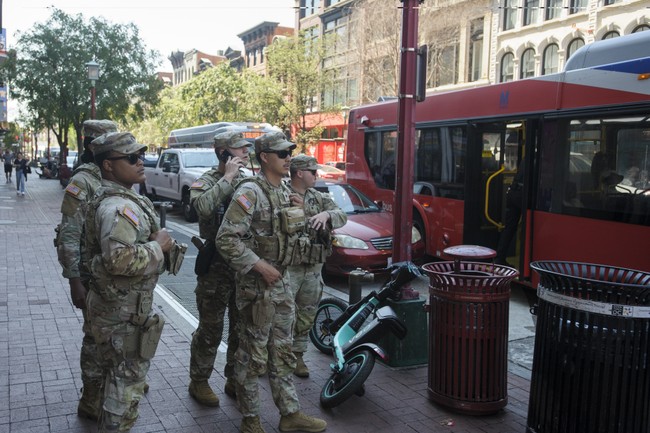
The National Guard is rolling out training for roughly 23,500 troops nationwide to build Quick Reaction Force units for crowd control and de-escalation, aiming to respond to growing unrest in major Democrat-led cities; this article explains the plan, its timeline, the incidents that prompted it, and the legal and political obstacles that remain.
The Department of Defense and the National Guard Bureau have started a broad training surge covering all 50 states, territories, and the District of Columbia, focused on de-escalation and crowd control tactics for 23,500 service members. The move follows an internal memo dated Oct. 8 from Maj. Gen. Ronald Burkett ordering Quick Reaction Force units to be fully operational by Jan. 1, 2026, and builds on an August executive order directing Guard readiness. The administration says the effort is designed to help local authorities confront sustained violent protests that have overwhelmed municipal capacity.
Officials point to a string of clashes in Los Angeles, New York, Chicago, Portland, and Atlanta where nightly confrontations between protesters and federal immigration agents escalated into arson, assaults, and the destruction of federal property. Rioters reportedly used bricks, Molotov cocktails, and other improvised weapons while some incidents required federal intervention to secure government buildings. At least one city needed Marines to protect federal infrastructure after local forces could not contain the unrest.
National crime statistics present a mixed picture: FBI mid-2025 data show an 8.2 percent drop in violent crime and a 17 percent reduction in murders nationwide, but dangerous trends persist in many Democrat-run metropolitan areas. Baltimore, Chicago, St. Louis, and Memphis remain among the highest per-capita homicide cities, a disparity that Republican leaders cite when arguing for stronger federal support in restoring order. The Guard training push is being framed as a practical response to the gap between national improvements and local breakdowns in public safety.
The memo and subsequent government statements make clear the plan responds to specific protest tactics that have evolved since 2017, when violent clashes in Berkeley highlighted law enforcement limits. Since then, recurring episodes like Portland’s extended nights of disorder and the occupation of zones in Seattle have shown how unrest can persist and outlast local capacity. Training aims to equip QRFs to operate where local legal constraints or resource shortfalls leave gaps in public protection.
A Pentagon official declined to speculate on future operations, saying only that planning and coordination are underway. The National Guard has informed partners that it is “working with the Pentagon and all 54 states, territories, and the District of Columbia ‘in planning that will implement the direction’ outlined by Trump in his August 25 executive order.” The administration also said the department is “fully committed to implementing the president’s order to establish specialized civil disturbance units.”
Deployments already authorized include federalized Guard units in Los Angeles and Washington, D.C., and task force assistance in Memphis, where officials report measurable reductions in violent crime after federal support. At the same time, proposals to send federal personnel into Chicago and Portland have run into resistance from state leadership and court obstacles, underscoring the legal and political complexity of using federal forces in local jurisdictions. Governors and courts can complicate rapid federal responses even when public safety is at stake.
Beyond operational hurdles, leaders argue this effort reflects a broader policy choice about restoring law and order in American cities. Republican voices pushing the plan emphasize the need for tools and authorities that can outmatch organized rioting and protect residents and federal property. They cast the QRF initiative as sober preparation rather than political theater, a means to ensure civilians and law enforcement aren’t left exposed when unrest spikes.
Critics warn about militarizing responses to protests and the risk of civil liberties concerns, but proponents counter that targeted, trained Guard units focused on de-escalation and crowd control can reduce harm and stabilize volatile situations. The Guard’s timeline—seeking fully operational QRFs by Jan. 1, 2026—signals a short runway for training and coordination, and it will be tested quickly if disturbances continue to surge. For now, the department and the National Guard are doubling down on readiness while navigating legal limits and political opposition.
Editor’s Note: The Schumer Shutdown is here. Rather than put the American people first, Chuck Schumer and the radical Democrats forced a government shutdown for healthcare for illegals. They own this.
Add comment