
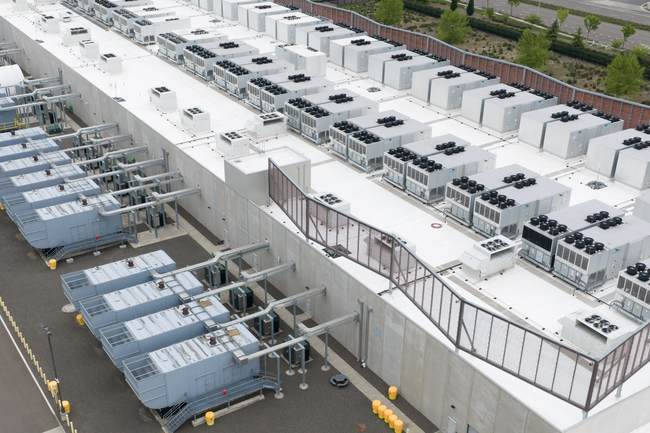
The Department of Energy announced a major redevelopment of the Paducah Gaseous Diffusion Plant that will transform an idle federal site into a large data center campus and new energy infrastructure, promising thousands of construction and permanent jobs along with expanded generation and storage capacity intended to lower regional energy costs.
The announcement centers on repurposing the long-decommissioned Paducah facility in western Kentucky into a high-performance computing and artificial intelligence campus. Officials say private-sector partners will fund and build new natural gas generation, battery storage, and a data center campus that could reshape the local economy. The plan projects significant construction employment and a handful of long-term technical positions tied to the data center and supporting infrastructure.
Secretary Chris Wright unveiled the redevelopment during a public appearance, describing the site’s history and its next chapter. He framed the move as turning a facility once used for wartime enrichment into peaceful commercial uses with large-scale private investment. The Secretary’s remarks emphasized thousands of jobs and tens of billions of dollars flowing into the rural region.
https://x.com/RapidResponse47/status/2082470338995114317
The Secretary said:
So, the big announcement this morning is about the Paducah Gaseous Diffusion Plant, used to enrich uranium right after World War II to build our original arsenal, and then that facility was decommissioned over a decade ago. But we’re announcing today a redevelopment of that site, there will be a lot of new natural gas power plants, a large data center, thousands of jobs, and tens of billions of dollars of investment in rural western Kentucky.
The Department of Energy confirmed a partnership with several major energy firms and local utilities to redevelop portions of the Paducah site into a data center campus with accompanying affordable energy infrastructure. Officials describe the investment as privately funded and one of the largest in the state’s recent history. The scale of the plan includes generation and storage sized to meet campus needs while delivering surplus power into the regional grid.
The U.S. Department of Energy (DOE) today announced a landmark partnership with Brookfield, NextEra Energy, Big Rivers Electric Power Corporation, Jackson Purchase Energy Cooperative, and Paducah Power System to redevelop portions of DOE’s Paducah Site into a data center campus accompanied by new affordable energy infrastructure. The more than $100 billion privately funded investment, one of the largest in Kentucky’s history, is expected to create approximately 8,000 construction jobs and 600 permanent jobs.
Consistent with President Trump’s Ratepayer Protection Pledge, the project’s generation and storage capacity would exceed the campus’s energy needs, allowing excess electricity to be delivered to the regional grid, helping reduce energy costs for American families and businesses. At or near the Paducah campus, NextEra Energy plans to develop 2 gigawatts (GW) of new grid-connected natural gas-fired generation, upgrade existing transmission infrastructure, and deploy up to 2.6 GW of battery energy storage to support a new 1.8 GW artificial intelligence and high-performance computing (HPC) innovation campus.
That blockquote lays out specific capacity goals: multiple gigawatts of gas-fired generation, substantial battery storage, and an AI-focused computing campus of nearly 1.8 GW. The partners expect the excess generation to flow onto the grid, easing regional price pressure according to project backers. Private investment of this scale would also require substantial upgrades to transmission and interconnection points around the Paducah site.
Nuclear would be preferable, but natural gas is better than the various “renewable” schemes pushed by the left. The pragmatic argument here is that reliable, controllable generation paired with large-scale batteries offers predictable capacity for both the campus and the broader grid. That approach avoids intermittent supply problems while providing dispatchable power when demand from data centers spikes.
Economically, the project is pitched as a win for rural Kentucky: a shuttered federal site becomes a hub for high-paying tech jobs, construction work, and utility investment. Local officials and developers emphasize supply-chain activity and secondary business growth that typically follow major infrastructure builds. There is also an expectation that added regional capacity will bring downward pressure on electricity prices, benefiting residents and businesses beyond the immediate area.
Data centers are infrastructure-heavy and demand a steady, cheap power supply, so developers often pair them with new generation and storage. As artificial intelligence and high-performance computing needs expand, so does demand for concentrated server capacity with resilient power. The Paducah campus proposal reflects that trend and the private-sector willingness to invest when policy and grid conditions line up.
The conversion of a Cold War-era site to civilian economic use carries symbolic weight as well as practical benefits. Where the facility once contributed to national defense, it will now host commercial computing and expanded grid resources. That transition illustrates how federal assets can be leveraged in partnership with private industry to generate jobs, tax revenue, and improved utility services in regions that have seen industrial decline.

Add comment