
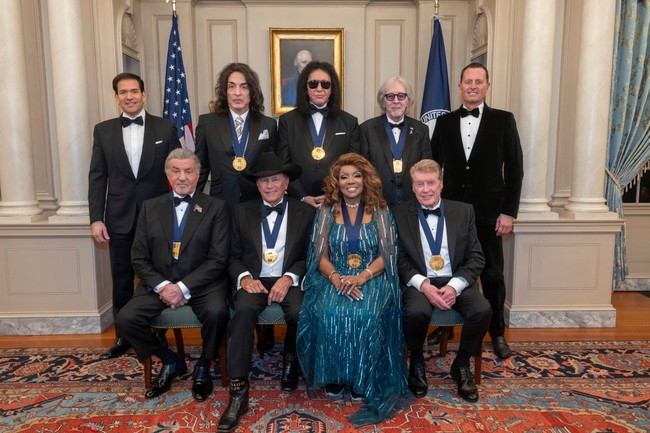
Gene Simmons, the outspoken KISS frontman and one of the 2025 Kennedy Center honorees, urged people in a recent interview to stop obsessing over their neighbors’ politics and to let private choices remain private. He argued that political belief is a personal matter and that the relentless fighting on social media does more harm than good. Simmons also described casual, human conversations with public figures that had nothing to do with politics, underscoring his point that life includes more than partisan squabbles. What follows captures his message, reaction, and the broader cultural scene he was addressing.
Gene Simmons, known for his blunt style, told an interviewer that people should mind their own business when it comes to whom others support. He said that the question of who someone votes for or supports is a matter of conscience, not public policing. That stance is a reminder that not everything needs to be turned into a political litmus test. For Simmons, there’s a simple boundary between civic engagement and intrusive judgment.
It’s nobody’s business who you support. Nowadays, people engage in, ‘So are you pro or,’ and my first question is, ‘Who the f*** are you? Who are you?’ Since when does who I support or not support is the business of anyone except my conscience?
The rocker’s line about privacy and conscience got straight to the point, and it landed for many who are worn out by constant online conflict. Simmons has a habit of cutting through noise, and this time he suggested that folks stop turning every social interaction into a political inquisition. That advice resonates for anyone tired of endless commentary, outrage, and tribal posturing that dominates feeds and dinner tables.
He didn’t ignore politics entirely, but he emphasized perspective and common courtesy over performative outrage. Simmons pointed out that maintaining a sense of humor and perspective helps keep relationships intact. That practical, low-drama approach clashes with how many people behave when politics becomes identity. It’s a call for restraint in an age of amplification and outrage economics.
Social media, where so much of this fault line plays out, amplifies small slights into public crusades at a speed that would boggle earlier generations. A scrolling session often reveals name-calling, trolling, and fury that have turned digital public squares into toxic arenas. Simmons’ message implicitly challenges that environment: stop weaponizing every disagreement and let private convictions remain private. The consequences of not doing so are social fragmentation and exhausted civility.
When asked about the MAGA wing of the Republican Party, he offered another blunt, human-focused remark and urged people to relax a bit. Rather than launching into policy critiques, Simmons stressed humor and tolerance as basic social tools. His point was not to avoid debate entirely but to refuse the idea that every acquaintance must be interrogated about their political life. People are more than one-dimensional political profiles.
Some of it makes sense and some not. But literally, have a sense of humor. Take a pill, shut up, and stop worrying what your next-door neighbor believes or doesn’t believe. It’s their America too.
That phrase — “It’s their America too” — sums up his plea for mutual respect across differences. The sentiment is blunt, yes, but it’s also a reminder that shared civic space requires tolerance if it’s going to function. When you strip away the performative outrage, everyday life benefits: neighbors can share sidewalks, conversations, and holidays without every interaction turning into a cultural trial.
Simmons also described meeting public figures and having straightforward, personal conversations that weren’t political at all. He recalled time spent talking about family and ordinary concerns with people he’d known long before they were political actors. His anecdote about the Kennedy Center honorees highlights a normal human rhythm: people talk about kids, families, and life details rather than policies. It’s a useful example of how human connection can exist independent of political labels.
Had some face time with Senator Tillis and Blackburn and met Mr. Schiff and so on. But the telling moment was after we all got our Kennedy Center awards, I had some face time alone with the president,” he said.
And I actually met the president and on and off for years and years, decades before he entered politics. And the conversation was what human beings do. How‘s the family? How are the kids? And, you know, all that stuff. It‘s not always about politics.
That anecdote underlines a point many forget: politics is not the only currency of human interaction. A bit of ordinary conversation is often what keeps relationships healthy. If more people treated neighbors and acquaintances as full people rather than walking policy positions, the public atmosphere would be less corrosive.
There’s no simple cure for the social media-fueled rage cycle, but Simmons’ prescription is modest: stop policing private beliefs, keep humor close at hand, and remember that people share common ground beyond ideology. Practically speaking, that’s about choosing restraint over immediate reaction when faced with disagreement. It’s a low-energy, high-return way to lower the temperature in daily life and leave room for real human interaction.


Add comment