
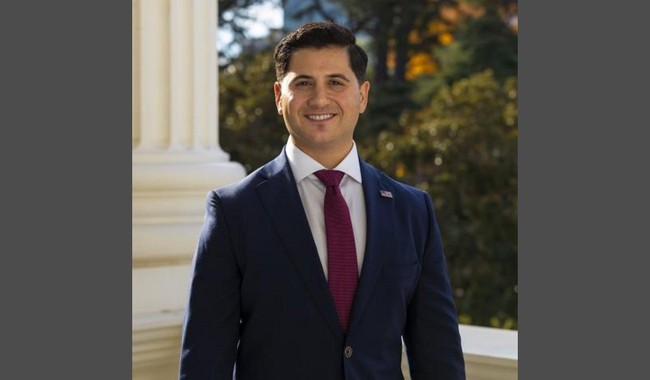
I’ll explain what happened with Bill Essayli’s appointment, what the judge ruled, how that affects prosecutions, how similar cases have been handled, and why Senate procedures like the blue slip matter to resolving the stalemate.
Bill Essayli was installed as acting U.S. attorney for the Central District of California in April after serving in the California State Assembly. That district is the nation’s largest by population, covering seven Los Angeles area counties, and Essayli quickly became associated with strict enforcement policies and backing for immigration enforcement. His role was always temporary unless the Senate confirmed him, which is the legal anchor for the job beyond the initial acting window. The administration treated him as the office’s leader while pushing his nomination forward.
On Tuesday evening a federal judge found that Essayli’s appointment had exceeded the permissible acting period and therefore was unlawful without Senate confirmation. The court’s order stated, “is not lawfully serving as acting United States Attorney” and “cannot continue to perform any role” that job entails. That language comes directly from the judicial opinion and frames the central legal problem: an acting appointment ran out of statutory authorization.
Practically speaking, the ruling does not collapse ongoing prosecutions brought by the office. The judge explicitly left intact the criminal cases that had been filed, noting defendants would not see their charges dismissed on the basis of Essayli’s status. The court allowed him to continue serving as the top deputy, the first assistant, which preserves continuity in the office’s day-to-day work while the legal question over the title is resolved. So prosecutions continue, even if leadership titles are in dispute.
There are strong political and procedural angles at play beyond the courtroom text. In New Jersey a similar dispute surfaced around Alina Habba, another acting U.S. attorney tied to the previous administration, and a judge there also found problems with her appointment. Team Trump pursued a workaround by adjusting titles and designations so the individual could remain in a leadership posture while the legal fight continued. That tactical shuffle highlights how administrations will seek practical fixes when Senate confirmation stalls.
The roadblock is often the Senate confirmation process and long-standing practices like the blue slip, where a single senator can withhold consent for nominees tied to their state. In California, opposition from home-state senators has been a primary barrier to a straightforward confirmation. Until senators drop the ability to block nominees unilaterally, acting appointments will keep being used and then litigated, producing legal uncertainty and political theater.
This case also shows a disconnect between political priorities and statutory limits. The White House can and will place people in acting roles to execute policy, but the law constrains how long that status can last without Senate approval. Courts are now policing that boundary, and the result is a hybrid reality: officials keep working, cases proceed, but their authority is legally fragile. That instability matters more in headline cases or politically charged prosecutions than in routine matters.
Republicans arguing for confirmations point out that the best remedy is to let the Senate vote. If the Senate affirms an appointee, the legal questions evaporate and the office gains unambiguously lawful leadership. If the Senate rejects a nominee, then voters and leaders can see who stands behind which priorities. Either way, letting the confirmation process run resolves the limbo that fuels these lawsuits and the resulting uncertainty for prosecutors and defendants alike.
Until the Senate acts, expect both political maneuvering and clever administrative fixes from the Justice Department. Departments will keep designating officers as first assistants or special attorneys to protect pending work, and litigants will continue to test the boundaries in court. The pattern is predictable: appointments, lawsuits, interim fixes, and then renewed pressure to confirm or replace the nominee.
Meanwhile, the judge’s ruling remains a sharp reminder that legal procedures have teeth. The phrasing from the opinion — “is not lawfully serving as acting United States Attorney” and “cannot continue to perform any role” — will be cited in similar challenges and in appeals. Lawyers and senators on both sides will study the reasoning closely as they prepare their next moves in a contest that mixes law, policy, and plain political power.
What happens next depends on two things: whether the administration can secure a Senate vote and whether courts uphold or narrow the judge’s interpretation on appeal. Either path will shape how the executive branch staffs critical law enforcement roles going forward and how much influence a single senator can exert over appointments.
The ruling creates leadership uncertainty in the nation’s largest judicial district, the Central District of California, which serves seven counties in the Los Angeles area. The order was issued by Judge J. Michael Seabright of the Federal District Court in Hawaii, who ruled that the Trump appointee, Bill Essayli, “is not lawfully serving as acting United States Attorney” and “cannot continue to perform any role” that job entails.
Essayli has responded by emphasizing continuity and the importance of keeping prosecutions moving despite the ruling. He and his team are treating the decision as a procedural hurdle, not a substantive rebuke of the office’s work. That posture matters politically because it frames the story as a legal technicality rather than a substantive challenge to the cases the office is handling. For supporters, that distinction keeps focus on results rather than titles.


Add comment