
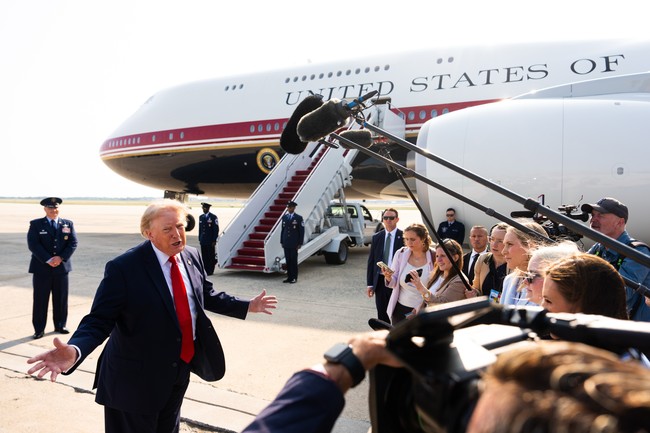
The Department of Justice has subpoenaed New York Times reporters in a leak probe tied to reporting about President Trump’s decision to fly on an older Air Force One during a NATO trip and related national security concerns, including an alleged Iranian plot. The subpoenas seek testimony before a federal grand jury and follow the Times’ refusal to delay publication or reveal sources after the FBI flagged potential security issues. The dispute pits press freedom arguments against legal steps to identify leaks of sensitive information and highlights broader questions about media responsibility and national security.
While traveling to the NATO summit in Turkey, President Trump switched planes, leaving on the longstanding Air Force One rather than the brand-new Qatari-donated Boeing 747-8 that had been sent ahead to the United Kingdom. Reporters on the aircraft asked why shades had to be lowered on the older plane, and Mr. Trump replied, “Because of the ‘sleazebags’ we have to deal with.” The Times later published reporting that the new plane lacked some advanced security features, a claim sourced to anonymous officials discussing sensitive matters.
On Thursday, The Times reported that the new Air Force One, a Qatari-donated Boeing 747-8, lacked some of the advanced security features of the older aircraft, including antimissile capabilities. Both articles cited sources who spoke on the condition of anonymity to discuss sensitive security issues.
https://x.com/EricLDaugh/status/2075902715218075686
Federal authorities say officials contacted the newspaper before publication, urging caution and requesting that the piece be held back for security reasons. The Times declined to delay the story and refused to turn over source information when asked. As a result, several reporters were issued subpoenas seeking testimony before a grand jury scheduled for July 15, naming journalists who worked on the article.
The Times journalists who received subpoenas included Julian E. Barnes, Eric Lipton, Tyler Pager and Eric Schmitt, who reported on Wednesday that Mr. Trump had departed Turkey on the old Air Force One as a security precaution at the urging of the Secret Service.
That refusal to cooperate drew sharp criticism from those who prioritize protecting classified details and the people who handle them. The public safety angle is not abstract here; the reporting intersected with reporting about a “very specific plot” allegedly tied to Iran that intelligence partners warned about. Given those stakes, officials argue it was reasonable to press the paper to pause and to ask for source disclosure to ensure sensitive operational details were not being exposed.
The Times pushed back, framing the subpoenas as a threat to press freedom and saying such legal actions “shock the conscience.” The Justice Department, however, countered with a clear distinction: reporters aren’t the targets, leakers are. A Justice Department spokeswoman stressed that while the press plays an essential role, the department must enforce laws protecting classified information and hold accountable those entrusted with secrets.
In a statement on Saturday, a Justice Department spokeswoman said that “reporters are not the targets, those leaking classified information are.”
“We value and appreciate the important role that the press plays in this country, but D.O.J. also plays an important role to make sure that the people entrusted with our nation’s secrets do what they’re supposed to do with that information,” said the spokeswoman, Emily Covington. She added, “We recognize there may always be natural tension there, but we are not going to ignore the law.”
This clash revives familiar arguments about where to draw the line between vigorous reporting and national security. Conservatives and many national security officials argue leaks that reveal vulnerabilities or operational detail can put lives at risk and must be treated as criminal acts when they cross certain lines. The DOJ’s approach here is framed as a narrow, enforceable step: identify who violated rules and proceed against those responsible for unauthorized disclosures.
Critics of the subpoenas insist that forcing reporters to testify undermines confidentiality and chills investigative journalism, while defenders of the DOJ move point to the unique danger posed by disclosures about presidential travel and physical protections. The reality is messy: the balance between protecting sources and protecting national security can tilt differently depending on the nature of the leak. When intelligence partners warn of assassination plots or when specific defensive capabilities are disclosed, the calculus shifts toward containment and accountability.
The episode also drew partisan commentary about double standards in enforcement and media treatment across administrations. Some notes of history surfaced, asking why similar measures didn’t draw equal outrage during previous investigations into other presidents. That argument is meant to frame the subpoenas not as a press crackdown but as a routine legal follow-up to an apparent leak of classified or sensitive operational information.
As the grand jury date approaches, attention will remain fixed on whether journalists will be compelled to testify and whether the Justice Department will pursue leakers aggressively. For those who prioritize secure handling of state secrets, this is a test of whether legal tools can deter careless disclosures that risk lives. For defenders of press confidentiality, it’s a test of how far the government can go before it chills reporting on matters of public interest.

Add comment