
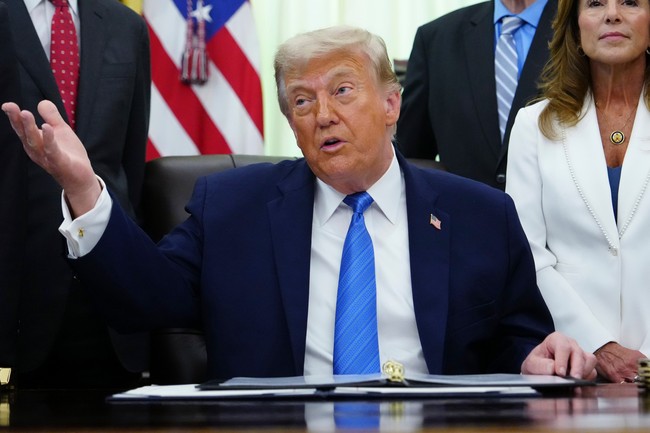
President Trump made clear in an Oval Office exchange that tougher measures are coming after Iran allegedly downed an American Apache helicopter; he warned of hard attacks, credited U.S. forces and technology for rescuing pilots, and said American oil shipments slipped through the Strait of Hormuz under cover of night to blunt diesel and gas prices at home.
Trump spoke bluntly about Iran’s behavior, framing the incident as a provocation that requires a decisive response rather than more diplomatic half-measures. He tied the action to a wider pattern of Tehran playing for time, and he indicated the administration will not repeat past mistakes from previous administrations. The tone was unapologetic and oriented toward strength, aimed at deterring further aggression. That posture resonates with a Republican view that deterrence, not appeasement, keeps Americans safe.
The president also highlighted an unusual rescue operation tied to the downed helicopter, noting that both pilots were recovered by an autonomous sea drone in the first successful rescue of that kind. This development underscores how new technologies are changing battlefield dynamics and rescue options. The use of an AI-enabled sea drone reflects an investment in military innovation that supporters say expands options while reducing risk to personnel. It also serves as a tangible illustration of how deterrence can be backed up by capability.
https://x.com/townhallcom/status/2064738820227002428
When asked by reporters what he meant by saying Iran “will now ‘have to pay the price,'” the president did not mince words: he warned, “We’re gonna be attacking them, and attacking them very hard.” The exchange included the exact back-and-forth: “Reporter: ‘You’re resuming bombing?’ Trump: ‘Yeah. Well, we are. Based on the helicopter, I guess we have the right to do that.'” That directness signals an administration prepared to match words with action when American lives and assets are threatened. For many conservatives, that clarity is a corrective after years of muddled messaging that invited risk.
TRUMP ON IRAN 👀
Reporter: “You said [Iran] will now ‘have to pay the price.’ What did you mean by that, specifically?”
Trump: “We’re gonna be attacking them, and attacking them very hard.”
Reporter: “You’re resuming bombing?”
Trump: “Yeah. Well, we are. Based on the helicopter, I guess we have the right to do that.”
Beyond immediate military response, Trump framed negotiations as contingent on real concessions, not paper promises. “I’ve been working with Iran for a number of months and they should sign that deal,” he said, adding that Washington wants a “deal that’s meaningful” rather than a repeat of past bad accords. The administration’s skepticism of the JCPOA-era posture remains firm, with a demand that any agreement truly constrains Tehran’s ability to threaten the region. That insistence on leverage reflects a Republican preference for verification and teeth in any treaty.
Trump accused Tehran of stalling talks because the regime has been conditioned to exploit weak or indecisive U.S. presidents. He suggested Iran continued to “play us for suckers” and praised a tougher track record that holds adversaries accountable. That critique is part political and part strategic: it asserts that deterrence restores negotiating power and weak deals only invite further bad behavior. This assessment fuels pressure for both military preparedness and stricter diplomatic benchmarks.
.@POTUS on Iran: “We hit them hard yesterday and we’re going to hit them again hard today… And we’ll see what happens with the deal. We were really close to a deal — but they keep tapping us along. They keep playing us for suckers because you know what? They dealt with some very stupid Presidents.”
On the economic front, Trump revealed that U.S. forces had moved significant amounts of oil through the Strait of Hormuz under cover of night to blunt price spikes that would otherwise have hit American consumers. He said the Strait operation involved “millions of dollars of barrels” and argued that this helped keep oil near $85 to $90 a barrel instead of surging far higher. The claim emphasizes a pragmatic link between military operations and economic stability, a theme Republicans often stress when arguing for robust national security budgets. Controlling energy flow in a crisis is a strategic tool as much as a financial one.
“They don’t have any radar,” the president said, “because we blasted the crap out of it.” That blunt assessment reflects a willingness to use force to degrade an adversary’s capability when necessary. For supporters, striking such systems reduces the risk of future attacks and restores leverage at the bargaining table. It also signals to regional partners and adversaries that U.S. capabilities remain formidable and will be used to protect American interests.
The administration’s stance makes clear it prefers a mix of credible military pressure and hard-nosed diplomacy rather than reliance on symbolic agreements. That approach is designed to force Tehran into meaningful concessions rather than let it exploit pauses in pressure. Whether the strategy delivers a lasting settlement or escalates tensions will be watched closely by policymakers and citizens alike.
Reporting on developments like the helicopter shoot-down, the sea drone rescue, and the covert oil movements illustrates how modern conflict involves both kinetic action and innovation. The narrative presented by the president underscores a Republican confidence in deterrence, technological advantage, and energy security as central to protecting American lives and the economy. The situation remains fluid and the administration signals it will act to prevent further Iranian provocations.

Add comment