
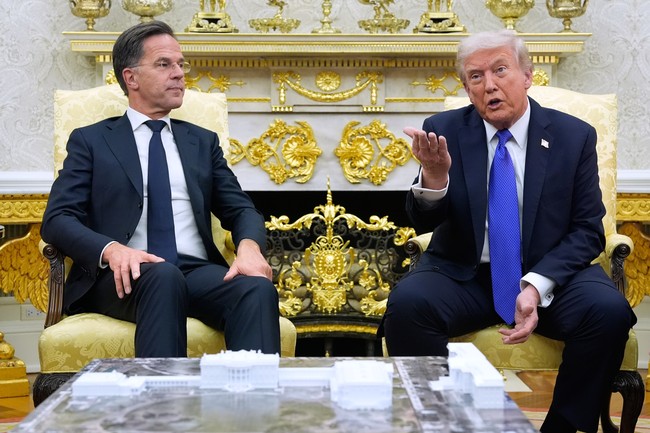
President Trump hosted NATO Secretary General Mark Rutte at the White House the night before the Great American State Fair, pressing allies on Iran, celebrating clearer burden-sharing on defense, and exchanging blunt assessments about recent British political shifts.
In the Oval Office, President Trump made his frustration plain about several NATO members that he says failed to back the United States on confronting Iran. He called out specific countries for not pulling their weight on an issue he views as existential: Iran’s nuclear ambitions and regional destabilization. That bluntness set the tone for a meeting framed around American leadership and allied responsibilities. The president’s message was unmistakable: security must be enforced, and allies must step up.
Mark Rutte responded by underscoring the severity of the Iran threat to countries in the region and the world. He stressed how close Iran had come to obtaining a nuclear capability and framed that risk as intolerable. His remarks reinforced the administration’s argument that decisive action was necessary to neutralize the nuclear pathway and curb Tehran’s export of terror. That testimony from a NATO leader bolstered the claim that U.S. pressure yielded concrete gains.
https://x.com/RapidResponse47/status/2069881306792546696
NATO Secretary General Mark Rutte praises President Trump for his work on Iran 🙌
“I really want to make clear how important it is what you are doing on Iran.
This is, first of all, about the nuclear capability Iran was getting its hands on. It would’ve been a threat to the region. It would’ve been a threat to the whole world. This is country which is exporting chaos, it is exporting terrorism, and they were very near to getting their hands on nuclear capability.”
The White House meeting highlighted consensus on one key point: Iran’s behavior was unacceptable and needed confronting. Rutte made a public show of support for the president’s strategy, and he connected the dots between U.S. pressure and diminished Iranian nuclear prospects. For Republicans, that kind of direct acknowledgment from an ally validates a posture of strength and diplomatic leverage. It shifts the narrative away from indecision toward effective deterrence.
Rutte also walked the press through charts that included what he described as the “Trump Trillion” — a label meant to capture the impact of higher allied defense spending during recent U.S. administrations. He credited the president’s influence for getting NATO partners to invest more in their militaries and meet agreed targets. That fiscal pressure has real strategic effects: better-equipped allies make collective defense both more credible and less one-sided. The spending shift is presented as a tangible result of firm U.S. leadership at the alliance table.
The picture painted in the Oval was of an America that pushes allies and gets results. Officials framed increased NATO defense contributions as not just numbers on a spreadsheet but as improved deterrence across Europe and the Middle East. That outcome fits a Republican view that leadership — coupled with a readiness to demand fairness — forces allies to act responsibly. It also serves as a counterargument to critics who say firm diplomacy lacks consequences.
During questions, British politics came up, and the conversation turned to the incoming prime minister, Andy Burnham, and the outgoing Keir Starmer. President Trump said he “didn’t know anything” about how U.K. leadership changes would alter relations but added a candid take on Burnham’s ideology. He called Burnham “extremely liberal—extremely,” and predicted that advice on energy policy might not find traction with a new British leader leaning left.
Trump shared a specific recollection about urging Starmer to open more of the North Sea to oil production after being pressed by industry executives. He said he tried to make the case for American-style energy opportunities, but he did not see movement on that front. That anecdote underscored a recurring Republican theme: energy independence and production are central to both economic strength and foreign policy leverage. It also served as a reminder that ideological differences among allied leaders can affect cooperation on strategic resources.
The meeting was encapsulated on camera and in public statements as both a policy and political win for the administration. Allies acknowledged the Iran threat, NATO partners pointed to increased spending, and the president’s blunt diplomacy was on full display. For supporters, the White House gathering is evidence that a straightforward, results-oriented approach to international threats and alliance management produces measurable benefits. The exchange also left little doubt that the administration intends to keep pressing allies until commitments match the risks.



Add comment