
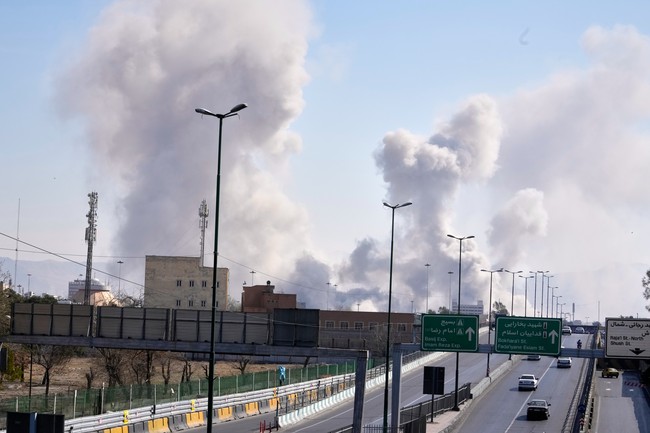
President Trump posted a short, dramatic clip showing Iran’s tallest bridge collapsing after an apparent strike, and he used the moment to push for a quick deal while warning of harsher steps if talks fail.
The video, roughly 10 seconds long, shows heavy smoke rising from the structure and a large section of the road deck collapsing in a cloud of dust and debris. The clip was shared on Truth Social and framed as proof that decisive action is happening on the ground. Supporters see it as confirmation the administration is following through on threats and weakening Iranian military logistics.
“The biggest bridge in Iran comes tumbling down, never to be used again,” Trump wrote. “Much more to follow!” He followed that with another blunt taunt: “It is time for Iran to make a deal before it is too late, and there is nothing left of what still could become a great country!” The posts were terse, direct, and meant to prod Tehran toward negotiation.
The strike appears to have affected the B1 Bridge, a structure that stood 136 meters high and served as a vital highway link on the northern Karaj bypass. Its fall interrupts a key route between Tehran and Karaj and constrains movement toward the northern provinces. Militarily, officials say it was used to move missiles and materiel, making it a legitimate target in the view of those overseeing the campaign.
In a primetime address a day earlier, the President described the campaign as Operation Epic Fury and said it has entered its fifth week. He credited coordinated strikes for degrading Iran’s navy, air force, missile systems, nuclear facilities, and command nodes connected to the Islamic Revolutionary Guard Corps. The message was clear: this is an attritional effort meant to strip Iran’s ability to project power and to pressure its leadership into a settlement.
“Very shortly, we are going to hit them extremely hard over the next two to three weeks,” the President said. “We’re going to bring them back to the Stone Age where they belong.” He added, “If, during this period of time, no deal is made… we are going to hit each and every one of their electric generating plants very hard and probably simultaneously.” Those words were unapologetically stark and meant to set a clear timeline.
The bridge’s collapse feeds into a broader tactical picture: targeting nodes that enable missile movement and logistic flexibility. Removing those choke points complicates Iran’s resupply options and forces commanders to reroute along less efficient paths. From a Republican perspective, crippling infrastructure tied to military use is pragmatic: it reduces the enemy’s capacity while keeping a pressure point for diplomacy.
Officials and commentators on the right argue that decisive action now creates leverage for a comprehensive deal that limits Iran’s military reach and nuclear ambitions. They contend that past administrations’ restraint only invited further aggression, and that striking symbolic and functional targets demonstrates resolve. The strike on the bridge is being framed as a signal that the U.S. will not tolerate unchecked militarization in the region.
The campaign has raised questions about escalation and civilian harm, but proponents say the focus has been on infrastructure clearly tied to military logistics rather than indiscriminate destruction. The administration insists it is calibrating strikes to minimize unintended casualties while maximizing strategic impact. That balance is essential for maintaining domestic and international support for continued pressure.
In public remarks and social posts, the President combined warnings with an off-ramp: negotiate now or face intensified attacks that would degrade Iran’s modern military and critical infrastructure. That approach is presented as straightforward leverage: create costs that encourage a meaningful settlement. For supporters, it is a return to a posture that prioritizes American security and regional stability through strength.
The response in Tehran and among global actors remains to be seen, but the collapse of the B1 Bridge will be read as both a physical setback for Iranian logistics and a symbolic victory for a strategy that pairs military pressure with a diplomatic deadline. The next weeks are likely to show whether the combination of strikes and public threats produces the intended political outcome or drives a different escalation dynamic.

Add comment