
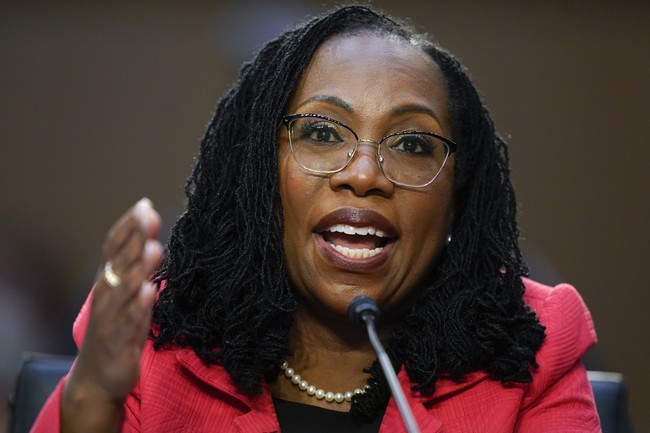
The Supreme Court on Monday issued short procedural orders in two Voting Rights Act cases from Mississippi and North Dakota, sending both back to lower courts for reconsideration in light of the Court’s recent decision in Louisiana v. Callais, vacating prior rulings without deciding the merits, and drawing a lone dissent from Justice Ketanji Brown Jackson who warned the remands could undercut long-standing enforcement of Section 2.
SCOTUS Just Hit Reset on Two Voting Rights Cases – and KBJ Is Not Happy
The Court’s orders did not resolve the core disputes; instead they granted review, vacated the lower-court decisions, and remanded for further consideration under the new framework the Court announced in Louisiana v. Callais. That move leaves the facts and claims intact but forces lower courts to analyze them against a narrower reading of Section 2. For conservatives, the outcome reinforces the Court’s effort to limit racial considerations that cross constitutional lines.
Justice Ketanji Brown Jackson dissented from both remands, signaling deep concern that any retrial under Callais could weaken private enforcement of the Voting Rights Act. In her view, the North Dakota case in particular raises a distinct procedural question that Callais did not address. Her dissent contains the following language exactly as written:
This case presents onlythe question of Section 2’s private enforceability, which our decision in Louisiana v. Callais, 608 U. S. ___ (2026), did not address. Thus I see no basis for vacating the lower court’s judgment.
Both cases implicate Section 2, which bars voting practices and maps that dilute minority voting strength, but they are procedurally different. The Mississippi matter concerns state legislative maps and whether Black voters were unlawfully packed or cracked in state districts. A three-judge panel in the Southern District of Mississippi found Section 2 violations and ordered new state legislative lines.
The North Dakota case involves tribal plaintiffs who claimed state maps diluted Native American voting power, but the Eighth Circuit reached the threshold question of enforceability. That court held that Section 2 does not create a private right of action, meaning only the Department of Justice could bring suit under the statute and private plaintiffs cannot use 42 U.S.C. § 1983 to proceed. If that view stands, it would sharply curtail private litigation and concentrate enforcement power in the federal executive branch.
Callais changed the legal landscape by emphasizing constitutional limits on race-conscious remedies, cautioning that Section 2 cannot be a backdoor for further racial gerrymandering. The Supreme Court’s remands ordered lower courts to reassess their rulings in light of that narrower scope. That puts trial judges back at work reexamining evidence, maps, and statutory arguments with an eye toward avoiding constitutionally problematic racial balancing.
Jackson’s identical wording in both dissents raises eyebrows because the Mississippi panel reached the merits and allowed private claims to proceed before addressing the substantive violation. Her objection suggests she thinks the remands were unnecessary in at least one case, while her colleagues apparently saw prudence in a Callais-based reassessment. The split highlights a Court that is narrowing remedies but not moving in lockstep on process.
From a Republican standpoint, the Court’s intervention is a welcome confirmation that race cannot be the dominant factor in drawing districts and that federal courts must respect constitutional boundaries. Limiting private enforcement of Section 2 would also reassert separation of powers by preserving DOJ primacy in certain civil-rights enforcement decisions. That outcome would reduce opportunistic litigation that treats race as the first resort rather than the last.
But the practical effect remains uncertain. Lower courts could respond in different ways: some might follow the Eighth Circuit’s lead and bar private Section 2 suits, while others could find ways to preserve private claims under the statute. Those divergent paths would produce conflicting circuit splits and likely draw the Supreme Court back for definitive rulings down the line.
Jackson fears the remands will lead to a stealth rollback of enforcement by enabling lower courts to construe Callais broadly, even on issues Callais did not squarely decide. Her lone dissent is less a prediction than a warning: remands we call routine can reshape doctrine if judges use them to read Callais expansively. That is precisely the sort of judicial ripple conservatives expect when the Court tightens constitutional controls on race-based policymaking.
For now, both matters return to the lower courts to reevaluate under the Callais framework, and the broader legal fight over how Section 2 works in practice continues. The split among the Justices is a reminder that even when the Court narrows a doctrine, disagreements about scope and procedure remain, and those disagreements will determine how voting cases play out across the country.


Add comment