
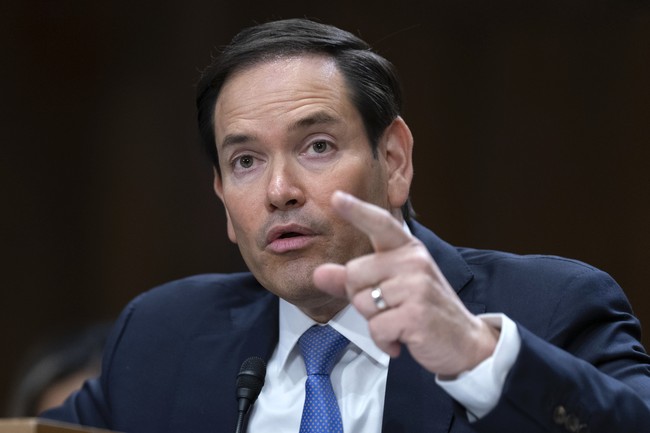
I’ll summarize Rubio’s Capitol Hill appearance, outline his points on American strength and Iran, note the sharp exchange with Democrats, highlight the economic pressure on Tehran, and include the president’s response — all while keeping the original quotes and embed markers intact.
Senator Marco Rubio appeared before the Senate Foreign Relations Committee to defend the State Department’s 2027 budget and to press a simple point: American power only counts if we use it. He argued the United States still holds unmatched economic and military advantages, but warned that strength alone won’t protect our interests unless it’s actively applied. Rubio made it clear he favors a posture that pairs diplomatic work with real leverage, not wishful thinking.
Rubio also flagged a strategic weakness: we rely too heavily on foreign suppliers for critical items, from ships to pharmaceuticals. That dependency, he said, undermines our ability to act swiftly and independently when global crises arise. Restoring production and supply chains at home is a national security priority in his view.
https://x.com/StateDept/status/2061816608163561498
Turning to Iran, Rubio painted a bleak picture for Tehran’s military and economic position while stressing that nuclear and shipping concerns remain central to negotiations. He described Iranian naval capabilities as essentially neutralized and insisted the regime’s nuclear ambitions and the Strait of Hormuz disputes are nonnegotiable sticking points. In his assessment, those issues shape any credible agreement.
“They did not, at which point the president decided, and I think appropriately, we can’t have a world in which Iran — only Iranian ships get through the Strait,” Rubio said. “And so, if they’re gonna shut down the Strait for everybody, we’re gonna shut down the Strait for them, and we have done that through a very effective blockade.”
Rubio argued that Iran’s refusal to settle these matters is costing it sizable revenue and that the economic pain is intentional pressure from the U.S. and its partners. He singled out Democrat Cory Booker in a direct rebuttal, correcting what he called misinformation about who is under pressure. Rubio’s tone in the hearing reflected frustration with Democrats who, in his view, were pushing a narrative disconnected from what he sees as on-the-ground facts.
He went further, warning that Iran’s internal decision-making is slow and fractured, which complicates negotiations and prolongs uncertainty. That fragmentation, Rubio said, means responses often take days and negotiating windows can close unexpectedly. For him, a patient but firm strategy that exploits those fractures is the most effective way to compel Iranian concessions.
The committee hearing grew contentious when a Democratic senator accused Rubio of failing to engage in talks; he pushed back forcefully. Rubio rejected the premise, saying the United States has been active and that allegations to the contrary are detached from reality. His response underscored the partisan divide over how to project strength and when to flaunt patience versus pressure.
While Rubio defended the administration’s approach, the president weighed in publicly, dismissing reports that contact with Tehran had ceased. He posted a forceful message warning Iran that it must make a deal or face continued consequences, portraying the administration as both confident and resolute. That public posture, Rubio suggested, complements private diplomatic efforts by placing clear red lines before the Tehran leadership.
Rubio emphasized that the combination of military readiness, economic pressure, and diplomatic clarity has put Iran on the defensive in ways seen over the past months. He credited sustained enforcement actions for degrading Iran’s naval reach and weakening parts of its defense industrial base. According to Rubio, those results matter because they change Tehran’s calculus about what it can realistically demand at the negotiating table.
.@SecRubio shuts down @SenBooker: “No one’s ‘begging’ for anything here. The Iranians might be begging — because their economy is losing hundreds of millions of dollars a day.”
“I don’t know where you’re getting this perception that Iran is stronger. Iran has no navy left. They’ve lost a substantial percentage of their defense industrial base… and their economy is far worse today—and I mean far worse today—than it was 6-9 months ago.”
The hearing also spotlighted broader themes Rubio returned to repeatedly: rebuild American manufacturing, maintain military superiority, and use sanctions and blockades to shape outcomes. He framed these measures as practical tools that protect citizens and preserve international order rather than unchecked aggression. For Rubio, clarity about objectives and the will to follow through are what separate credible foreign policy from empty rhetoric.
As the committee wrapped, the exchanges left no doubt about where Rubio stands: he favors a muscular approach that couples negotiation with tangible pressure. In his view, that combination is what keeps adversaries in check and preserves the peace through strength he says is already producing results. The debate on Capitol Hill will continue, but Rubio’s message was blunt and consistent throughout the session.


Add comment