
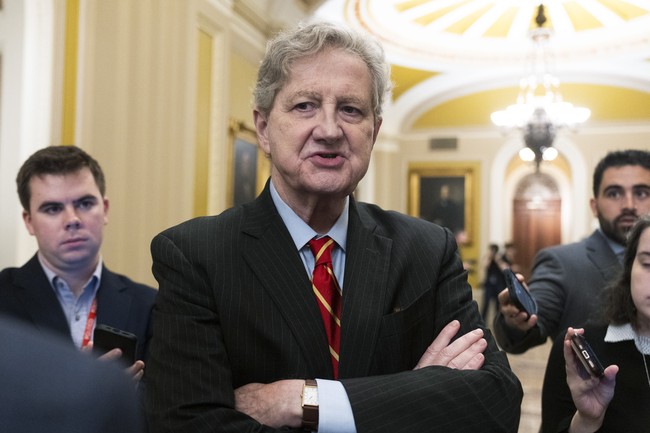
The weekly roundup covers five hot political stories: a Senate exchange over DHS funding, incendiary rhetoric from the left, newly surfaced documents about Trump and Epstein, a clash between Trump and an Olympic athlete, and a cultural debate over halftime performances — all framed through a conservative lens and preserving key quotes and evidence.
Sen. John Kennedy’s blunt take on Senate dynamics grabbed headlines for a reason. He painted Democratic leadership as captive to a more extreme faction, saying, “The Karen wing of the Democratic Party wants to defund ICE, just like they wanted to defund the police.” That line landed because it reduces a messy intra-party fight to something voters can understand: Democrats constrained by their loudest activists.
Kennedy didn’t stop there, using a sharp pop-culture jab to make his point. “And we know how that vampire movie turned out. The Karen wing of the Democratic Party is in control of the Democratic Party. Even if we agreed to every one of Sen. Schumer’s conditions – and I wouldn’t vote for ’em – he couldn’t deliver the Democratic votes. Because the Karen wing will punish any Democrat who votes to keep the DHS open.” His imagery — calling Schumer a “roomba, looking like a man who has just lost his luggage” — underscores a GOP argument that Democratic leaders can’t control their caucus when it matters.
That Senate scene ties directly into a broader argument about border security and governing competence. Conservatives argue that Democrats’ internal battles over immigration policy have real consequences, like the risk of funding gaps or weak enforcement. Framing the fight as one between pragmatic governance and performative purity resonates with voters tired of gridlock and risky messaging.
Another story that set off alarm bells involved Rep. Ilhan Omar. Reporting highlighted language many saw as dangerously escalatory, and commentary noted how that kind of rhetoric raises questions about safety and norms in public discourse. The write-up also pointed to scrutiny over sudden wealth in her home state amid a reported $9 billion fraud epidemic, amplifying concerns about accountability for public officials.
In that piece, the article referenced media analysis and included an embedded element to show the original source material: . The inclusion of a direct embed helps readers see the statements and judge tone for themselves, while the coverage connected rhetoric to real-world consequences for public trust. Conservatives see this as part of a pattern: sharp left-wing rhetoric plus weak oversight equals political and moral risk.
On another front, a newly released document set up a narrative shift around President Trump and Jeffrey Epstein. The reporting described “bombshell” material suggesting Trump contacted police about Epstein in 2006, with the quoted assessment that “This bombshell document release is narrative-busting stuff.” That claim matters because Democrats have long tried to tie the president to Epstein in ways that hurt politically.
The piece preserved context about Epstein’s criminal history, noting he “was convicted of procuring for prostitution a girl below the age of 18 in 2008 and was facing sex trafficking charges until he died, according to authorities, by suicide in a Manhattan jail cell in 2019.” That passage keeps the legal facts in the reader’s face and contrasts them with rebuttals to political attacks.
The president’s responses to cultural flashpoints kept the conservative narrative tight and visible this week. When an Olympic skier criticized the United States, reporters showed President Trump calling out the athlete’s comments and defending national pride. That segment included an embed for readers to view the exchange directly: .
Conservatives argue that international image and national unity matter, and public figures who denigrate the country while representing it on the world stage deserve pushback. The coverage stressed that point and showed how Trump’s bluntness plays well with voters who want leaders defending American strength instead of apologizing for it.
The final item zeroed in on cultural polarization: a TMZ-style poll comparing performances by Bad Bunny and Kid Rock stirred more than music debates. Observers noted subtle symbols, like flag color choices, that carry political meaning. The story highlighted how entertainment events are now battlegrounds for identity and civic messaging, with conservative audiences often aligned with displays of patriotism and skepticism of left-leaning cultural icons.
Throughout the week, the theme was consistent: conservative critiques of left-wing rhetoric, concerns about accountability, and a focus on national sovereignty and law and order. The articles preserved key quotes and documents while using pointed commentary to make those arguments accessible to readers. Each item reinforced a GOP framing that centers firmness on borders, refusal to kowtow to radical factions, and defense of traditional symbols of American identity.



Add comment