
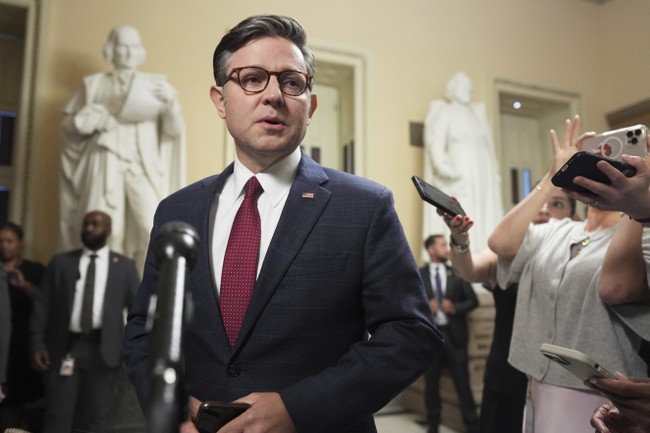
The Schumer Shutdown has dragged into its 24th day, with House votes paused as Speaker Mike Johnson seeks to ratchet pressure on Senate Democrats. The House has passed a clean continuing resolution multiple times, but Senate Democrats are blocking it over demands tied to health subsidies. Meanwhile, federal workers and service members feel the financial squeeze, and the standoff shows no sign of a quick end.
Speaker Mike Johnson announced that the House will cancel all votes until the government re-opens, a tactical move meant to sharpen pressure on Senate Democrats and Minority Leader Chuck Schumer. With the House already having passed the clean continuing resolution, Johnson is shifting the burden squarely onto the Senate to act. This pause in House floor votes is procedural but symbolic, sending a message that legislative business will remain limited until funding is restored.
Johnson’s move is a part of his continued pressure strategy on Senate Democrats and Minority Leader Chuck Schumer, D-N.Y., who have sunk the GOP’s federal funding plan 12 times since Sept. 19, when the House passed the measure.
Sept. 19 was also the last day the House was in session, meaning lawmakers have been largely in their home districts for over a month.
Republicans are pushing a short-term extension of fiscal year (FY) 2025 spending levels through Nov. 21 — called a continuing resolution (CR) — aimed at giving congressional negotiators time to strike a longer-term deal for FY2026.
The House’s decision to halt votes does not stop the Senate from acting; the Senate has repeatedly declined to pass the clean CR that would reopen the government. Democrats in the Senate have tied their obstruction to extending pandemic-era enhanced Obamacare subsidies that expire at year-end. That demand has become the sticking point, even though those subsidies were a temporary response to an emergency that has long passed.
Democrats, furious at being sidelined in federal funding discussions, have been withholding their support for any spending bill that does not also extend COVID-19 pandemic-era enhanced Obamacare subsidies that are due to expire at the end of this year.
Johnson’s decision was made public on Friday afternoon during a brief pro forma session in the House. Under rules dictated by the Constitution, the chamber must meet for brief periods every few days called “pro forma” sessions to ensure continuity, even if there are no formal legislative matters at hand.
Those pandemic-era subsidies are controversial because they continue to expand entitlement spending long after the emergency is over and could be extended to noncitizens in some interpretations. Critics point out that continuing those subsidies would commit billions more in federal spending without a clear end date. For fiscal conservatives, protecting taxpayers and reining in open-ended programs is central to any funding negotiation.
On the Senate floor, the clean CR has failed 12 times, with only three Democrats — Senator John Fetterman (D-PA), Senator Catherine Cortez Masto (D-NV), and Senator Angus King (I-ME) — breaking ranks to vote to reopen government. That left the measure five votes short of the 60-vote threshold required under Senate rules. The arithmetic in the upper chamber remains the decisive factor in ending the shutdown.
Practical consequences are mounting as federal operations remain disrupted. Estimates show roughly 670,000 federal employees are furloughed and 730,000 are working potentially without pay during the shutdown. Some federal workers have already missed full paychecks, and parts of the military are being paid only because of short-term reallocation measures and private donations that cannot replace stable, congressional action.
Senate Democrats could put an immediate end to the disruption by passing the clean CR that keeps funding at FY2025 levels while negotiators work on a longer-term FY2026 agreement. Until then, agencies operate with limited resources, families face unpaid bills, and national security personnel deal with financial uncertainty. The Senate reconvenes Monday, October 27th, where the next votes and negotiations will determine how quickly the government reopens.
Editor’s Note: The Schumer Shutdown is here. Rather than put the American people first, Chuck Schumer and the radical Democrats forced a government shutdown for healthcare for illegals. They own this.


Add comment