
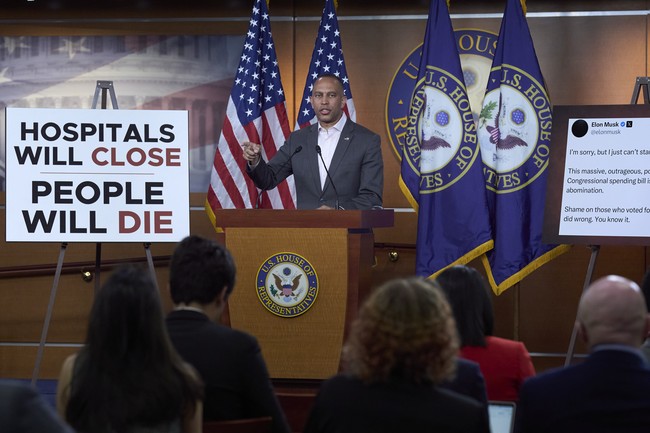
The article examines House Minority Leader Hakeem Jeffries’s remarks about Operation Epic Fury, presenting a Republican viewpoint that his comments — predicting the operation will “end in failure” — are irresponsible and undermine national unity during ongoing military action. It reviews his interview statements verbatim, contrasts them with assertions from House Speaker Mike Johnson about intelligence of an imminent Iranian threat, and highlights public reactions that accuse Jeffries of rooting for American failure. The piece argues that attempting to halt or constrain the mission now would be reckless and that the timing of his statements invites political and public backlash.
Hakeem Jeffries told CNN anchor Kate Bolduan that “The American people want us to focus on making their life better and making their life more affordable; not getting involved in another endless war in the Middle East that is going to end in failure.” That line landed like a bomb in Republican circles because it sounds less like a caution and more like a prediction, and worse, like a wish for our forces to fail. In wartime, rhetoric matters; public confidence and unified political support help protect troops and maintain resolve.
Jeffries added criticism about domestic priorities, saying “This administration somehow found the resources, has found billions of dollars for bombs but can’t find any money to actually bring down the high cost of living here in the United States of America.” Framing the debate as bombs versus domestic needs is a standard partisan move, but timing is everything — raising that argument while a defensive operation is underway looks like political theater. Voters can disagree about budgets, but many expect a basic level of support for troops when they face imminent danger.
The interview clip shows Jeffries repeating that Americans “are not interested in their taxpayer dollars being spent for another failed regime change war.” Those words are easily read as leveling an indictment not just of strategy but of the mission’s likely outcome. From a Republican perspective, suggesting an American operation will fail while it is still in progress can embolden adversaries and undercut commanders on the ground. Responsible leadership typically avoids issuing a verdict before operations conclude.
House Speaker Mike Johnson, according to public statements, said intelligence indicated a massive Iranian assault was imminent and that the U.S. strike was defensive to prevent “staggering losses” to American troops and assets. That claim reframes the operation as preemptive protection rather than an unnecessary intervention. If intelligence justified immediate action to save lives, then public calls to halt the mission midflight look dangerously out of step with the goal of protecting citizens and servicemembers.
The American people want us to focus on making their life better and making their life more affordable; not getting involved in another endless war in the Middle East that is going to end in failure.
This administration somehow found the resources, has found billions of dollars for bombs but can’t find any money to actually bring down the high cost of living here in the United States of America.
Jeffries also threatened to force a War Powers Resolution vote, arguing Congress has a role in authorization. That’s a familiar playbook for Democrats, but again, the timing raises practical concerns. Forcing a mid-operation vote to constrain actions could disconnect political process from military necessity and endanger those whose safety depends on continuity of effort until objectives are secured.
Critics online seized on Jeffries’s words, accusing him of predicting or even hoping for American failure. Social reactions quoted in response called the remarks a shocking position for a Democratic leader and questioned his priorities in the middle of a conflict. Political opponents see this as more than spin; they view it as a lapse of judgment that harms national cohesion during a moment of danger.
There’s a broader political context: some Democrats and progressive voices have long opposed distant military engagements, and that stance now collides with an event framed by the current Republican administration as necessary and defensive. For Republicans, the key issue is whether public figures should undercut operational credibility while operations are still underway. The consensus among many conservatives is that such comments do more harm than good.
From a policy standpoint, the debate over war powers and budget priorities will continue, but most observers agree that debates about authorization and funding are best held after immediate threats are addressed. Ending or constraining an active operation mid-course invites strategic risk and potential human cost, which is why many on the right view Jeffries’s timing and phrasing as reckless. Political disagreement is expected, but rhetoric that appears to cheer for defeat crosses a line for many Americans.
Public trust in political leaders rests on a mix of candor and prudence; when leaders predict failure during active defense measures, they test that trust. Republicans argue that criticizing strategy is fair, but doing so in a way that seems to prefer failure is unacceptable. At a minimum, critics contend, lawmakers should weigh the consequences of their words on morale, security, and the safety of those serving on the front lines.
And that’s why the power was given explicitly to the House and to the Senate. And Donald Trump chose intentionally not to come before Congress, which is why we’re going to force this vote on a War Powers Resolution and make sure that we do everything we can to constrain him at this point in time.
The debate over Operation Epic Fury will not end with sound bites, and it should not be reduced to partisan theater. Still, the reaction to Jeffries’s comments shows how high the stakes are when leaders discuss ongoing military operations. Republicans warn that undermining a defensive action in real time risks lives and national security, and they expect lawmakers, especially leaders, to choose their words with the consequences in mind.
Predicting (hoping for?) American failure is an for a Democrat leader.
This guy doesn’t have a in his head.
Maybe someday this annoying tool will instead of a Democrat.
Jeffries , he WANTS the US to fail. He hates our president so much and he hates our country.

Jeffries is a useless garbage scow enemy of the People and America that’s just full of lies, trash and shit; listen to NOTHING he says! He should have been locked away in GITMO as a Traitor in GITMO with many other Demoncrap congressional members long ago!
What a punk criminal thinking he knows so much and better than any of the real experts on the job of defending America and the People! LIES THROUGH HIS TEETH CONTINUALLY!
Well, we should pay attention, because Hakeem the Spleen has such an outstanding record of success in international endeavors (not).
RIGHT, Y’all!!!
Jefferies, likes most demonrats is so blinded by his hatred of the American people who elected him that he would cheer IF his dire predictions were to come true. He is, however, most definitely NOT a soothsayer – just a disgruntled demonrat.
You are precisely correct!