
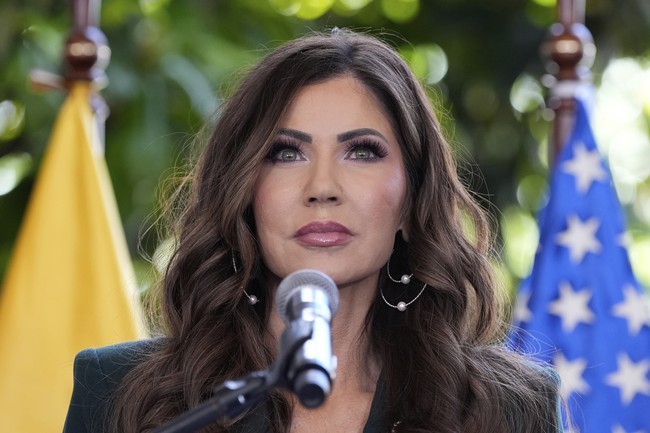
I’ll summarize a Senate hearing where DHS Secretary Kristi Noem exchanged sharp answers with Senator Dick Durbin over DACA recipients, arrests by ICE, and the broader issue of illegal immigration and public safety.
On Tuesday, Secretary of Homeland Security Kristi Noem faced the Senate Judiciary Committee and answered pointed questions from Senator Dick Durbin. Her responses were direct and unapologetic, and she pushed back hard on the framing Democrats tried to use. The exchange highlighted a deep divide over how to treat those in the country illegally and what counts as a crime.
Durbin attempted to use statistics about DACA recipients to challenge Noem, but she responded by stressing public safety and the range of offenses that matter to families. Noem underscored that many arrests involve crimes beyond what some labels treat as violent offenses. The contrast was sharp: a senator leaning on narrow definitions, and a secretary emphasizing the everyday harms that affect communities.
When the committee discussed DACA specifically, Noem noted law enforcement findings and outcomes that complicate the conventional narrative. As reported in committee correspondence, a large majority of arrested DACA claimants had prior criminal histories. That letter included a precise figure, and Noem relied on those numbers to make her case. The exchange made clear she expected questions to be grounded in the actual letters and evidence presented.
The committee record contained a blunt statistic: “241 out of 261 (92%) DACA recipients arrested by ICE had criminal histories.” That line was presented exactly as written in the materials Noem cited. The number drove home the point she tried to make about the scope of offenses among people arrested after program participation. It also undercut the senator’s attempt to portray enforcement as misdirected toward noncriminal individuals.
Noem did not stop there. Durbin pushed a different angle, pointing to arrests during the prior administration and arguing most lacked violent records. Noem corrected the premise by listing types of crimes often omitted in such summaries. She argued those omissions matter because they leave out DUI, embezzlement, theft, drug trafficking, and other offenses that harm families every day.
In her reply to Durbin she said that counting only so-called violent crimes misses much of the real harm. She insisted that if one properly counts the full spectrum of offenses, the percentage with criminal records rises dramatically. The secretary framed this as a matter of common-sense public safety, insisting the law must be enforced and the impact on American families must be considered.
Senator Durbin: Let me ask you about the fact that 85 percent of the 400,000 immigrants that ICE arrested during President Trump’s first term in office, had no violent criminal record. The president said over and over at his rallies, ‘We’re going after the worst of the worst, the terrorists, the murderers, the rapists, and then it turns out that 85 percent of the people you’ve gone after have no criminal history whatsoever. How do you explain that?
Secretary Noem: Sir, when you talk about violent crimes, what you’re saying (is) the crimes that don’t matter that you aren’t counting are ones that affect American families every single day. You’re not counting DUI. You’re not counting embezzlement. You’re not counting theft. And you’re not counting the other crimes against people, and drug trafficking, and proliferating that. So, if you don’t count those as crimes, that these individuals, and impacting families, in this country…
Durbin: They are counted, and they calculated 14 percent of those that you…
Noem: Those are not counted in your 14 percent. If you were counting crimes that these individual illegal aliens in this country have committed, it would be well over 65 to 70 percent of the individuals that are detained today, have those crimes on their record. Besides the crime of being in this country illegally.
The tone of the hearing made one thing obvious: Noem was not there to play defense for policy positions that contradict strict enforcement. Her answers repeatedly returned to the principle that illegal entry is itself a violation of law, and that enforcement matters regardless of partisan spin. That plainspoken approach resonated with those who prioritize secure borders and accountability.
Democrats at the hearing framed the debate as one about compassion and selective enforcement, while Noem framed it as a question of law and order. She kept insisting the law is not optional and that illegal presence undermines community safety and sovereignty. Her rhetoric was forceful: those who enter or stay here illegally are subject to removal, and that should be nonnegotiable under the rule of law.
The exchange also revealed an ongoing political split over how immigration enforcement is measured and reported. One side focuses on narrow categories that minimize the appearance of widespread criminality, while the other points to a wider set of offenses that affect victims and neighborhoods. That difference in perspective drives not only debate but the policies Republicans are pushing for at the federal level.
The hearing left clear that Noem favors strict enforcement and that she will defend that approach publicly. Her message to lawmakers was straightforward: count the crimes that matter to families, uphold the law, and prioritize the safety of American communities. The disagreement is unlikely to fade, but the hearing gave Republicans a crisp, enforceable argument to use in policy fights ahead.



Add comment