
This article examines mounting signs that Iran’s economy may be collapsing toward a real tipping point, driven by crushing inflation, widespread shortages, and rising public unrest. It covers reported theft of staples, staggering inflation figures, comments from analysts and Iranian officials, and the political fallout as leadership appears fractured. The piece offers a Republican-leaning perspective that economic pressure can accelerate regime vulnerability and underscores the potential for internal unrest to prompt significant change. Facts, direct quotes, and numbers from recent reporting are preserved exactly as they appeared.
Iran has endured sanctions for years, but recent reports suggest a convergence of pressures that are unprecedented for the regime. Beyond long-running penalties, the country now faces restricted oil sales, frozen assets, a plunging currency, and sky-high food prices all at once. Those combined stresses are producing visible signs of strain on daily life for ordinary Iranians.
There are multiple accounts of people taking basic groceries from stores simply to survive, a vivid indicator of growing desperation. Reports describe supermarket workers encountering customers who hide inexpensive food items or eat packaged products inside stores without paying. These anecdotes match hard data showing dramatic price jumps across staples.
An investigation published Wednesday by the Iranian newspaper Jahan-e Sanat described supermarket workers encountering customers who allegedly concealed inexpensive food items or ate packaged products inside stores without paying. [….]
These are anecdotal, but they align with hard data,” Miad Maleki, an associate fellow at the Foundation for Defense of Democracies, told Fox News Digital.
“Iran is already inside the tipping zone,” Maleki said. “But a genuine ‘tipping point’ wouldn’t be a single dramatic event. It would look like what’s already unfolding in slow motion: currency collapse, World War II-level food inflation and now theft of staples, reaching a threshold where basic caloric/nutritional access breaks down for a large share of the population, not just the poorest.”
The inflation numbers are brutal and straightforward, and they help explain why people are stealing food. Official statistics cited point-to-point inflation of 113.8% for food and beverages and 112.5% for food items in March compared with the same month a year earlier. Bread and cereal prices increased 140%, while milk, cheese and egg prices rose 116.8%.
The Statistical Center of Iran data cited in separate reports showed point-to-point inflation of 113.8% for food and beverages and 112.5% for food items in March compared with the same month a year earlier. Bread and cereal prices increased 140%, while milk, cheese and egg prices rose 116.8%
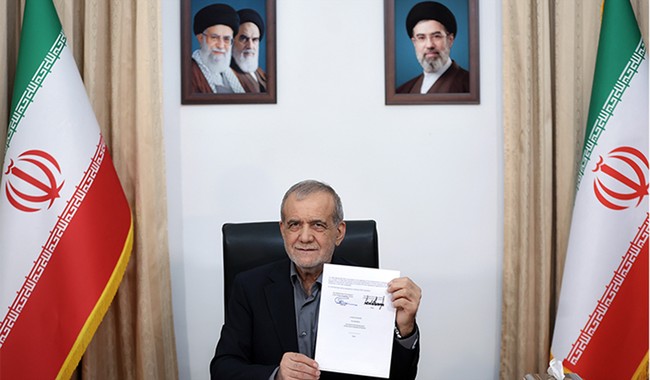
Iranian leadership is publicly acknowledging trouble, though they frame it as foreign pressure and provocations. President Masoud Pezeshkian admitted there were “difficulties and problems,” while suggesting adversaries want to inflame protests. That narrative is predictable, but it also signals that Tehran is worried about social stability and how unrest could spread.
“The enemy is exerting pressure in an attempt to provoke the people into protesting,” Pezeshkian said, according to an account of his Aug. 5 address published by Iran’s state-affiliated Press TV.
Maleki said worsening food insecurity could become a trigger for renewed demonstrations, pointing to Iran’s November 2019 protests following a sharp government-imposed increase in gasoline prices.
“The regime’s own history proves it, because its most dangerous moments have been economic, not ideological,” Maleki said.
Analysts warn that economics—not ideology—has toppled regimes in the past, and Iran’s recent pattern fits that script. If basic caloric and nutritional access deteriorates across broad swaths of the population, the result could be a slow-moving collapse rather than a single dramatic event. That scenario makes popular unrest both more likely and more sustained.
Resistance networks inside Iran report people preparing for a confrontation, stockpiling crude weapons and seeking firearms to be ready when opportunity presents itself. Such preparation is a raw signal that some inside the country expect the moment for open revolt might not be far off. When daily survival becomes the central concern, political grievances can quickly turn into direct action.
Meanwhile, observers note confusion at the top of Iran’s command structure, including uncertainty about who is actually in charge. The absence of visible leadership and reports of secretive meetings do little to reassure the public or the international community. That kind of chaos plays into the hands of internal opponents and external policymakers who want to keep pressure on the regime.
From a Republican viewpoint, these developments suggest economic pressure and decisive policy can bear fruit without direct military occupation. Sustained financial measures, targeted sanctions, and diplomatic isolation have tangible effects on the ground. The unfolding crisis in Iran shows how economic leverage can create openings for political change if policymakers remain resolute.


Add comment