
The piece examines foreign funding aimed at blocking U.S. data center and AI growth, the strategic stakes involved, and the local and national tensions that follow, including concerns about energy, land use, and geopolitical competition with China and Russia.
We are living through a major technological shift driven by artificial intelligence and the enormous data centers that support it. Those facilities are large, energy-hungry, and visible on the landscape, and their scale triggers both practical questions and political fights. This report looks at who is financing opposition inside the United States and why that matters for national competitiveness. The stakes are not abstract: leadership in AI will shape economic, military, and technological power for decades.
Recent analysis shows significant foreign money flowing into U.S. anti-data center and anti-AI activism, and that fact should make every policymaker sit up. Critics who oppose new data center builds often raise legitimate local concerns about traffic, noise, and changes to rural vistas, but money from abroad adds a national security dimension to those arguments. When outside interests fund campaigns that stall critical infrastructure, the question becomes whether those campaigns serve local residents or foreign agendas. That distinction matters when the technology being blocked is central to national competitiveness.
A new American Energy Institute report shows that foreign billionaires have provided funding upwards of $39 million to the anti-AI data center movement in the United States, with experts saying AI infrastructure must be advanced in order to assert American tech dominance over communist China.
Founder, CEO and Chairman of State Armor as well as expert on Chinese influence in America Michael Lucci told The Center Square: “Either the United States or communist China will dominate artificial intelligence, and therefore, likely dominate the leading technologies of the 21st-century.”
“The world we leave behind for our children and grandchildren will be a very dark one if a communist regime has technological dominance over the United States of America,” Lucci said.
Those quotes make the point bluntly: this is not solely a debate about aesthetics or zoning; it’s a contest over who leads in next-generation tech. If foreign actors are bankrolling efforts that slow American infrastructure, it weakens our hand against strategic rivals. The U.S. must balance local concerns with a national imperative to preserve technological leadership. Policies should recognize the broader consequences of blocking infrastructure that underpins AI innovation.
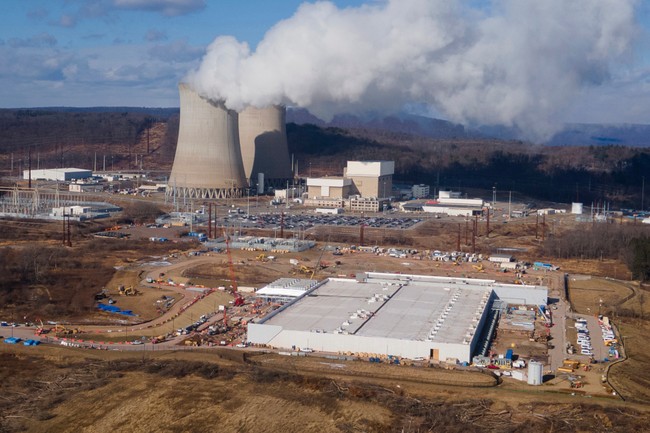
There are practical problems to solve around data centers: siting, energy supply, and community impact. Data centers can be placed on repurposed industrial sites, near existing transmission lines, or in urban-adjacent locations that minimize disruption to scenic areas. Some operators are already exploring on-site power generation and small modular reactors to meet demand without overloading local grids. Thoughtful planning can reduce friction while enabling the capacity America needs to remain competitive.
“Some of this comes from direct enemies like Communist China and Russia,” Lucci said. “Other times it comes from wrong-headed European leftists who view technological development and energy consumption as an inherent evil.”
CEO of the American Energy Institute Jason Isaac told The Center Square that his organization’s report “makes clear that opposition to U.S. data center expansion is not organic or purely local.”
“It is being fueled by a coordinated network of activist groups backed by more than $39 million in foreign funding,” Isaac said.
Those are serious charges and deserve public scrutiny. Whether the source is adversarial states or well-moneyed environmental networks, the effect is the same when campaigns slow infrastructure that supports economic growth and national defense. Transparency about funding sources and the goals of coordinated campaigns should be required in contentious local hearings. Citizens have a right to know who is shaping decisions that affect their towns and the nation.
Local residents have valid instincts about preserving quality of life, and those instincts should be respected in planning processes. But local decisions that are influenced by well-funded external actors can produce national harms. If policymakers reflexively block projects without exploring mitigation measures, the U.S. could cede critical capacity to rivals. A smarter approach is to demand both local protections and national foresight.
Republican policymakers should press for clear rules that protect communities while ensuring America builds the infrastructure necessary for AI leadership. That means faster permitting for suitable sites, incentives for redeveloping brownfields, and strict disclosure of foreign funding for activist groups involved in infrastructure fights. It also means investing in resilient power solutions and workforce development so data centers bring jobs, not just visual impact.
AI is already reshaping economies and militaries, and the infrastructure behind it is nonnegotiable if the U.S. wants to stay on the cutting edge. Blocking progress without offering realistic alternatives is a luxury we cannot afford when rivals are intent on gaining technological advantage. Practical, transparent, and strategic planning will let communities keep their character while allowing America to lead in the technologies of this century.



Add comment