
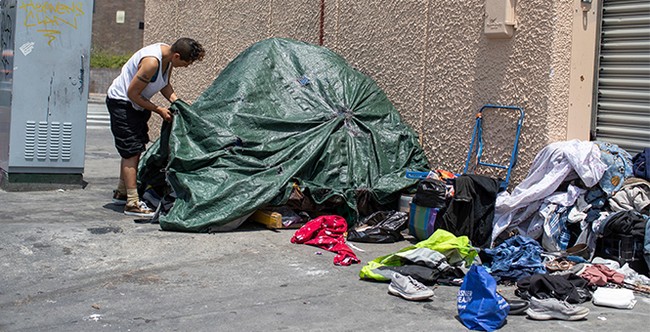
The federal government has paused HUD funding to the Los Angeles Homeless Services Authority amid allegations of fraud and severe financial mismanagement. This move follows audits, a federal inquiry, and a separate probe by a U.S. attorney into suspected misuse of homelessness relief dollars. The action centers on failures in internal controls, conflicts of interest, and inaccurate financial statements. The story exposes how billions intended to address homelessness have been handled in Los Angeles.
The Department of Housing and Urban Development notified LAHSA it was cutting off funds effective immediately while HUD’s inspector general investigates. The agency faces accusations of “obvious fraud” and “wanton mismanagement,” language that signals a serious breakdown in oversight. HUD’s letter, which detailed the decision, points to repeated false statements and failures in financial management. These are not minor accounting errors but structural problems that threaten public trust and service delivery.
LAHSA has received more than $1 billion in federal funds since 2021 and operates on a budget of $829 million for the 2025-26 fiscal year. The agency is a joint powers authority serving both the City and County of Los Angeles, with substantial contributions from local governments. Auditors found “significant” inaccurate amounts in financial statements that had to be adjusted late in the audit process. Those adjustments, and the missed filing deadline, were tied to a “significant deficiency” in internal controls.
Local governments have already reacted to persistent problems by pulling back funding and reconfiguring responsibilities. Los Angeles County withdrew future funding and created its own Department of Homeless Services and Housing. That decision reflects a loss of confidence after audits showed repeated compliance failures. The county move is meant to create greater accountability, though it also raises questions about how newly formed agencies will prevent the same pitfalls.
Conflicts of interest featured prominently in audit findings, including a contract where $1.7 million was paid from a $2.1 million agreement to Upward Bound House. That contract involved connections to the former LAHSA CEO, who had signed the contract and amendments while listed as the LAHSA administrator for the work. Prior arrangements included a no-bid $60,000 contract to consult on homelessness initiatives and a CEO salary reported at $430,000 per year. Those details underline why auditors flagged ethical and oversight concerns.
Judicial scrutiny has accompanied the audits, as a federal lawsuit brought by housing advocates alleged that homeless conditions violated state and federal law. A 2024 audit ordered in that case described absent financial accountability and ignored conflict-of-interest policies. Auditors also found siloed operations that duplicated spending and effort rather than streamlining services for people in need. The litigation and oversight combined to create mounting pressure for transparency and reform.
Investigations are not limited to audits and HUD reviews; Bill Essayli, First Assistant U.S. Attorney for the Central District of California, launched a Homelessness Fraud and Corruption Task Force in April 2025. That unit is probing fraud, waste, abuse, and corruption involving funds allocated to fight homelessness in the region. The task force is separately examining LAHSA’s finances alongside HUD’s inspector general. Federal criminal investigations raise the stakes far beyond administrative fixes.
Auditors also reported that LAHSA did not verify that service provider invoices matched actual services provided at the stated locations before approving payments. The sampling of invoices showed a “high level of noncompliance,” creating openings for contractors to overbill or misuse funds. That gap in verification helps explain how large sums could be diverted or misspent without prompt detection. Poor invoice controls are a common red flag in fraud examinations.
High-profile arrests have illustrated the consequences of weak oversight, such as the case of Alexander Soofer, the founder of a charity that allegedly received millions to feed the homeless. Prosecutors say Soofer diverted program dollars to luxury purchases, real estate, travel, and other personal spending. Those charges present a vivid example of taxpayer-funded programs being exploited when supervision fails. Cases like this feed public outrage and justify federal intervention.
HUD’s letter included pointed language about the risks posed by LAHSA’s conduct: “HUD has evidence that LAHSA’s repeated false statements and its irresponsible actions and failures, including its lack of financial management, internal controls, and safeguards against conflicts of interest, pose a threat to HUD, the public, and those living on the streets of Los Angeles.” That exact quote frames the federal rationale for halting funds while an investigation proceeds.
Stopping the flow of federal dollars to organizations that cannot demonstrate transparent, accountable practices is the immediate consequence of these findings. Local officials and federal investigators now face the task of untangling contracts, auditing expenditures, and ensuring services for vulnerable people continue. The situation in Los Angeles is a cautionary tale about the need for rigorous oversight when large public sums are funneled through nonprofit partners.
https://x.com/SecretaryTurner/status/2065089729062707501

Add comment