
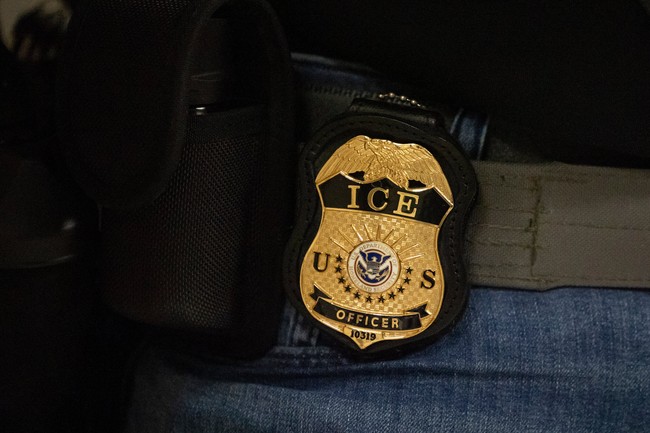
I’ll recap how CBS framed ICE’s arrests during President Trump’s deportation push, why DHS pushed back, and why the numbers matter to conservatives defending law and order while calling out media spin. I will explain the data CBS cited, include the exact DHS rebuttal, place the three original embeds where they appeared, and argue why enforcing immigration laws remains a priority for safety and fairness.
The story from CBS claimed that “Less than 14% of nearly 400,000 immigrants arrested by Immigration and Customs Enforcement in President Trump’s first year back in the White House had charges or convictions for violent criminal offenses, according to an internal Department of Homeland Security document obtained by CBS News.” That sentence became the headline takeaway for many, and it was presented as if ICE’s actions targeted mostly nonviolent people. Conservatives read those numbers and saw a different picture.
CBS’s write-up also stated, “The official statistics contained in the DHS document, which had not been previously reported publicly, provide the most detailed look yet into who ICE has arrested during the Trump administration’s far-reaching deportation operations across the U.S.” Presenting detail is fine, but interpretation matters. The report itself still showed that a substantial portion of those arrested had criminal histories, and that fact gets short shrift when the media run with a single percent.
Context is everything. Even 14 percent of 400,000 is about 60,000 people with violent offenses who are no longer at liberty to prey on communities. Beyond that, the DHS data reportedly indicated that “Nearly 60% of ICE arrestees over the past year had criminal charges or convictions, the document indicates. But among that population, the majority of the criminal charges or convictions are not for violent crimes.” The number of arrestees with any criminal record shows ICE is not rounding up purely innocent families at random.
That nuance drew an immediate response from the Department of Homeland Security public affairs team. Assistant Secretary for Public Affairs Tricia McLaughlin pushed back hard, listing examples of offenses the article and some critics casually labeled as nonviolent. Her point was that many of those crimes are seriously harmful to victims and communities even if they are not classified as violent on paper.
Her exact words were quoted in the original coverage and deserve to be seen without alteration: “Drug trafficking, Distribution of child pornography, burglary, fraud, DUI, embezzlement, solicitation of a minor, human smuggling are all categorized as “non violent crimes.” Like we said, ~70% of those illegal aliens arrested under @POTUS Trump and @Sec_Noem have pending criminal charges or prior convictions.” That list reads like a roll call of offenses that still ruin lives and demand enforcement.
When the media choose to spotlight a narrow statistic and omit the broader context, they shape public opinion in predictable ways. CBS noted a dip in public support for deportation, saying a recent poll found Americans’ support for Mr. Trump’s deportation efforts had fallen to 46%, down from 59% at the start of his second term. Polls matter, but they are also susceptible to framing and question wording, and they do not change the underlying public safety argument.
The political calculus is obvious: activists and sympathetic outlets highlight sympathetic stories to push for reduced enforcement, while DHS and law-and-order conservatives emphasize the crimes that enforcement prevents. For Republican readers, enforcement is not about cruelty, it’s about protecting communities, preserving jobs and reducing crime. Deporting people with criminal records, violent or otherwise, advances that goal.
Practical effects matter: removing criminals lowers crime, eases pressure on housing and wages, and prioritizes citizens for jobs. The criticism that deporting nonviolent offenders is unfair ignores the ripple effects those crimes create. Law enforcement does not only remove people for violent acts; drug trafficking, fraud, human smuggling and child exploitation also have victims who deserve protection.
CBS framed the story to generate sympathy for certain migrants and to question broad enforcement priorities, but DHS responded by pointing out that many of the people ICE arrested were involved in what most Americans would call serious wrongdoing. That clash — between media narratives and enforcement priorities — is exactly the debate playing out across the country as voters weigh safety against sympathetic anecdotes.
The bottom line for conservatives is straightforward: enforcement of immigration laws matters because it protects Americans and upholds the rule of law. Media pieces that cherry-pick numbers without showing the whole dataset contribute to confusion rather than clarity, and DHS’s pushback demanded that readers see the fuller picture of who ICE was arresting.
Add comment