
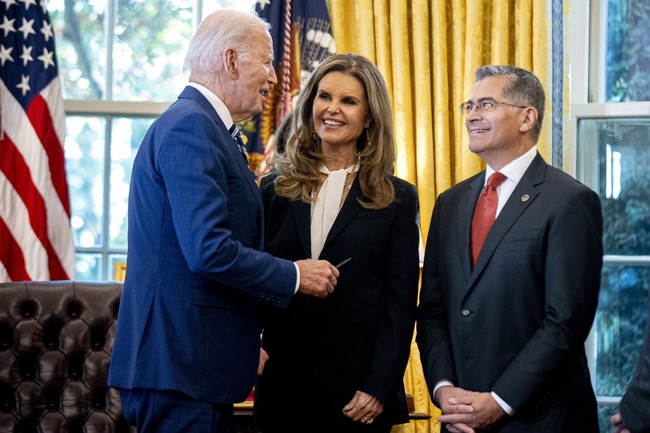
I’ll call out leadership and weakness, explain why a withheld endorsement matters in a high-stakes California governor’s race, compare Biden’s choice to other national figures who have picked sides, and note the political consequences for Democrats when leaders refuse to lead.
Biden’s Profiles in Cowardice: No Endorsement, No Backbone
John F. Kennedy wrote his Pulitzer Prize–winning tome “Profiles in Courage” in 1956, highlighting senators who took big risks because it was the right thing to do. Those old examples of backbone stand in sharp contrast to what we saw recently from former President Joe Biden. On an important decision—whether to endorse in California’s crucial gubernatorial contest—he chose to sit out.
Reports say Biden told his former chief of staff, Ron Klain, that he would not endorse any candidate in the California governor’s race. The plain answer was nobody. That avoidance speaks louder than any carefully worded statement; it reads as an unwillingness to stand up for convictions or face political consequences.
This is the same man who was the nation’s leader just over a year ago, who could have lent weight to a contest that matters for national politics and for a state that sets policy trends. Instead he opted for neutrality. You can frame it as “letting voters decide,” but in practice it’s a dodge that leaves allies and rivals guessing and the party without clear direction.
As Xavier Becerra campaigns for California governor on his long record of government service, Democratic insiders have wondered if he will receive a late campaign endorsement from his last boss, former President Joseph R. Biden Jr.
The answer appears to be no.
Mr. Biden recently told Ron Klain, Mr. Biden’s former chief of staff, that he would not make an endorsement in the race, Mr. Klain said. But that is not meant as a slight against Mr. Becerra.
“He told me that he is a big fan of Xavier, he likes Xavier, appreciates the job he did, but that there are other people in the race who he also has a relationship with,” Mr. Klain said in an interview this week. “He’s just going to stay neutral.”
Xavier Becerra, the former state attorney general and one-time cabinet official, has climbed toward the front of the Democratic field partly because voters don’t see an energetic alternative. That rise coincides with attacks from rivals and a messy field that has left moderates and progressives uneasy. Becerra may prefer the safe ambiguity of a non-endorsement; for a candidate it can look like tacit support without the risk of alienating other Democrats.
California’s Democratic primary features familiar names and some longshots, including billionaire Tom Steyer and several past elected officials. On the Republican side there are at least two competitive candidates who might capitalize on Democratic disarray: a businessman turned media figure and a law-and-order sheriff. An active endorsement from a national leader could have reshaped fundraising, coalition-building, and voter perceptions, but Biden chose not to intervene.
Other prominent Democrats have followed suit. Former vice president Kamala Harris and Governor Gavin Newsom have also declined to make decisive endorsements in this race. That pattern suggests a broader problem: leaders who are afraid to pick winners or losers because they fear short-term backlash, even when the stakes are high for policy and party cohesion.
Contrast that with recent Republican behavior on endorsements. When faced with a difficult choice in a statewide contest, President Donald Trump made a clear pick and stuck with it. Whether you agree with his choice or not, it showed a willingness to accept responsibility for a political decision. Picking a side is what leaders do; staying publicly neutral to avoid criticism is what followers do.
Biden’s nondecision landed poorly for independent observers and for those who expect clearer leadership from senior figures. In practical terms, a withheld endorsement can encourage chaos in a primary, fuel infighting, and leave voters wondering what the party actually stands for. In strategic terms, avoiding a tough call signals prioritizing short-term comfort over long-term success.
Politics is messy and endorsements carry consequences, but avoiding the fight leaves the field to actors with clearer, louder messages. When leaders refuse to lead, they create openings for outsiders and opportunists, and they hand opponents a ready argument about lack of conviction. Biden’s silence in this race is a reminder that leadership sometimes means making hard choices, not dodging them.
Add comment