
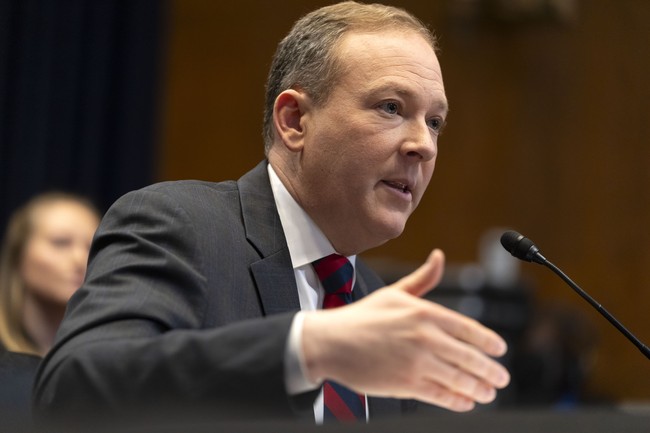
EPA Administrator Lee Zeldin faced Congress recently and did not flinch, using blunt language to call out what he sees as both failed predictions and political self-dealing by climate alarmists. His testimony mixed sharp critiques of past forecasts, specific accusations about how climate funds were distributed, and a mic-drop line aimed at a senator with a controversial club membership. The remarks sparked praise from conservatives who view Zeldin as cutting through hypocrisy and defending sound science over partisan theatrics. Below are the core excerpts and a straightforward Republican take on why this matters for policy and accountability.
Administrator Zeldin’s performance read like a clean-up job after years of overheated rhetoric and promises that never materialized. He pointed to dramatic climate predictions by public figures that have not held up, and he framed those failures as part of a broader pattern where fear fuels funding and influence. For many conservatives, the issue is not denying science but demanding honest assessments and transparent spending. Zeldin repeatedly linked the climate funding apparatus to insiders and donors, arguing that money flowed to the familiar names of the political class.
At one point the coverage referenced a RightLine News item and a social embed concerning the exchange, with additional multimedia attached for context.
The hearing highlighted a viral social media post quoted in full during the session, and it captured the tone of the exchanges on the Hill. The post reads in full:
“I told Sen. Sheldon WhiteClub [Whitehouse] today that I won’t be listening to or caring about any of his lessons on ‘MORALITY’ knowing that he joined an all-white Rhode Island Country Club!”
He just keeps PUMMELING these Dems!
“Climate alarmist AOC wants to be taken seriously while also insisting the world is imminently about to end due to climate change — Just under 5 years remain on her nutty Jan 2019 prediction that only 12 years of life are left on Earth).”
“Al Gore is now speaking publicly about his concern with global freezing after decades of grift talking about global warming. ‘Within the decade there will be no more snows of Kilimanjaro,’ said Gore in 2006 (There’s still snow on Kilimanjaro year-round). Gore also predicted in 2009 ice-free Arctic summers within 5-7 years.”
“John Kerry warned in 2009 that the Arctic would be ice-free by 2013. These people are dishonest, power-hungry hacks. The GREEN NEW SCAM is DEAD!!!”
Freaking awesome.
What a GREAT Trump pick!
That quoted post captures the no-nonsense tone Zeldin brought to the hearing, and it underlines a conservative frustration with alarmism that outlived its failed forecasts. Zeldin then addressed scientific predictions and how administrations lean on worst-case scenarios to justify regulatory power. He argued that updating policy to reflect present facts is both sensible and necessary, rather than clinging to alarmist assumptions from years past.
Later in the hearing Zeldin offered a longer, measured explanation of how science and policy interact, and why past endangerment findings deserve fresh scrutiny. He stated that agencies often adopt the most pessimistic projections to justify sweeping rules, but that policymakers in 2026 can rely on current evidence rather than the harshest assumptions from 2009. The point was simple: policies should be grounded in today’s verified data instead of outdated fear-based models.
When predictions are made in the past, science will have a range of the pessimistic to optimistic. And then, in order to justify, for example, that 2009 endangerment finding, they were adopting the most pessimistic views. Now, when you get to 2026, great news. You’re able to rely on present-day facts in 2026 rather than any bad assumptions from 2009. And just because when you take exception when a member of Congress says in January 2019 that in 12 years the world’s about to end. If we’re sitting here today saying, ‘Well, gosh, it’s only four years-and-nine-months left,’ I don’t think the world is about to end. They want to vilify you as if you’re denying science.
Zeldin also went after the financial side of climate programs, naming specific funds and recipients and claiming conflicts of interest. He noted that money from programs like the Greenhouse Gas Reduction Fund flowed to former officials, donors, and groups linked to prior administrations. For a conservative audience, this is the heart of the matter: policies that appear green on the surface but function as channels for political patronage must be exposed and reformed.
I just saw a clip yesterday where Al Gore was talking about global freezing. I’m having trouble keeping up. I thought it was global warming, now it’s global freezing. And I don’t know what kind of money is made, making money off of a climate grift. What won’t get referenced by your colleagues on the opposite side of the aisle, who bring up the Greenhouse Gas Reduction Fund (GGRF), is that the money was going to former Obama and Biden officials. The money was going to Democratic donors. The conflicts of interest that we saw. The amount of self-dealing. The unqualified recipients. Climate United Fund CEO was a special assistant in the OMB during the Obama-Biden administration. They received $6.9 billion. If you could go down the list with that. And today you can go through Coalition for Green Capital — about a Biden-Harris climate advisor serving on the board, joining the board in ’23 while the organization applying for GGRF. Power Forward Communities CEO of Fannie Mae during Obama-Biden administration.
For conservatives who favor accountability and limited government, Zeldin’s hearing was a welcome break from the usual performative outrage. He emphasized sticking to facts and science while refusing to accept moralizing lectures from opponents he described as implicated in the same systems they criticize. That dynamic — call it hypocrisy if you like — is politically potent and helps explain the energized response from the right.
He wrapped with a remark that landed hard in the hearing room and on social media, taking aim at a senator whose past club membership has been controversial. The line was brief, pointed, and exactly in keeping with the tough tone Republicans wanted to hear from an EPA chief.
Observers on the right praised the administration for picking leaders who will push back against left-wing narratives and demand transparency in both science and spending. Zeldin’s testimony offered a blend of policy skepticism and blunt political messaging that reassured conservatives who see climate policy as too often driven by special interests. The hearing was a reminder that oversight matters and that questions about past predictions and financial ties deserve clear answers.

The ENTIRE Climate Push has been a giant HOAX and GRIFT by the Demoncraps to keep themselves and all of their Partisans cashing in on $Billions of taxpayer funds!
Anyone that takes the small amount of time needed to research and study the FACTS about Earth’s Climate History knows throughout the millennia it’s normal for changes to occur from one extreme to another because the primary driving force behind Climate Change is the Electromagnetic Spectrum of the SUN!
It’s all been a NORMAL OCCURRENCE and these ASSHOLES have all LIED about what’s going on and why! A foremost expert Marc Morano of the Climate Depot has been proving the truth for years that the bought and paid for Mainstream Media lie purveyors have ignored with their hosts the Demoncraps! “Taking Back Earth Day – The Climate Realism Show – w/ Marc Morano” is easy enough to look up! ://www.climatedepot.com/author/marcmorano/
The US Citizenry need to wake up and stop being so gullible or even stupid listening to the the likes of that IDIOT WITCH AOC!