
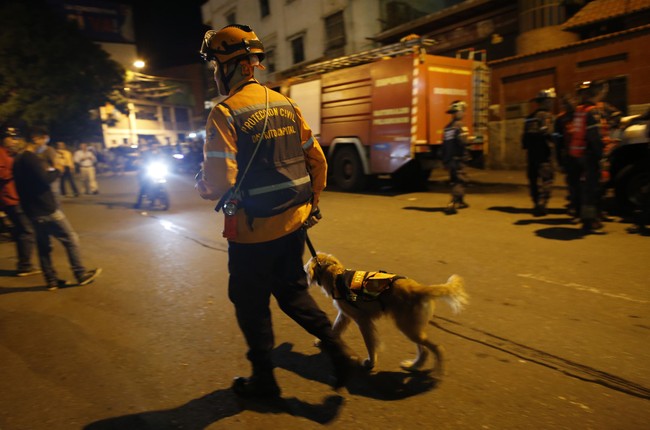
Two massive earthquakes struck Venezuela within a minute of each other, collapsing buildings along the northern coast, killing at least 164 people, injuring nearly 1,000, and prompting a regional outpouring of search, rescue, and humanitarian support as crews race to reach survivors amid damaged infrastructure.
The first tremor registered magnitude 7.2 and was followed about 40 seconds later by a 7.5 quake, the most powerful to hit Venezuela in over a century. The combined shaking and successive ruptures produced far longer and more destructive motion than a single event of that size would normally create. Officials say the death toll is expected to rise as rescue teams reach areas where buildings collapsed.
President Trump ordered federal agencies to act swiftly and issued a formal statement within hours. Senator Marco Rubio announced U.S. search-and-rescue teams, medical assets, and humanitarian aid were being deployed immediately. Acting President Delcy Rodríguez said Venezuela would “never forget the helping hand” extended by the United States, and other countries also pledged support.
La Guaira, the coastal state north of Caracas, suffered the most severe damage with high-rises pancaking and a hotel collapsing in the chaos. Rescue workers described scenes of concrete and dust, people trapped under rubble, and whole city blocks rendered unsafe. Night fell with crews still digging and lights from heavy equipment cutting through dust and smoke.
https://x.com/WhiteHouse/status/2069993600432136695
Simón Bolívar International Airport took serious hits as ceiling panels fell and dust filled the terminal, forcing passengers and staff to drop to the floor to avoid falling debris. The airport was closed and commercial carriers suspended flights to Caracas while authorities assessed structural safety. For many travelers, the evacuation was chaotic and abrupt as services and communications faltered.
Power outages were widespread across parts of Caracas, and internet connectivity dropped sharply from normal levels, leaving families cut off at a crucial time. Schools were closed for the week while metro and rail service remained suspended pending safety checks. Thousands of residents opted to sleep outdoors rather than risk returning to buildings that might not stand after aftershocks.
Rescue teams worked through the night in La Guaira and other hard-hit neighborhoods, where official counts lag behind the scale of destruction. Officials urged the public to report missing people and damage to their homes as operations continued. In many streets, dust and smoke still rose above rooftops as crews cleared access to blocked areas.
On the human side, survivors described terrifying moments of shaking and collapse. “I’ve never felt something so strong,” one woman near the epicenter said after part of her house came down. In the capital, a baseball game was interrupted in the first inning as the stands and field shuddered dramatically, sending spectators scrambling for safety.
Meteorologist Noah Bergren noted how rare it is for two major quakes of this size to strike the same region within the same minute, estimating it as roughly a 1-in-1,000- to 1,200-year event. Seismologists believe the first rupture transferred stress onto a neighboring fault that then failed, explaining the closely spaced double event. A separate large quake struck Japan within the same two-hour window, underscoring a volatile day for global seismic activity.
The Dominican Republic, El Salvador, Mexico, Qatar, Brazil, China, and the European Union joined the United States in offering assistance, sending rescue specialists, supplies, and other aid. Local emergency services coordinated with international teams to focus on immediate life-saving work, searching collapsed structures and setting up medical triage points. Authorities warned that aftershocks could hamper efforts and urged caution during rescue operations.
Infrastructure checks included gas and water line inspections after some areas experienced service cuts while crews searched for hidden damage. Hospitals treated hundreds of the injured, and medical teams prepared for more casualties as rubble removal continued. With many roads blocked and communications degraded, delivering aid and transporting patients remained a major logistical challenge.
As daylight revealed the full scope of destruction in several neighborhoods, the scale of the response expanded and coordination intensified. International and local rescuers kept working through the debris, using heavy equipment and hand tools where access was tight. Families continued to report missing relatives, and officials cautioned that tallies could climb as teams reach pockets of collapse not yet surveyed.
For now, the focus remains on finding survivors, stabilizing damaged buildings, and restoring basic services in affected communities. Seismologists emphasize that monitoring will continue as aftershocks are likely, and public safety officials are urging residents to follow guidance from emergency teams. The coming days will test the speed and reach of relief efforts as Caracas and coastal towns begin the long work of recovery.

Add comment