
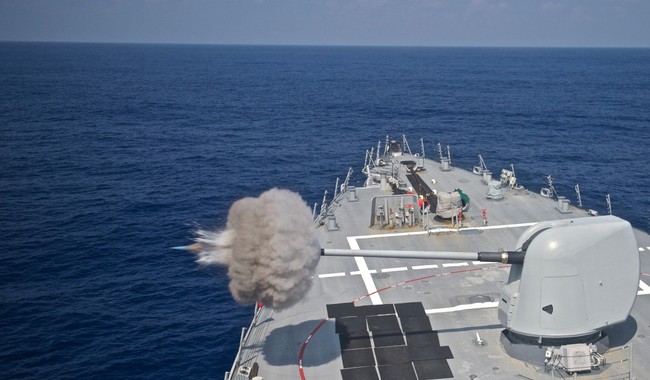
U.S. Central Command says Iran launched missiles and one-way attack drones toward the Strait of Hormuz and multiple Gulf states, and U.S. forces intercepted the threats and struck Iranian coastal radar sites in response. The exchanges highlight a shaky ceasefire, Iran’s repeated disinformation, and a clear U.S. message: attacks on regional shipping or American forces will be met with force.
On Friday, CENTCOM reported that Iranian forces fired missiles and unmanned attack drones at Persian Gulf countries and the Strait of Hormuz, prompting immediate U.S. defensive actions. American units intercepted most of the incoming weapons and conducted strikes on Iranian coastal surveillance sites to prevent follow-up attacks. The operation came amid a broader pattern of provocations and false claims from the Iranian regime that aim to shape a narrative on regional influence.
There are reports now that they have launched attacks across multiple Gulf States, including Kuwait and Bahrain.
…
Those states have U.S. military bases.
U.S. Central Command (CENTCOM) explained [in an X post] that the attacks failed and/or were intercepted, and we retaliated with “.”
That earlier reporting tracked with what unfolded: Iranian missiles and drones were launched toward Kuwait, Bahrain, and the strait, but U.S. and partner forces successfully neutralized the immediate threats. CENTCOM noted that seven ballistic missiles were fired toward Kuwait and Bahrain, with six shot down and one falling short. Hours earlier, U.S. assets downed four Iranian one-way attack drones headed for the strait.
Iranian state media and the Islamic Revolutionary Guard Corps issued statements claiming they had struck U.S. and allied targets in retaliation for strikes on Iranian positions. The IRGC claimed ballistic missile strikes at Ali Al Salem Air Base in Kuwait and facilities used by the U.S. Navy Fifth Fleet in Bahrain, and it warned of stronger responses to future U.S. strikes. Those public claims feed Tehran’s information campaign even as the physical results on the ground are contradicted by U.S. military accounts.
…the claim was false, that the regime did not attack or fire on U.S. warships, that to do so would be a “gross violation of the ceasefire.”
CENTCOM pushed back hard against Tehran’s narrative, using public updates to lay out what happened and what U.S. forces did in self-defense. Command statements made clear U.S. forces shot down the drones that posed an immediate risk to maritime traffic and then targeted coastal radar sites on Qeshm Island and in Goruk to blunt Iran’s ability to conduct additional strikes. Those defensive and disabling actions were framed as necessary to protect commercial shipping and regional partners.
CENTCOM also said as of Thursday that U.S. forces had “redirected 127 commercial vessels, disabled 6 non-compliant ships” as part of the blockade. Iran has not been able to stop the blockade. That’s frustrating the Iranian regime and crushing its economy.
Beyond the kinetic actions, U.S. forces have been actively rerouting commercial ships and enforcing restrictions in the region, measures CENTCOM described as critical to keeping trade flowing and denying Iran leverage. These maritime safeguards complicate Tehran’s attempts to project power and have tangible economic effects that frustrate the regime. The combination of defensive strikes and maritime control aim to raise the cost to Iran for continued aggression.
Iranian propaganda also circulated claims that small boats “chased off” U.S. destroyers — reports CENTCOM explicitly labeled false and misleading. False narratives like that are part of a playbook to inflate Iranian success and intimidate neighbors, but they do not change the tactical realities U.S. commanders report. Clear, public rebuttals by CENTCOM are meant to undercut Tehran’s attempts to rewrite events in real time.
Iran’s Islamic Revolutionary Guards Corps said early Saturday local time that it had responded to U.S. attacks in Sirik and on Qeshm Island by striking “enemy bases” in the region. The statement, published by Iranian state media, said the Revolutionary Guards had launched ballistic missiles at the Ali Al Salem Air Base in Kuwait and the U.S. Navy Fifth Fleet’s facilities in Bahrain. It warned of a stronger response if such U.S. strikes happened again.
After the interceptions, CENTCOM posted an update detailing the strikes and defensive posture, explaining why the radar sites were targeted and stressing vigilance in the region. The command emphasized U.S. willingness to defend forces, allies, and maritime traffic from unjustified attacks. That posture is designed to deter future Iranian operations that threaten freedom of navigation and the safety of service members.
The sequence of attack, interception, and counterstrike highlights a broader strategic contest in the Gulf where Tehran tests limits and the U.S. responds to protect interests and partners. For American commanders, the objective is straightforward: prevent escalation that threatens civilians and commerce while ensuring Iran understands there are clear, tangible consequences for aggression. Events are still unfolding and reliable updates from military authorities will matter most as the situation develops.
https://x.com/CENTCOM/status/2063030319490744715?ref_src=twsrc%5Etfw


Add comment