
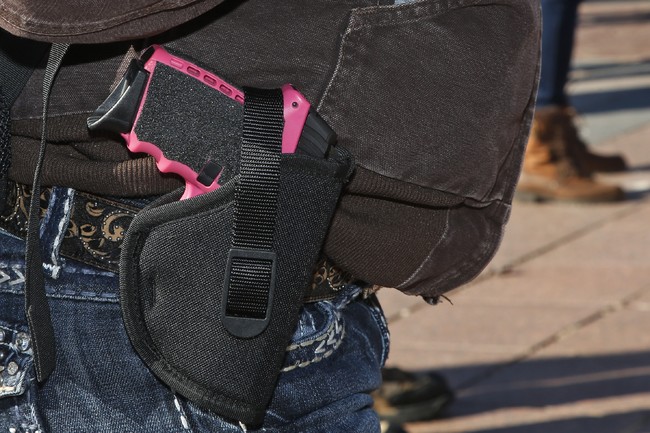
Trump Pushes National Right to Carry: Major New 2A Win Incoming?
President Trump told supporters he backs a “national right to carry,” and that declaration has revived a practical debate: will this mean nationwide reciprocity for state concealed-carry permits, or a federal constitutional-carry law that removes permitting requirements entirely? Supporters of the Second Amendment see both options as wins, but each comes with different political realities and legal questions tied to the Constitution and federalism. This article explains the two main paths being discussed, the constitutional arguments that supporters use, and why reciprocity is the likeliest near-term outcome while constitutional carry remains the preferred long-term goal for many conservatives.
At a Mack Trucks plant in Pennsylvania, President Trump made his position clear when answering a question from the crowd and noting the support of the NRA. He said, “The (National Rifle Association) NRA, everybody, they really have been, they’ve been with me right from the beginning. And Bill asked me would I support the national right to carry legislation, how do you feel about national right to carry? (Cheers) That’s my free poll. You know what that is? That’s the free poll. You don’t have to pay $300,000 to somebody that doesn’t even do polling. To give you phony numbers. See, those are real numbers. National right to carry. Yeah, we’re working on it.” Those are not tentative words; they signal an administration willing to advance pro-gun policy.
There are basically two concrete policy options under discussion. The first is a federal law requiring states to honor concealed-carry permits issued by other states, mirroring how driver’s licenses and other official documents travel across state lines. Advocates point out this respects state-issued permits while solving the practical problem of Americans traveling for work, family, or recreation who want consistent legal treatment.
https://x.com/nicksortor/status/2069513406084702550
The second option is a national statute that would establish constitutional carry, eliminating permit requirements nationwide so law-abiding citizens could carry without government permission. Dozens of states already offer permitless carry for residents, and constitutional carry is favored by many activists who argue permits amount to an unconstitutional restriction on a fundamental right. Politically, though, federal constitutional carry faces much higher hurdles in a divided Washington.
Supporters of reciprocity argue their approach is politically realistic and constitutionally sound. They highlight Article IV’s Full Faith and Credit Clause to make the case that states should respect each other’s public acts and records. The text quoted by advocates makes the point simple: “Full Faith and Credit shall be given in each State to the public Acts, Records, and judicial Proceedings of every other State. And the Congress may by general Laws prescribe the Manner in which such Acts, Records and Proceedings shall be proved, and the Effect thereof.” That language offers a clear avenue for Congress to require mutual recognition of permits.
Beyond Article IV arguments, defenders of broader carry rights point back to the Second Amendment’s plain words. The amendment reads, “A well regulated Militia, being necessary to the security of a free State, the right of the people to keep and bear Arms, shall not be infringed.” Conservatives see that sentence as affirming an individual right that federal policy should protect rather than nullify with burdensome permitting regimes. For many, constitutional clarity is the corrective remedy that would render permit schemes unnecessary.
Practical politics favors the reciprocity route because it can be framed as restoring common-sense, uniform treatment for legal gun owners across state lines. A federal reciprocity law would avoid a dramatic federal takeover of state criminal law and could win support from members who worry about upsetting state autonomy. It gives conservatives an immediate, measurable improvement while staying within familiar federalist bounds.
Still, the appetite for national constitutional carry remains strong among grassroots activists and many elected Republicans. They view reciprocity as a compromise, not the end goal, believing that true protection comes from eliminating government permission slips entirely. That stance appeals to voters who see permits as paperwork that can be weaponized by political opponents or used to ration rights based on bureaucratic discretion.
Which path the administration favors will matter for strategy and messaging. A focus on reciprocity positions supporters to argue from pragmatism and federalist compromise, while a push for constitutional carry would be a clear ideological win for those demanding minimal government interference. For now, the public statement from the president is enough to put both options on the table and mobilize advocacy networks.
For conservatives who prioritize the Second Amendment, this moment offers an opportunity to press lawmakers to convert rhetorical support into concrete legislation. National reciprocity is the likely first stop, but constitutional carry remains the principled destination for many advocates who believe the Constitution already protects the right without permits.
:


Add comment