
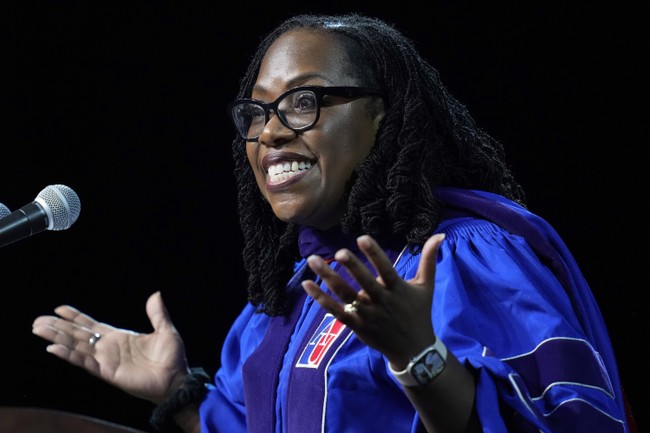
This piece examines why the prospect of court-packing is alarming from a conservative perspective, focusing on Justice Ketanji Brown Jackson’s frequent solo dissents, her clashes with colleagues, and the risk of shifting the Supreme Court’s role if an expansion filled the bench with similar-minded jurists.
Justice Ketanji Brown Jackson has become the face of a style of jurisprudence that troubles conservatives: frequent, often solitary dissents that read more like personal manifestos than careful legal reasoning. Her reputation for writing solo opinions has grown fast since 2022, and those lone dissents keep drawing fire from across the bench. That pattern invites a serious question: if Democrats expand the Court, will they fill it with more justices who treat the bench as a platform for activism?
Justice Jackson famously said, “I just feel that I have a wonderful opportunity to tell people in my opinions how I feel about the issues.” There is nothing wrong with passion, but law requires restraint, doctrine, and respect for precedent. When a justice openly frames opinions as expressions of feeling, it undermines the expectation that judges interpret law impartially rather than legislate from the bench.
Her docket behavior is striking. Since joining the Court she has authored many dissents — significantly more solo dissents than fellow liberals — and she has been the lone no vote in several 8-1 rulings. Those numbers tell a story beyond statistics: they reveal a justice who often stands apart from both conservative and liberal colleagues. That isolation suggests her approach is not merely different, it is inconsistent with the collaborative temper of the Court.
Criticism of Jackson’s opinions has not come only from conservatives. Her dissents have been called out by other justices for being careless with doctrine and precedent. In at least one opinion she accused colleagues of “spawning chaos,” a charge that reads oddly coming from a justice whose lone dissents have themselves been criticized for contributing to unpredictability. When colleagues of any ideological stripe question the seriousness of your legal reasoning, it should be a red flag.
Examples of sharp rebukes are instructive. Opposing justices have labeled her arguments “trivial at best” and “utterly irresponsible,” and have said portions of her reasoning are “at odds with more than two centuries’ worth of precedent.” Those are not casual barbs; they are formal recordings in the Court’s opinions that future readers will note when evaluating jurisprudential fitness. Repeated public rebukes from the bench erode the institutional credibility of any justice.
There is also a real institutional risk if one party decides to pack the Court with like-minded figures. One of the most alarming possibilities is an enlarged bench populated by multiple justices whose method resembles Justice Jackson’s. One KBJ might be manageable; five would be transformative in the worst sense for judicial independence. A Court stacked with partisan activists would not merely shift legal outcomes — it would permanently alter the public’s trust in neutral adjudication.
Calls to expand the Court have crept from fringe talk into mainstream political strategy, and influential voices on the left have even suggested quietly preparing to act once power returns. The idea of treating judges as political placeholders undermines the rule of law. Judicial independence means the Supreme Court must be insulated from short-term partisan games, not turned into a spoils system for policy preferences.
Conservatives are right to warn that packing the Court risks normalizing a practice that invites retaliation when power changes hands. If one party expands the bench to lock in a policy advantage, the next majority can do the same in reverse. That tit-for-tat would degrade constitutional stability. The long-term consequences would be a court system where legal doctrine bends to electoral cycles instead of enduring principles.
Beyond institutional mechanics, the substance of jurisprudence matters. The role of a justice is to interpret text, apply precedent, and exercise judgment with humility. When a justice treats opinions primarily as vehicles for expressing personal feelings or political aims, the balance between law and policy tilts in favor of policy. This is not a debate about personalities; it is about safeguarding a constitutional framework that relies on a nonpartisan judiciary.
In short, the near-term danger of court-packing is not merely more of one controversial justice; it is an invitation to remake the Court into a permanent arm of partisan politics. That outcome would harm the rule of law, invite retaliation, and erode the credibility of our highest tribunal. Conservatives who value institutional integrity should be alarmed at the prospect and press for reforms that preserve judicial independence and doctrinal fidelity.



The most incompetent Supreme Judge ever. Can’t define a man or woman.
Exactly my 1ST thought! How this Leftist Lunatic doesn’t even know what a woman is and she supposed to be one; let alone a Supreme Court Justice!!! Time for our Government to get REAL and boot this TOTALLY INCOMPETENT Ignoramus from the Ghetto back where she belongs, and NO WHERE near any Judicial System!
That is what is called USELESS TRASH!!!
This judge is not making judgments according to our constitution, she is making them according to the democrat party’s anti-America agenda. She is a socialist not a capitalist, and certainly not an American. I really believe if the democrats could physically force Americans into following their woke socialist ideology they would.
Absolutely on the mark!