
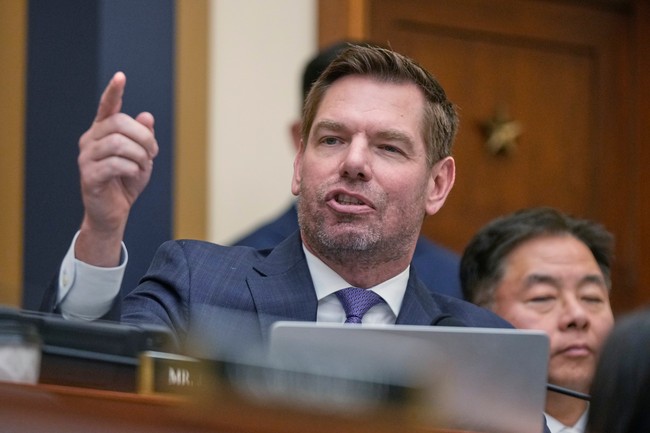
I’ll outline how a billionaire’s ad about Eric Swalwell exposed Democratic infighting, the voting attendance facts involved, the sharp responses from fellow Democrats, and the mocking follow-ups that underscore why voters are frustrated.
California’s political scene is messy and getting messier, and a new ad from Tom Steyer set off a fresh round of finger-pointing inside the Democratic camp. The ad targeted Rep. Eric Swalwell for missing a striking number of roll call votes while campaigning for higher office, and it landed exactly where critics wanted.
Outside observers see this as another symptom of a party that spends more energy sparring internally than addressing voters’ real concerns. Polling already shows Republicans competitive in the governor’s race, and a divided Democratic field only magnifies that worry. Voters who feel taken for granted notice when candidates aren’t showing up to do the basic work of the job.
Steyer’s ad was blunt and designed to provoke. “Call me old-fashioned, but you typically need to show up to work to get a promotion,” he quipped while cutting to footage of Swalwell on the beach and in a gym, implying those moments came while votes were being missed.
“In 2025, Eric Swalwell missed 95 votes. That’s more than Rep. Raul Grijalva missed. Rep. Grijalva died in March of 2025. Since declaring for governor, Eric Swalwell has missed 68 percent of the votes it’s his job to take. He hasn’t been showing up to work, and now he’s asking for a promotion.”
That line hit a nerve because attendance records are concrete and easy to verify, and Steyer’s spot leaned on them heavily. When a lawmaker asks for a bigger job, basic competence and presence are fair game. The ad framed the issue simply: if you want a promotion, show up for the work you already have.
Independent tracking bears that out. Data from the nonpartisan Congress-tracking website GovTrack shows that Swalwell missed 102 of 139, or 73 percent, of roll call votes between Sept. 19, 2025, and Feb. 9, 2026. That statistic sharpens the question voters have about priorities. The numbers aren’t partisan spin; they’re roll call data anyone can check.
As expected, other Democrats reacted with heat rather than with a willingness to engage the substance of the critique. Rep. Jimmy Gomez dismissed Steyer as “angry” and an “old-timer,” which reads like a reflexive defense rather than a rebuttal to the attendance figures.
Sen. Ruben Gallego pushed back harder on a personal level, reminding Steyer of where he says he was on January 6 and painting the ad as another example of billionaire interference in politics. “Tom, while you were sitting in your $30 million house on Jan 6, Eric Swalwell was with me on the floor of the House — fighting to save our Democracy from a mob,” Gallego said, followed by a swipe at billionaires.
Those defenses may play to a base that dislikes wealthy critics, but they don’t erase the practical problem Steyer raised. Saying someone was “fighting to save our Democracy” is a strong rhetorical move, but it doesn’t explain why roll call votes went unanswered. Voters tend to care less about theater than they do about whether officials are doing their day-to-day job.
Responses on social platforms quickly descended into mockery, with opponents sliding in unflattering images and memes to puncture the solemnity of Democrat leaders defending one another. The most savage clapback showed the two men in a far less serious light during a trip abroad, undercutting the “we were on the floor” defense with embarrassing visuals.
This episode does more than rile up comment threads; it highlights a larger political risk. When a party’s internal disputes center on whether its candidates do the basics of office, that narrative becomes an easy win for the opposition. Republican strategists will point to these moments as proof that Democrats have lost focus, and independent voters will notice the tone and the attendance numbers alike.
Democrats can either double down on internal sparring or confront the facts and answer them directly. Right now, the infighting and the campy responses make a tidy argument for voters who want accountability and steady representation, and the optics are only getting worse for a party that needs unity more than ever.


Add comment