
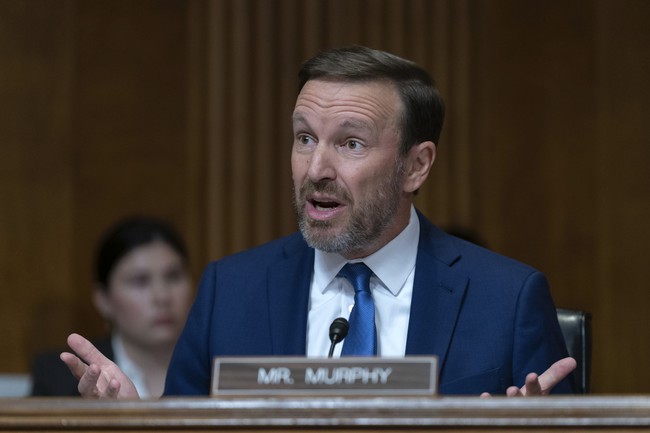
Senator Chris Murphy seized on an AI clip of President Trump to rail about censorship after Stephen Colbert’s “The Late Show” ended, tying unrelated controversies together and missing the bigger story about ratings, money, and cultural shifts. This piece looks at Murphy’s reaction, the AI clip at issue, the media’s response, and why the real takeaway is simpler than the outrage suggests.
The ending of Stephen Colbert’s run on “The Late Show” drew loud reactions across the political spectrum, and Democrats treated the farewell like a cultural crisis. Conservative commentators, meanwhile, saw the moment as a long-overdue reminder that entertainment tastes and business realities change without needing a political villain. The debate became a vehicle for broader arguments about free speech, media bias, and what late-night television represents politically.
Senator Chris Murphy focused his criticism on a White House post that used an AI clip of former President Trump interacting with Colbert in a mocking, satirical way. Murphy framed the post as evidence of the president using his power to intimidate and censor critics, a claim he broadcast to his followers as if the clip were the central issue. That claim shifted public attention away from the network and industry reasons that actually explain Colbert’s departure.
Critics on the left treated the AI clip as a censorship story, while many on the right saw it as political theater. The AI piece showed Trump playfully tossing Colbert into a dumpster, then doing a celebratory dance, a simple piece of mockery rather than a legal or institutional attempt to silence anyone. The debate hinged less on law and more on narrative: who gets to play the victim, and which side gets to use outrage as a rallying cry.
It is tempting to paint the episode as an attack on free speech, but the corporate and financial context is more persuasive. Networks make decisions based on viewership and profit, and “The Late Show” had been a longtime platform with a predictable political slant that served a particular audience. When those numbers shift, executives respond, and cancellations follow without a conspiratorial hand needing to be proved.
Some commentators tried to connect the Colbert farewell to other controversies, including primary races and investigative files, folding separate threads into a single narrative of authoritarian threat. That approach dilutes rather than clarifies the facts and invites people to accept emotional conclusions in place of evidence. Political leaders should be careful about conflating distinct events to score rhetorical points, especially when the core facts point to economics and audience trends.
Murphy’s social post included a quoted line that fueled the uproar: “We live in a country now where the president uses his power to censor media figures who criticize him and then brags about it.” That sentence circulated widely and became shorthand for a broader complaint about media intimidation. The quote must be preserved exactly as he said it, because precise wording drives how people interpret intent and severity.
Using an AI clip for mockery or satire is not the same as deploying state power to silence dissent, and mixing those ideas weakens the free speech argument. The White House is not shutting down networks or criminalizing criticism here; it is broadcasting a provocation that plays to its supporters. In the marketplace of ideas, provocation and counterprovocation are old tools, not new evidence of a constitutional emergency.
Some media figures responded with predictable indignation, treating the moment as if it were proof of a new level of threat. That response fits a pattern: when a media institution loses cultural prominence or profitability, its defenders often interpret market failure as persecution. That narrative comforts insiders but does not substitute for the realities executives cite when canceling shows.
Beyond the politics, there is a practical story about television economics. Long-running shows eventually become expensive, and when ad sales and ratings decline networks make cuts. Colbert’s program reportedly encountered those pressures, and executives chose to reallocate resources. Those decisions are mundane and financial, even if they provoke theatrical political commentary.
The political theater around the clip highlights how easily outrage can be manufactured and weaponized in modern media. A short AI video, a pointed social-media line, and a few viral responses can escalate into a national controversy that drowns out underlying facts. Observers on the right see this as yet another example of media elites crying foul when market forces shift against them.
In Congress, familiar left-leaning voices predictably voiced displeasure as the story unfolded, treating the cancellation and the AI clip as part of a larger grief ritual. That pattern says less about a coordinated campaign to silence dissent and more about identity and grievance politics. Watching those reactions play out can be instructive about how narratives are built and how easily they can obscure neutral explanations.
Ultimately, the episode is a reminder to separate theatrical outrage from institutional action. Satire and mockery will always be part of political life, and private companies will keep making decisions based on viewers and dollars. Calling every setback a censorship crisis cheapens genuine threats to liberty and confuses the public debate.
The AI clip served its purpose as a provocation, but it did not create a constitutional crisis or a new media censorship regime. People across the spectrum can argue about taste and responsibility, but the core facts point to shifting audiences and economic realities driving change in late-night television. Recognizing that keeps the conversation grounded in policy and incentives rather than perpetual outrage.


Add comment