
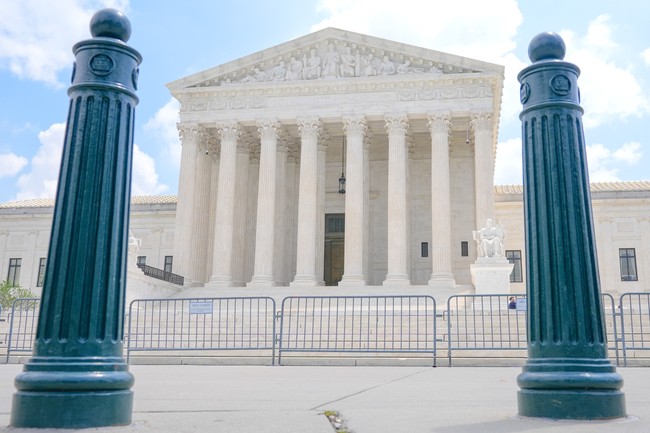
Two short videos capture a stark contrast in how recent presidents treated the Supreme Court: one shows a president acknowledging and accepting a ruling, while the other shows a president claiming he sidestepped the Court’s decision. The footage and statements raise questions about respect for the rule of law and which actions truly threaten the separation of powers.
The first clip shows the current president in the Oval Office responding plainly to a reporter’s question about whether he would accept the Supreme Court’s decision on birthright citizenship. He answers, “Well, I guess I’ll have to accept it,” and adds, “It’s the Supreme Court, so I’ll accept it.” That exchange is short, direct, and framed as a simple recognition of the Court’s authority even when the outcome hurts his position.
The other clip captures the previous president at a public event boasting about finding ways around a Supreme Court ruling that blocked his student debt forgiveness plan. He tells supporters, “The Supreme Court blocked me from relieving student debt,” and follows with, “But they didn’t stop me.” That line reads like an admission he believed he could pursue policy goals despite the Court’s rebuke.
These two moments, side by side, change the narrative many Democrats pushed for years about who would defy the judiciary. For a long time, critics warned that a returned president would ignore the high court and erode checks and balances, using that potential threat to stoke fear. Now the video evidence points the finger at the other side: a president who openly described circumventing the Court’s decision rather than accepting it.
The difference is not merely rhetorical. Accepting an adverse ruling and adjusting policy or messaging is consistent with constitutional norms. Publicly celebrating ways to evade a decision signals a willingness to blur institutional boundaries and invites a cycle where executive preference outweighs judicial determinations. That dynamic undermines legal predictability and weakens the idea that courts have a final, constrained role in disputes between branches.
Beyond the student loan example, there are other instances where the previous administration pushed back against or worked around rulings and legal constraints. During the pandemic, the eviction moratorium controversy showed officials willing to test the limits of administrative authority after the Court questioned the relevant agency’s power. That episode ended with the justices intervening and the government adjusting course under pressure.
https://x.com/townhallcom/status/2071694616894607806
On matters like education policy, the aftermath of the Supreme Court’s 2023 decision on race-conscious admissions also produced guidance from the Education Department that critics said could allow institutions to pursue similar diversity goals while avoiding a direct clash with the ruling. Those moves heightened tensions about where policy ends and judicial authority begins, and they raised concerns about executive agencies shaping reality to fit policy aims.
One president’s posture was to accept the Court’s pronouncements even when politically inconvenient, while the other’s posture at times was to find workarounds and then tout them as victories. That contrast matters for how citizens assess which side respects constitutional limits and which side treats judicial rulings as obstacles to be bypassed.
Political discourse has long leaned on the narrative that the opposing party will be the source of constitutional threats, often framing those threats as unique and existential. But these videos complicate that story by showing concrete examples of differing attitudes toward the judiciary. When elected leaders signal they will follow the Court, even reluctantly, they reinforce constitutional stability; when they signal they will sidestep rulings, they risk normalizing executive overreach.
The visuals are simple but persuasive: one leader calmly acknowledges defeat from the bench, the other brags about continuing anyway. Voters and civic institutions should note the difference and consider what it means for the long-term health of separation of powers. Those patterns matter beyond a single policy fight because they reflect how each administration views institutional constraints and the durability of legal norms.
Editor’s Note: Do you enjoy conservative reporting that takes on the radical left and woke media? Support our work so that we can continue to bring you the truth.


Just another case of mostly Democrats but surely some Republicans who believe they’re above the law.