
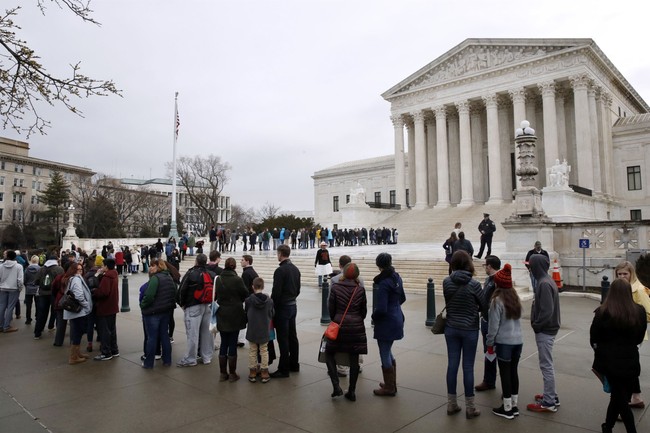
The Supreme Court’s 6-3 decision to vacate the lower court’s order gives Alabama back the ability to use previously drawn congressional maps while federal courts reassess the impact of the Court’s recent Voting Rights precedents. The move remands the matter for further consideration while referencing the Court’s Louisiana v. Callais guidance, and it has immediate effects on election logistics ahead of the May primaries. The ruling highlights a Court majority skeptical of the lower court’s remedy and underscores the continuing tug-of-war between state mapmakers and federal judges. Dissenting justices stressed the stakes for minority voters, keeping the issue politically charged as election calendars approach.
The Court’s written disposition was concise and procedural, vacating judgments and ordering remands with instruction to consider Louisiana v. Callais. That text reads in part: “The motions to expedite are granted. The petition for a writ of certiorari before judgment in No. 25-243 is granted. The judgment of the United States District Court for the Northern District of Alabama in that case is vacated, and the case is remanded to the United States Court of Appeals for the Eleventh Circuit with instructions to remand to the District Court for further consideration in light of Louisiana v. Callais, 608 U.S. ___ (2026). The judgments in No. 25-273 and No. 25-274 are vacated, and the cases are remanded to the United States District Court for the Northern District of Alabama for further consideration in light of Louisiana v. Callais, 608 U.S. ___ (2026). The judgments will be issued forthwith pursuant to Rule 45.3.”
Justice Sonia Sotomayor issued the dissent, joined by Justices Elena Kagan and Ketanji Brown Jackson, signaling a clear ideological split on how Section 2 of the Voting Rights Act should be applied to congressional maps. The dissent framed the majority’s procedural approach as insufficient to protect minority representation, while the majority focused on the need to align lower-court remedies with the Court’s new precedent. That split makes this a flashpoint case for future litigation over race, maps, and remedying alleged Voting Rights Act violations.
Alabama officials welcomed the decision as a return of authority to state institutions to enforce maps they contend were lawfully enacted. State leaders had previously petitioned the Court to restore maps used in 2023 and argued that the district court’s remedy improperly carved districts along racial lines. With the Supreme Court’s vacatur, state election officials moved to proceed under the maps they prefer, at least until further district court proceedings play out in light of Callais.
The timing matters: Alabama’s primary deadlines were looming and the state legislature had passed contingency measures to preserve election scheduling depending on the Supreme Court’s action. Those contingency plans included provisions for special elections if courts did not resolve the disputes before key ballot deadlines. The practical upshot is the Secretary of State can move forward with preparations under the status quo maps, reducing immediate uncertainty for election administrators and voters alike.
Legal observers note that the Court’s approach effectively buys time for lower courts to interpret and apply Louisiana v. Callais. That decision, issued earlier this term, reshaped how race can be weighed in mapmaking and narrowed the circumstances where race-based districting is permissible. By sending the case back down, the Supreme Court ensured lower courts would have to reconcile their prior rulings with new guidance from the High Court before imposing entrenched remedies on the state.
The political contours are obvious: for Republicans in Alabama and nationwide, the decision was a win for state control of redistricting and for resisting expansive federal remedies aimed at redrawing maps. Conservatives argued the district court’s remedy risked turning race into the dominant factor in mapmaking and that such an outcome would be inconsistent with the Court’s recent rulings. That argument resonates with voters concerned that courts were stepping beyond their role and into state legislative territory.
Opponents counter that vacating the lower court’s judgment temporarily delays relief for minority communities who claim their ability to elect candidates of choice was diluted. Civil rights groups and their advocates emphasize the need for remedies when racial bloc voting and district lines interact to weaken minority influence. The remand process will force lower courts to wrestle again with those factual and legal assessments under the new framework the Supreme Court has articulated.
Practically speaking, the litigation will continue in the Eleventh Circuit and back in the Northern District of Alabama, where judges must apply Callais to the record already developed. That means more briefing, potential new hearings, and the possibility of additional appeals depending on how the lower courts respond. Meanwhile, Alabama elections will proceed amid political debate, with partisan actors framing the Court’s action to suit their narratives as primaries approach.
The decision underscores a broader trend at the Supreme Court: a majority willing to constrain certain race-based remedies and to emphasize deference to procedural paths that let lower courts revisit holdings in light of new precedent. For now, Alabama’s congressional maps remain usable while the legal process plays out, and both sides are preparing for another round of contested litigation once the remands are resolved.



Add comment